


Projection Welding: Principles, Applications & Best Practices for High-Performance Manufacturing
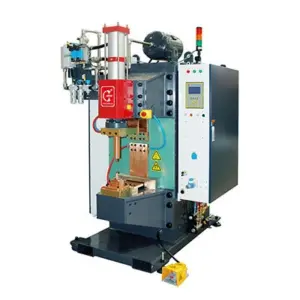
Projection welding is a cornerstone joining process in modern manufacturing — delivering repeatable, high-quality welds in high-volume production environments. As a global leader in industrial welding and metal-joining equipment, Heron Welder understands the technical nuances and application-specific challenges that engineers and production leaders face when specifying and deploying projection welding solutions.
In this post, we’ll explore the fundamentals of projection welding, its key industrial applications, how it compares to other resistance welding processes, best practices for implementation, and how Heron’s advanced welding technologies can elevate your operations.
What is Projection Welding?
Projection welding is a resistance welding process in which weld current is concentrated at predetermined points, or projections, on one or both workpieces. These projections — typically formed by embossing, stamping, or machined features — localize heat at the contact interface. As current flows through the projection, resistance heating causes rapid softening and fusion of the material at that point, producing a weld.
Unlike conventional spot welding, which relies on electrode force and current to create a weld between smooth surfaces, projection welding leverages geometry to control where the weld occurs — improving accuracy, consistency, and productivity in demanding applications.
How Projection Welding Works
The projection welding cycle generally follows these key phases:
-
Clamping: Electrodes bring the workpieces together with controlled force.
-
Current Flow: Weld current is applied and flows through concentrated projections.
-
Resistance Heating: Localized resistance at the projections generates heat rapidly.
-
Forge Force: As projections collapse due to heat, the weld zone forms under continued electrode force.
-
Cooling: Force is maintained while the weld cools to solidify and establish joint integrity.
This process allows manufacturers to reliably create multiple welds in one operation — depending on projection design and electrode configuration.
Key Advantages of Projection Welding
Projection welding offers distinctive benefits that make it well-suited for industrial assembly lines:
-
Precise Control Over Weld Location: The projection features define where the weld will occur, reducing reliance on operator skill and variation.
-
Multiple Welds in Single Cycle: Well-designed projections enable simultaneous formation of multiple welds — increasing throughput and lowering cycle time.
-
Reduced Electrode Wear: By concentrating current at designed points, electrodes experience lower overall surface wear and extended life.
-
Better Heat Distribution: Localized heating limits distortion and enhances joint quality, especially in complex geometries.
Common Industrial Applications
Projection welding serves critical functions across industries that demand reliability and volume:
Aerospace & Automotive
Automotive manufacturers often use projection welding to join components such as brackets, fasteners, and chassis hardware where dimensional precision and joint strength are paramount. Aerospace OEMs similarly depend on projection welding for structural assemblies where quality and repeatability cannot be compromised.
Electronics & Electrical Components
Projection welding is ideal for fastening terminals, leads, and connectors, because it allows manufacturers to weld small features rapidly while maintaining electrical and mechanical integrity.
Appliance & HVAC Manufacturing
HVAC housings, cooling fins, and sheet metal assemblies benefit from projection welding’s ability to manage heat and produce consistent joints in high-speed production.
Industrial Machinery
Heavy equipment and industrial machinery manufacturers leverage projection welding to secure wear components, flanges, and critical attachment points in welded assemblies that operate under load and vibration.
Projection Welding vs. Spot Welding: What’s the Difference?
While both projection and spot welding are resistance welding methods, they differ in how joints are formed:
| Feature | Projection Welding | Spot Welding |
|---|---|---|
| Weld Location Control | Defined by geometrical projections | Dependent on electrode placement |
| Multiple Welds per Cycle | Yes — inherent to design | Typically one per cycle |
| Electrode Wear | Lower (targeted current path) | Higher (uniform electrode contact) |
| Cycle Efficiency | High | Moderate |
| Application Suitability | Complex assemblies with defined projections | Simple lap joints |
In summary, projection welding excels where predictable weld placement, multi-point welding, and production efficiency are priorities.
Best Practices for Successful Projection Welding
To maximize performance and consistency from your projection welding process, consider the following best practices:
1. Design Projections with Precision
Projection features should be engineered to ensure uniform collapse and weldability. Factors such as height, diameter, pitch, and material thickness influence current density and heat generation.
2. Control Weld Parameters
Thoroughly define and monitor weld current, force, and weld time. Too much current or insufficient force can lead to expulsion, while too little current results in weak joints.
3. Choose the Right Welding Equipment
Invest in a robust welding power supply and control system that can handle the required duty cycle and monitor process metrics in real-time. Heron Welder’s MFDC and automated projection welding systems provide precise control for consistent repeatability.
4. Maintain Electrode Condition
Routine inspection and maintenance of electrodes preserve quality. Proper electrode material selection and tip geometry further extend service life and improve joint integrity.
5. Integrate Automation for Throughput
Automated projection welding cells — equipped with PLC controls, safety interlocks, and part handling systems — increase throughput while reducing human error. Heron’s customized automation solutions are engineered for high-volume production lines.
Why Choose Heron for Projection Welding Solutions
Selecting the right welding partner is as important as choosing the right process. Heron Welder brings decades of expertise in resistance welding and automation to help you optimize projection welding operations:
-
Advanced Welding Power Supplies: Our MFDC and capacitor discharge machines deliver clean, controllable energy for projection welding applications.
-
Custom Automation: From part feeders to robotic integration, Heron designs systems that fit your workflow and quality requirements.
-
Application Engineering Support: We work directly with production engineers and integrators to define parameters, select tooling, and validate processes.
-
Global Service & Spare Parts: Local support and readily available parts help minimize downtime.
Whether you’re upgrading an existing welding line or deploying a new projection welding solution, Heron offers scalable technology backed by deep application knowledge.
Projection Welding FAQs
1. What materials can be projection welded?
Projection welding is typically used on steel, stainless steel, and low alloy metals. With proper parameter tuning, aluminum and other conductive metals can also be welded effectively.
2. How is projection welding best utilized in automated production?
Projection welding integrates well with robotic handling, conveyors, and PLC control, enabling high throughput and data-driven process monitoring.
3. What are common defects in projection welding and how can they be mitigated?
Defects may include lack of fusion, expulsion, or excessive indentation. Mitigation includes precise control of current, force, and ensuring projection geometry is consistent.
4. Can multiple welds be made simultaneously?
Yes. Properly designed projections and tooling allow multiple weld points to be formed in a single cycle — improving cycle time and consistency.
5. How does projection welding compare with TIG or MIG welding?
Projection welding is much faster, localized, and ideal for mass production, whereas TIG/MIG are suited for complex joints, varied geometries, and lower volumes.
Ready to Upgrade Your Welding Operations?
Projection welding offers a powerful combination of speed, precision, and repeatability for manufacturers across automotive, electronics, appliance, and heavy machinery sectors. At Heron Welder, we’re committed to helping engineers, OEMs, and automation integrators achieve their production goals with tailored welding solutions, integrated automation, and unmatched technical support.
Contact Heron today to request a quote or speak with our application experts about projection welding and custom welding automation solutions.

 English
 Français
 Español
 Português
 Deutsch
 Türkçe
 Dutch
Dutch
 Italiano
 Russian
 Romaian