


Understanding the Growing Cyber Risks of Shadow AI in 2025 and Beyond
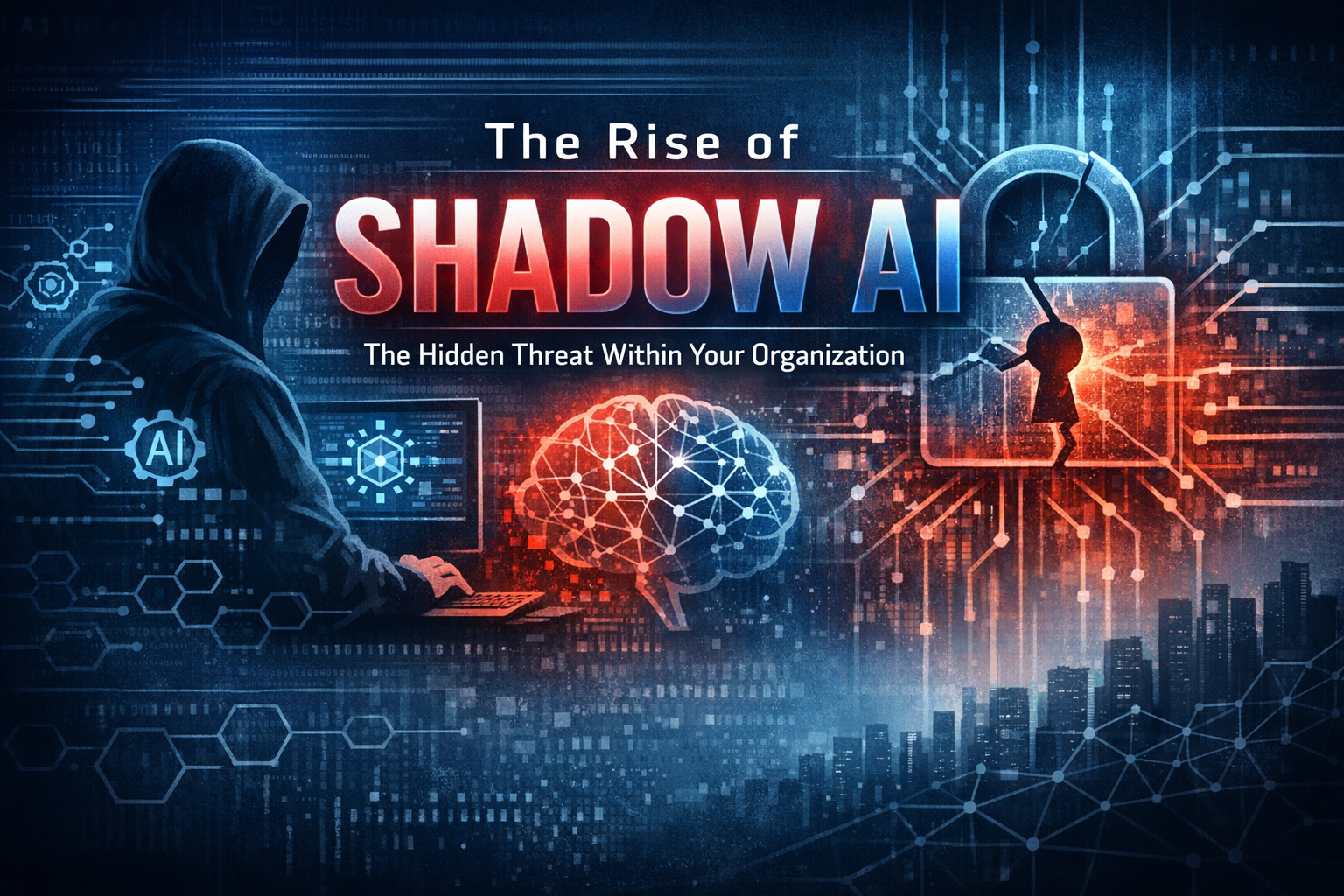
As artificial intelligence becomes deeply embedded in enterprise workflows, a troubling trend has emerged: Shadow AI — the unauthorized or unmanaged use of AI tools by employees — is now one of the fastest-growing security blind spots for organizations worldwide. Unlike traditional sanctioned AI platforms, Shadow AI operates outside IT and security oversight, creating serious cyber risks that are accelerating as adoption increases.
What Is Shadow AI?
Shadow AI refers to the use of AI tools, models, or agents within an organization without the knowledge, approval, or governance of IT and security teams. This includes employees tapping public generative AI tools, browser extensions, embedded AI features in SaaS apps, or autonomous AI agents — all without formal controls.
This trend resembles the earlier problem of Shadow IT, but with far higher stakes: AI tools actively process and generate data, while often storing or training on that data in external systems.
Why Shadow AI Is Such a Growing Cyber Threat
1. Exploding Use — With Little Visibility
Shadow AI use is widespread. Reports show large numbers of employees — including security professionals — regularly using unapproved AI tools because official ones don’t meet their needs. In many organizations, less than 20 % restrict AI use to sanctioned platforms.
With adoption outpacing governance, IT teams often don’t even know how many AI tools are in use, where sensitive data is going, or who is using them.
2. Data Leakage and Exposure
When employees input proprietary information — such as customer data, internal strategy documents, or IP — into public or unmonitored AI tools, that data can be stored, logged, or even used to train third-party models. This creates the very real possibility of data leakage outside corporate boundaries.
In regulated industries, this can trigger compliance violations, hefty fines, or class-action risks — especially under privacy laws like GDPR. Unauthorized AI use also undermines contractual obligations around data handling.
3. Expanded Attack Surface
Each unsanctioned AI tool represents an unmanaged element of the attack surface. These tools often lack enterprise-grade security controls like encryption, strong access management, or multi-factor authentication — making them potential entry points for attackers.
Worse, autonomous AI agents granted broad privileges can act behind the scenes, moving data or interacting with systems beyond immediate human control — widening the attack surface even further.
4. Model Vulnerabilities and Supply-Chain Risk
Many shadow AI tools are not vetted for security, privacy, or governance. A recent analysis identified multiple widely used AI applications that lack basic security controls, such as encryption or secure authentication. This means business data could be exposed due to weak safeguards or third-party vulnerabilities.
These vulnerabilities turn everyday AI use into a potential supply-chain security risk, where attackers can exploit lesser-known tools to gain access to corporate environments.
5. Compliance, Legal, and Intellectual Property Risks
Shadow AI bypasses the usual risk assessments that accompany sanctioned technology deployments. When AI tools don’t undergo compliance vetting, organizations risk violating data protection regulations and industry standards. This can lead to regulatory action, fines, and reputational damage.
Shadow AI also complicates IP ownership, as content generated or processed through external models may be subject to unclear or unfavorable licensing terms.
6. Blind Spots and Lack of Governance
Perhaps the most insidious risk of Shadow AI is not knowing it’s happening. Without visibility, enterprises cannot:
- Detect when unauthorized tools are used
- Assess what data is exposed
- Enforce access controls
- Audit how AI outputs influence decisions
This lack of transparency undermines security, compliance, and risk governance strategies.
Why the Risk Will Continue to Grow
Industry analysts warn that a significant portion of enterprises will suffer security or compliance incidents due to unmanaged AI use by 2030 — a clear signal that Shadow AI is not a temporary issue.
As AI tools become more powerful and integrated into workflows, unauthorized use — if left unmanaged — will continue to expose organizations to larger data, legal, and cyber risks.
Final Thoughts
Shadow AI represents a rapidly expanding cyber risk with real consequences. Because it operates outside the visibility and controls of traditional IT and security teams, it can expose data, increase regulatory exposure, expand attack surfaces, and introduce vulnerabilities that are hard to detect and even harder to mitigate.
The good news is that awareness is rising. But mitigating Shadow AI risk requires more than banning tools — it requires visibility, governance policies, and proactive monitoring to safely harness AI’s potential without damaging security or compliance.
About US:
AI Technology Insights (AITin) is the fastest-growing global community of thought leaders, influencers, and researchers specializing in AI, Big Data, Analytics, Robotics, Cloud Computing, and related technologies. Through its platform, AITin offers valuable insights from industry executives and pioneers who share their journeys, expertise, success stories, and strategies for building profitable, forward-thinking businesses.
Read More: https://technologyaiinsights.com/shadow-ai-cyber-risk-2025/

 Arabic
 Français
 Español
 Português
 Deutsch
 Türkçe
 Dutch
Dutch
 Italiano
 Russian
 Romaian