


Automation and Control Systems in Modern Base Oil Plants
The Rise of the Digital Refinery: Automation in Base Oil Production
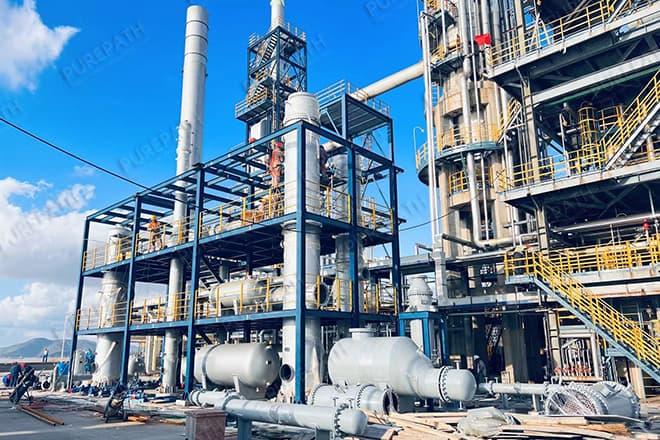
Gone are the days of purely manual operations and analog gauges in base oil manufacturing. The modern base oil plant is a symphony of precision, orchestrated by advanced automation and control systems. These technologies are no longer a luxury but a critical necessity, driving efficiency, product quality, and competitiveness in a demanding market. By integrating sensors, software, and smart control loops, plants can achieve a level of operational excellence that was previously unattainable. This digital transformation touches every unit, from vacuum distillation and solvent extraction to hydrotreating and dewaxing, ensuring each step of the re-refining or conventional production process is optimized.
Core Components of a Modern Control System
A modern automated base oil plant relies on a layered architecture of interconnected systems. At the foundation is the Distributed Control System (DCS), the central brain that continuously monitors and controls thousands of process variables like temperature, pressure, and flow rates. Complementing the DCS is the Safety Instrumented System (SIS), a dedicated, fail-safe layer designed solely to prevent hazardous incidents by automatically bringing the plant to a safe state if operational limits are exceeded. Furthermore, Programmable Logic Controllers (PLCs) automate specific machinery and discrete tasks, such as pump sequences and valve operations, while Supervisory Control and Data Acquisition (SCADA) software provides the overarching human-machine interface (HMI) for operators to visualize and supervise the entire process.
Key Benefits Driving Adoption
The implementation of robust automation delivers tangible benefits across the board. Firstly, it enforces unparalleled consistency in product quality. By maintaining exact process parameters, automated systems ensure each batch of base oil meets stringent Group II, III, or IV specifications. Secondly, operational efficiency soars through optimized energy and feedstock consumption, directly reducing production costs. Enhanced safety is perhaps the most critical benefit, as automated systems can respond to upsets faster than any human operator, mitigating risks. Finally, these systems provide a wealth of historical data for predictive maintenance, allowing engineers to address equipment issues before they cause unplanned downtime.
The Future: Integration with AI and IIoT
The evolution continues with the integration of Industrial Internet of Things (IIoT) devices and Artificial Intelligence (AI). IIoT sensors expand data collection at an unprecedented granularity, while AI and machine learning algorithms analyze this big data to identify hidden patterns. This enables predictive analytics for equipment health and advanced process control (APC) that can dynamically adjust set-points for maximum yield or minimum energy use. The future base oil plant will be a self-optimizing, adaptive facility, where automation not only executes commands but also recommends and implements continuous improvements, securing a sustainable and profitable future.
 Deutsch
 English
 Arabic
 Français
 Español
 Português
 Türkçe
 Dutch
Dutch
 Italiano
 Russian
 Romaian