


AI Agent Development: Tools, Infrastructure, and Integration Methods
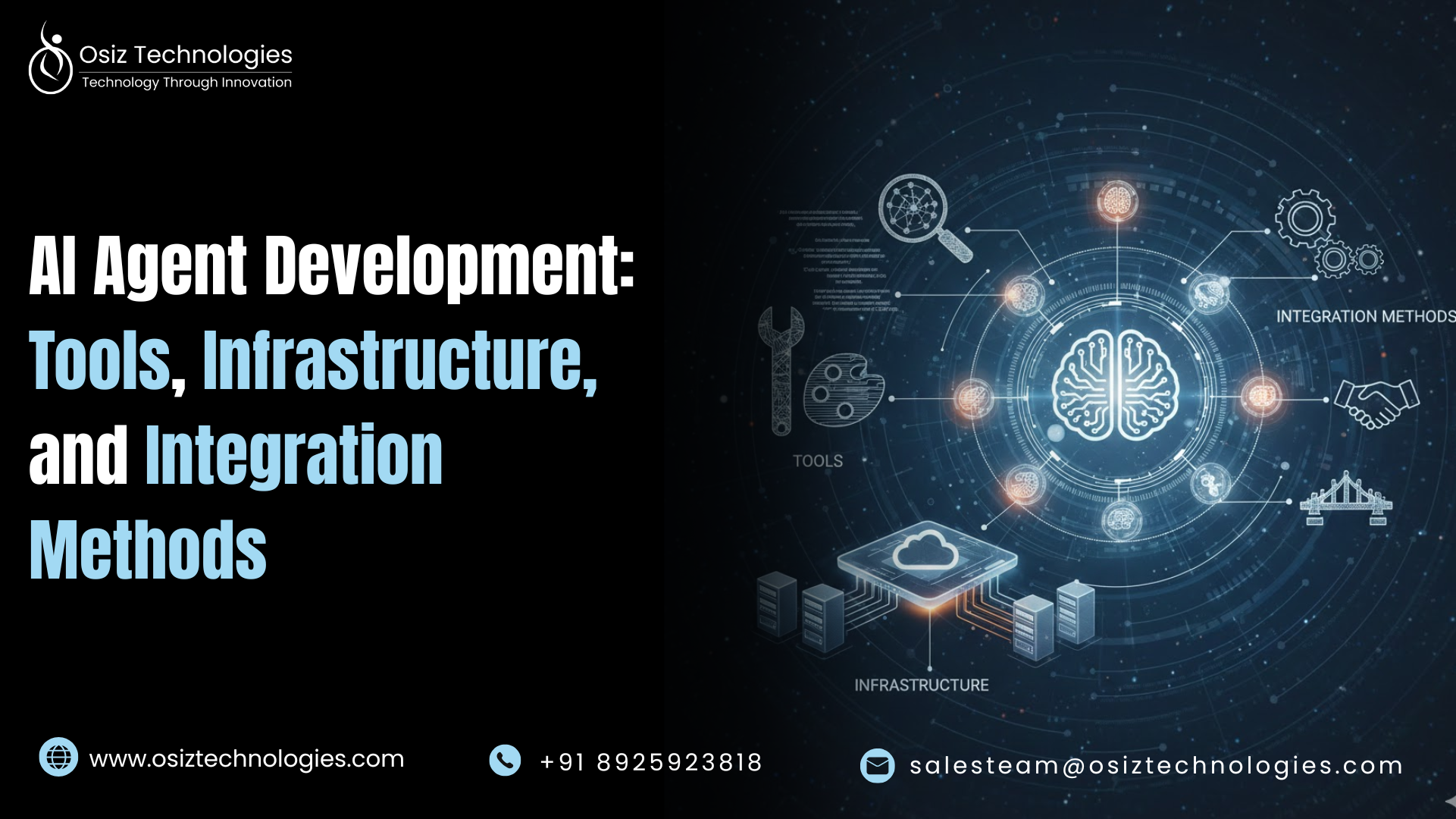
Businesses are moving beyond basic automation and intelligent chatbots toward systems that can act, decide, and execute tasks independently. This shift has accelerated the demand for AI agent development, as organizations look for solutions that combine reasoning, memory, and tool usage into a single intelligent workflow.
Unlike traditional software, AI agents can interpret context, break down complex goals, interact with multiple systems, and continuously improve through feedback. From customer service automation to enterprise workflow orchestration, AI agents are becoming central to digital transformation strategies. Companies investing in AI Agent Development are not just improving efficiency they are redefining how work gets done across departments.
Core Architecture of AI Agents
Large Language Models (LLMs)
LLMs form the cognitive core of AI agents. These models process natural language, generate responses, analyze data, and enable contextual reasoning. The choice of LLM significantly impacts accuracy, speed, and operational cost.
Memory Layer (Short-Term vs Long-Term)
Short-term memory allows agents to retain conversational context during interactions. Long-term memory stores historical data, preferences, and domain knowledge. Together, these layers ensure continuity, personalization, and improved decision-making.
Planning & Reasoning Engine
This component enables agents to break complex tasks into smaller executable steps. Planning engines evaluate goals, determine action sequences, and adapt dynamically when conditions change.
Tool Integration Layer
AI agents connect with external APIs, databases, CRM systems, and enterprise applications through tool integration layers. This capability allows agents to move beyond conversation and perform real-world actions.
Feedback & Learning Loop
Continuous improvement is achieved through monitoring outputs, capturing user feedback, and refining prompts or model behavior. This loop ensures higher accuracy and operational efficiency over time.
AI Agent Development Tools and Frameworks
Open-Source AI Agent Frameworks
Frameworks such as LangChain, AutoGen, and CrewAI enable developers to build modular, customizable AI agents. These tools support multi-step reasoning, tool orchestration, and memory management.
Commercial AI Agent Platforms
Enterprise platforms offer managed services with built-in scalability, governance, and integration capabilities. These solutions reduce development complexity while accelerating deployment.
Model Providers (OpenAI, Anthropic, Open Source)
Choosing the right model provider affects performance, cost, and compliance. Organizations evaluate proprietary APIs alongside open-source models depending on their scalability and data requirements.
Vector Databases & Embedding Tools
Vector databases store embeddings for semantic search and contextual retrieval. They power Retrieval-Augmented Generation (RAG) systems and improve the accuracy of enterprise AI agents.
Orchestration Tools
Orchestration layers coordinate multi-step workflows, agent collaboration, and API execution. These tools ensure structured, goal-oriented task completion.
Infrastructure Requirements for Scalable AI Agents
Cloud Infrastructure (AWS, Azure, GCP)
Cloud platforms provide elastic compute resources, storage, and AI services required for scalable deployments. They enable rapid experimentation and production-ready environments.
On-Premise & Hybrid Infrastructure
Industries handling sensitive data may require on-premise or hybrid deployments. This approach balances data security with cloud-based scalability.
Data Pipelines & Real-Time Processing
AI agents rely on structured and unstructured data streams. Robust data pipelines ensure real-time processing, transformation, and integration across systems.
Monitoring & Observability Tools
Monitoring tools track latency, model performance, error rates, and token usage. Observability ensures reliability and enables proactive issue resolution.
Scalability & Load Handling
Enterprise environments demand consistent performance under heavy workloads. Proper load balancing and auto-scaling mechanisms maintain stability during peak usage.
Integration Methods for Enterprise AI Agents
API-Based Integration
APIs allow AI agents to communicate with third-party systems securely. This method ensures seamless task execution across platforms.
CRM & ERP Integration
Integrating with CRM and ERP systems enables AI agents to automate customer interactions, manage records, and streamline operational workflows.
SaaS Application Integration
AI agents enhance SaaS platforms by adding intelligent automation, predictive insights, and contextual assistance within applications.
RAG Implementation
Retrieval-Augmented Generation connects AI agents with enterprise knowledge bases. This method improves response accuracy and ensures data-driven outputs.
Multi-Agent Integration
Multi-agent systems coordinate specialized agents to handle complex tasks collaboratively, improving efficiency and decision quality.
Security, Compliance, and Governance
Data Privacy & Encryption
Encryption protocols protect sensitive enterprise data during storage and transmission. Secure data handling is foundational to trusted AI systems.
Role-Based Access Control
RBAC ensures that only authorized users and systems can access specific functionalities or data layers within the AI environment.
Compliance Standards
Adhering to regulations such as GDPR, HIPAA, and SOC 2 ensures that AI deployments meet industry-specific compliance requirements.
AI Governance & Risk Management
Governance frameworks establish accountability, define usage policies, and mitigate risks such as bias, hallucinations, and misuse.
Cost, Scalability, and Performance Optimization
AI agent deployment costs depend on model usage, infrastructure, integration complexity, and maintenance requirements. Optimizing prompt engineering, caching responses, and selecting appropriate model sizes can significantly reduce operational expenses.
Scalability planning ensures agents handle increasing workloads without compromising performance. Fine-tuning deployment strategies and leveraging load balancing techniques help maintain speed, reliability, and cost efficiency across enterprise environments.
Why Choose Osiz for AI Agent Development
Osiz is a trusted AI Agent Development Company delivering scalable, secure, and enterprise-grade AI solutions tailored to complex business needs. With deep expertise in AI architecture, tool integration, and cloud infrastructure, Osiz builds intelligent agents that seamlessly connect with CRM, ERP, SaaS platforms, and custom enterprise systems. Focused on performance, compliance, and long-term scalability, Osiz enables organizations to drive measurable automation, operational efficiency, and competitive advantage.

 English
 Arabic
 Français
 Español
 Português
 Deutsch
 Türkçe
 Dutch
Dutch
 Italiano
 Russian