In the era of data-driven AI, Named Entity Recognition (NER) has become a foundational capability for extracting structured insights from unstructured text. From financial documents and healthcare records to customer support tickets and legal contracts, NER enables organizations to identify and classify entities such as names, dates, locations, and domain-specific concepts.
However, achieving high-performing NER models is not solely dependent on algorithms—it hinges on the quality, scalability, and adaptability of annotation pipelines. For enterprises aiming to iterate rapidly and deploy robust models, building a scalable NER annotation pipeline is critical.
At Annotera, a leading data annotation company, we specialize in designing and managing high-performance annotation workflows that accelerate model development while maintaining data quality and governance.
Why Scalable NER Annotation Pipelines Matter
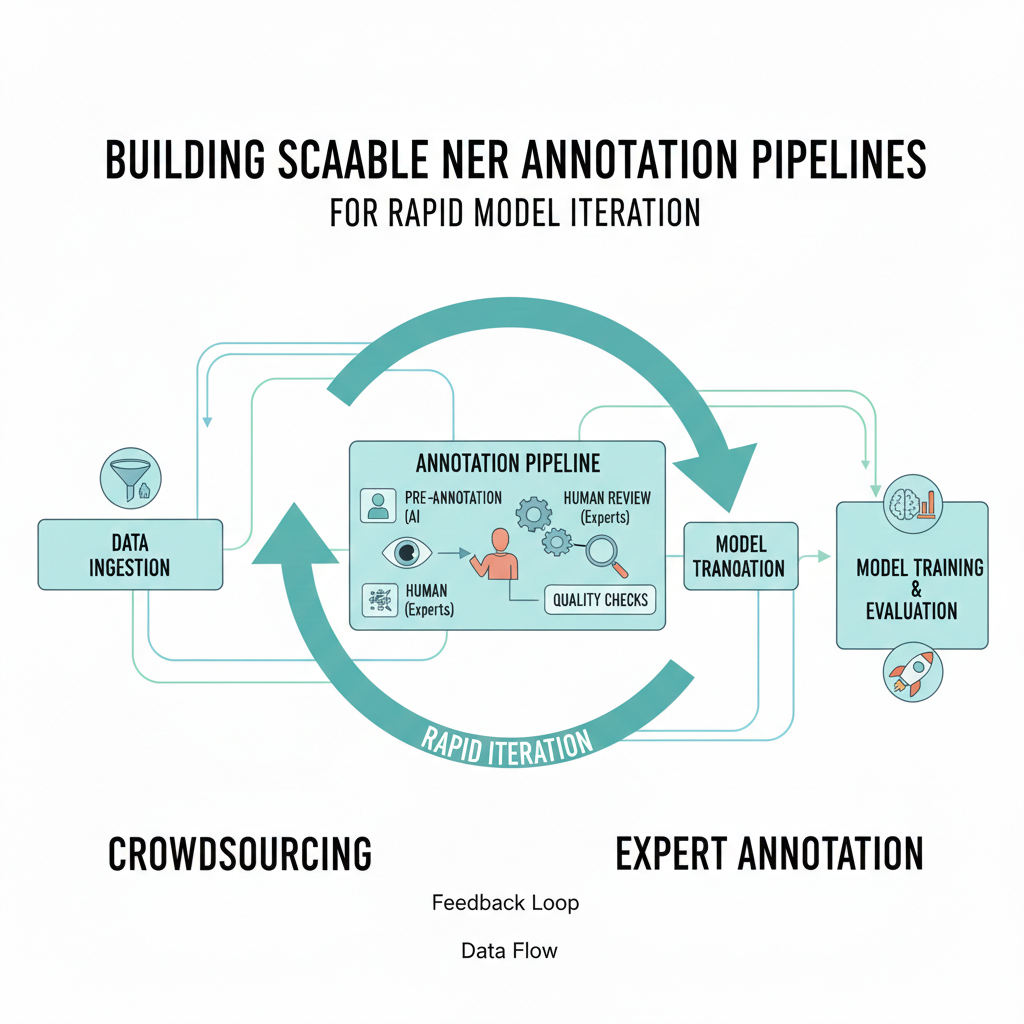
NER systems are inherently iterative. As models evolve, datasets must be continuously refined, expanded, and re-annotated. Without a scalable pipeline, teams encounter bottlenecks such as:
-
Inconsistent labeling across datasets
-
Delays in annotation turnaround
-
Difficulty in incorporating feedback loops
-
Increased costs due to inefficiencies
A scalable pipeline ensures that annotation processes can handle growing data volumes while maintaining consistency, accuracy, and speed—key requirements for rapid model iteration.
Core Components of a Scalable NER Annotation Pipeline
1. Data Ingestion and Preprocessing
The first stage involves collecting and preparing text data from multiple sources such as PDFs, APIs, or databases. Preprocessing tasks include:
A well-structured ingestion layer ensures that only relevant and clean data enters the annotation workflow, reducing downstream errors.
2. Annotation Schema Design
A robust schema defines the types of entities to be labeled and their relationships. Poor schema design can lead to ambiguity and inconsistent annotations.
Best practices include:
-
Defining clear entity categories and subcategories
-
Creating annotation guidelines with examples
-
Incorporating edge cases and domain-specific nuances
-
Versioning the schema to track changes over time
As a trusted text annotation company, Annotera emphasizes schema standardization to ensure alignment across annotators and stakeholders.
3. Human-in-the-Loop Annotation
Human expertise remains essential for high-quality NER annotation. However, scalability requires structured workflows:
-
Task distribution across trained annotators
-
Multi-level quality checks (reviewers and auditors)
-
Annotation tools with intuitive interfaces
-
Performance tracking for annotators
Leveraging data annotation outsourcing allows organizations to scale annotation teams efficiently without compromising quality.
4. AI-Assisted Annotation
To accelerate throughput, AI-assisted techniques such as pre-labeling and active learning are integrated into the pipeline:
-
Pre-trained models generate initial annotations
-
Annotators correct and validate predictions
-
Active learning prioritizes uncertain samples
This hybrid approach significantly reduces manual effort and speeds up iteration cycles.
5. Quality Assurance and Validation
Quality control is a non-negotiable aspect of any annotation pipeline. Scalable systems incorporate:
-
Inter-annotator agreement (IAA) metrics
-
Automated validation rules
-
Spot checks and audits
-
Feedback loops for continuous improvement
At Annotera, we implement rigorous QA frameworks to ensure that every dataset meets enterprise-grade standards expected from a top-tier data annotation company.
6. Dataset Versioning and Management
Frequent iterations require proper dataset governance. Versioning enables teams to:
Efficient dataset management systems are essential for maintaining traceability and supporting experimentation.
7. Integration with Model Training Pipelines
A scalable annotation pipeline must seamlessly integrate with ML workflows:
-
Exporting data in model-compatible formats (BIO, JSON, etc.)
-
Automating data handoffs to training pipelines
-
Enabling continuous training and evaluation
This integration reduces friction between data preparation and model development, enabling faster deployment cycles.
Strategies for Achieving Scalability
Modular Pipeline Architecture
Designing the pipeline as modular components allows teams to scale individual stages independently. For example, annotation capacity can be increased without affecting preprocessing or QA modules.
Cloud-Based Infrastructure
Cloud platforms provide the flexibility to scale storage, compute, and annotation tools on demand. This is particularly useful for handling large datasets and distributed teams.
Workforce Scaling via Outsourcing
Partnering with a reliable data annotation outsourcing provider ensures access to trained annotators, domain experts, and QA specialists. This eliminates the overhead of hiring and training in-house teams.
Continuous Feedback Loops
Rapid iteration requires constant feedback between annotators, data scientists, and model outputs. Incorporating feedback loops helps:
-
Identify labeling inconsistencies
-
Refine annotation guidelines
-
Improve model accuracy over time
Automation and Tooling
Investing in advanced annotation platforms with features like:
These tools significantly enhance productivity and reduce manual errors.
Challenges in Scaling NER Annotation Pipelines
Despite best practices, organizations often face challenges such as:
-
Domain Complexity: Specialized industries require expert annotators
-
Ambiguity in Language: Context-dependent entities can be difficult to label
-
Data Privacy Concerns: Sensitive data requires secure handling
-
Maintaining Consistency: Large teams may introduce variability
Annotera addresses these challenges by combining domain expertise, secure infrastructure, and standardized workflows—hallmarks of a reliable text annotation company.
Use Cases Across Industries
Scalable NER annotation pipelines are transforming multiple sectors:
-
Healthcare: Extracting patient information and medical entities
-
Finance: Identifying transactions, entities, and compliance-related data
-
E-commerce: Structuring product data and customer feedback
-
Legal: Parsing contracts and legal documents
Each use case demands tailored annotation strategies, further emphasizing the need for flexible and scalable pipelines.
The Annotera Advantage
As a premier data annotation company, Annotera delivers end-to-end NER annotation solutions designed for scalability and speed. Our approach includes:
-
Customized annotation schemas for diverse industries
-
AI-assisted workflows for faster turnaround
-
Robust QA mechanisms ensuring high accuracy
-
Scalable teams through strategic data annotation outsourcing
-
Seamless integration with client ML pipelines
We enable organizations to focus on innovation while we handle the complexities of data preparation.
Conclusion
Building scalable NER annotation pipelines is no longer optional—it is a strategic necessity for organizations aiming to stay competitive in AI development. By combining structured workflows, AI-assisted tools, and robust quality assurance, businesses can accelerate model iteration without compromising data integrity.
Whether you are developing enterprise-grade NLP systems or experimenting with new use cases, partnering with an experienced text annotation company like Annotera ensures that your annotation pipeline is optimized for performance, scalability, and long-term success.
As the demand for named entity recognition continues to grow, investing in scalable annotation infrastructure today will define the efficiency and accuracy of tomorrow’s AI systems.




 Arabic
 Français
 Español
 Português
 Deutsch
 Türkçe
 Dutch
Dutch
 Italiano
 Russian
 Romaian