


Algae Protein Industry Analysis by Source & End Use
Algae Protein Market | From Alternative Nutrition to Strategic Food-System Infrastructure
At first glance, the algae protein market looks like a classic emerging category.
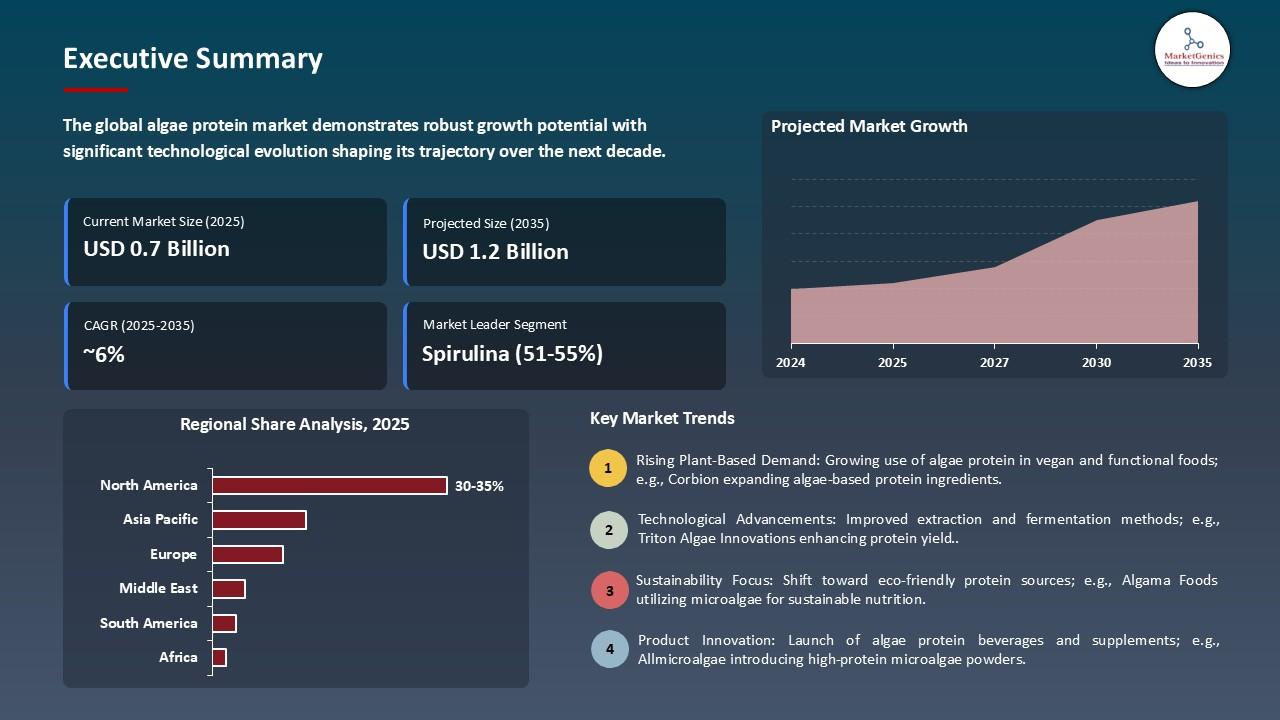
Algae Protein Market is valued at roughly USD 0.7 billion in 2025 and projected to reach about USD 1.2 billion by 2035 at a 5.8% CAGR, it signals respectable growth—but nothing explosive.
Compared with plant proteins like soy or pea, this remains a niche segment, concentrated in supplements, specialty foods, and aquaculture.
(MarketGenics Global Research Market Intelligence Data)
That interpretation, however, misses the deeper transformation underway.
Algae protein is no longer being adopted merely as another plant-based ingredient. Increasingly, it is being positioned as a structural solution to constraints facing global food, feed, and sustainability systems.
In other words, the Algae Protein Market is shifting from alternative nutrition to strategic resilience infrastructure.
The Old Story | Health, Sustainability, Novelty
For years, algae protein was framed through a familiar trio of benefits:
Spirulina and chlorella as “superfoods”
High protein density and micronutrient content
Low land and water requirements
Appeal to vegan and flexitarian consumers
This narrative remains valid. Spirulina alone accounts for about 55% of the global algae protein market share, largely due to regulatory acceptance, commercial maturity, and strong consumer recognition.
But these factors do not fully explain why governments, aquaculture giants, food multinationals, and investors are now treating algae protein as a strategic technology platform rather than a dietary trend.
To see why, the analytical lens must shift from consumer demand to system constraints.
The New Pressure Point is Protein Security
The global protein supply chain is entering an era of structural stress driven by converging forces:
• Population growth and rising protein consumption
• Land and water scarcity limiting traditional agriculture
• Climate volatility affecting crop yields
• Pressure to reduce livestock emissions
• Overfishing threatening marine protein sources
• Supply chain disruptions exposing import dependence
Under these conditions, protein sources are no longer evaluated solely on nutrition or cost. They are judged on scalability, reliability, and environmental resilience.
Algae performs unusually well across all three.
It produces far more protein per acre than terrestrial crops, requires minimal freshwater, can be cultivated on non-arable land, and can operate in controlled systems independent of weather variability.
This shifts algae protein from “sustainable option” to “strategic fallback”—a controllable source of nutrition when conventional systems face shocks.
Spirulina | Incumbent Advantage as Platform Stability
Spirulina’s dominance is often attributed to its long commercial history and established safety profile. But its deeper importance lies in something more structural: predictability.
In an industry where novel proteins face regulatory hurdles, consumer skepticism, and supply uncertainty, spirulina offers a rare combination of:
• Proven production methods
• Existing global supply chains
• Regulatory approvals across major markets
• Multi-industry applicability (food, feed, supplements, cosmetics)
This makes spirulina less a growth engine and more a stabilizing anchor for the broader algae protein market ecosystem.
Companies entering the sector frequently build around spirulina first—not because it is the most advanced option, but because it reduces execution risk while newer technologies mature.
Production Technology in the algae protein market | The Real Bottleneck is Infrastructure
Unlike traditional crops, algae protein production depends heavily on engineered systems:
Photobioreactors requiring capital investment
Energy-intensive cultivation processes
Complex harvesting and drying methods
Specialized downstream extraction facilities
These constraints explain why algae protein remains more expensive than soy or pea protein despite strong environmental advantages.
But they also reveal why major investments are flowing into precision fermentation, hybrid cultivation, and advanced extraction technologies.
When productivity increases by 200–300% through hybrid systems, as emerging methods suggest, algae protein shifts from premium ingredient to scalable commodity.
This is not merely process optimization. It is the unlocking of a new industrial protein pathway.
Aquaculture | Where Sustainability Meets Immediate Necessity
One of the most consequential algae protein market demand drivers lies outside human nutrition.
Aquaculture depends heavily on fishmeal and fish oil derived from wild-caught fish—an increasingly fragile and environmentally contentious supply chain.
Algae protein offers a direct biological substitute, providing:
Complete amino acid profiles
Omega-3 fatty acids identical to marine sources
Natural pigments for species coloration
Immunostimulatory compounds improving health
Because aquaculture operates at industrial scale, even partial substitution creates massive demand.
More importantly, it provides algae producers with stable, high-volume markets that help achieve economies of scale—eventually lowering costs for food applications.
In this sense, aquaculture is not just a customer segment in the algae protein market. It is the bridge to mainstream affordability.
North America | Innovation Hub Rather Than Demand Center
North America leads the global algae protein market, but not purely because of consumer appetite for plant-based foods.
Its dominance reflects a concentration of enabling conditions:
Strong venture capital ecosystems
Advanced biotechnology research institutions
Clear regulatory pathways (such as GRAS status)
Established functional food industries
Integrated distribution networks
Clusters in regions like California, Colorado, and Texas function as development engines, translating laboratory advances into commercial products.
This positions North America as the innovation core of the algae protein value chain—even as future production capacity may expand in regions with lower operating costs.
Bio-Industrial Co-Products | Algae Protein Market Economics Beyond Protein
A distinctive feature of algae systems is their ability to produce multiple high-value outputs from the same biomass:
Omega-3 oils
Natural pigments (such as astaxanthin)
Nutraceutical compounds
Biofuels
Carbon sequestration credits
This multi-product model fundamentally changes project economics.
Instead of relying solely on protein margins, producers can optimize revenue across several markets, improving financial viability even when protein prices remain high.
In effect, algae cultivation behaves less like agriculture and more like a bio-refinery platform.
A Market Defined by Capability, Not Consumption
The algae protein market remains moderately consolidated, with specialized players focusing on particular species, technologies, or end uses.
Yet competitive advantage increasingly depends on capabilities rather than product portfolios:
Who can scale production efficiently?
Who can reduce energy intensity?
Who can secure downstream offtake agreements?
Who can integrate co-product value streams?
These questions resemble those asked in energy or infrastructure sectors more than in traditional food markets.
Growth rates alone fail to capture this strategic dimension.
The Strategic Question Algae Protein Market Players Now Face
As the protein landscape evolves, stakeholders across food, feed, and biotechnology sectors are confronting deeper uncertainties:
• Which protein sources remain viable under climate stress?
• How can supply chains reduce dependence on vulnerable ecosystems?
• Where will future regulatory incentives favor low-impact production?
• Which technologies provide both nutrition and environmental performance?
Algae protein increasingly appears in the answers—not as a universal replacement, but as a strategic complement.
Why This Algae Protein Market Requires a Different Lens
The algae protein market has quietly crossed a threshold.
It is no longer simply about developing new plant-based products or meeting consumer trends. It is about constructing a more resilient protein system capable of operating under environmental, economic, and geopolitical uncertainty.
Understanding this shift requires moving beyond conventional market metrics toward structural analysis: infrastructure readiness, technological maturity, policy alignment, and system-level risk mitigation.
That is why advisory-grade intelligence in this sector focuses less on short-term demand forecasts and more on long-term capability building.
Because in the coming decades, the question may not be which protein is most popular—but which protein systems continue functioning when others cannot.
And that is precisely where algae protein is positioning itself: not as a trend, but as insurance for the global food future.
If helpful, MarketGenics can translate this analysis into a concise due-diligence brief tailored for algae protein investments — including scalable production economics, photobioreactor vs. fermentation cost curves, offtake sensitivity (aquafeed vs. food), co-product revenue stacking, and break-even utilization thresholds.
That framework is often what separates a promising sustainable-protein narrative from a bankable, infrastructure-grade opportunity.
We’re here to support your evaluation of the algae protein landscape — whether you are assessing market entry, capacity expansion, technology selection, or strategic positioning. Our team can provide the clarity needed to move from uncertainty to decision with confidence.

 Arabic
 Français
 Español
 Português
 Deutsch
 Türkçe
 Dutch
Dutch
 Italiano
 Russian
 Romaian