


How AI Is Accelerating Reusability and Innovation in Space Launch Technology
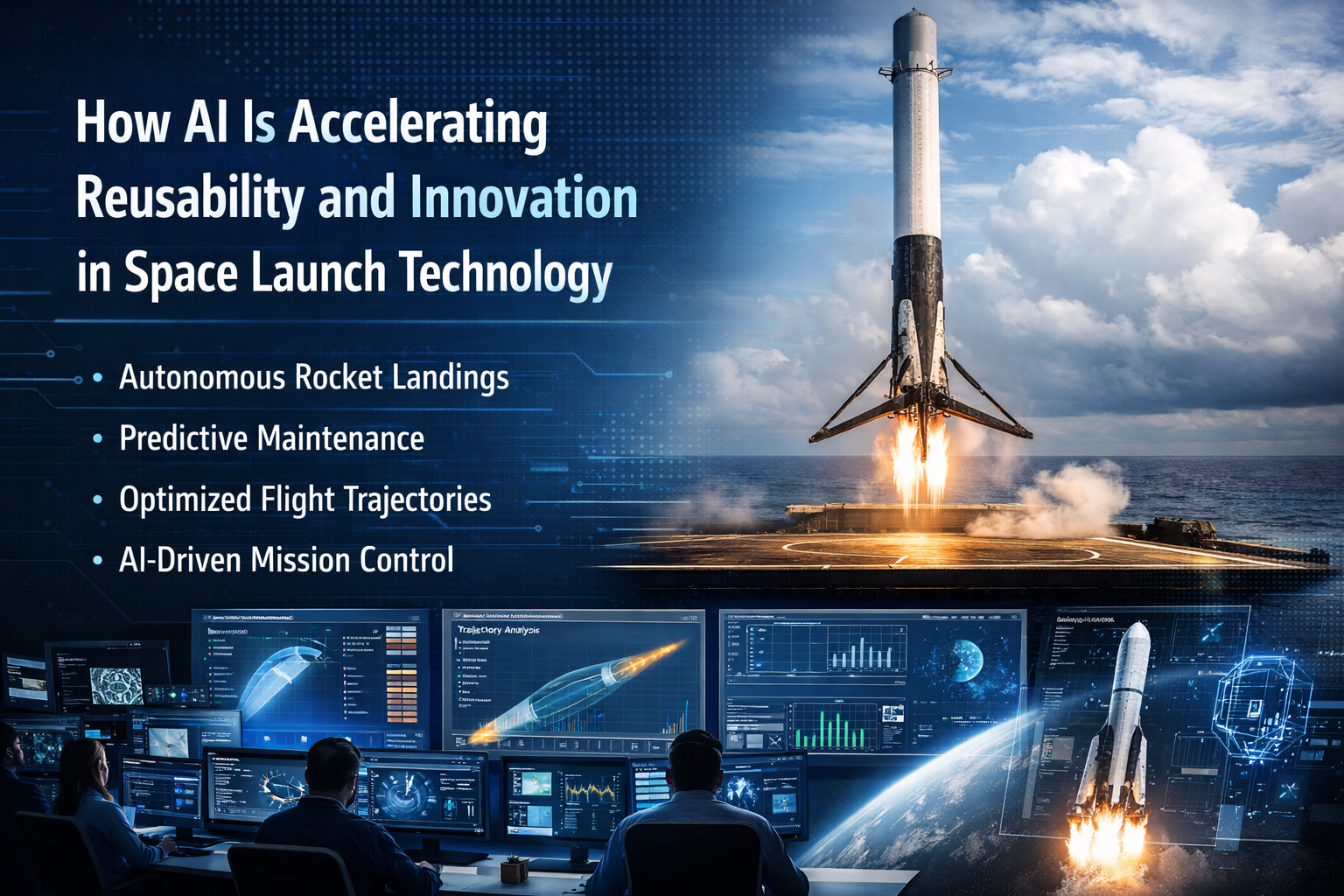
The modern space industry is no longer defined solely by government programs—it’s powered by rapid commercial innovation. A major driver behind this acceleration is artificial intelligence (AI). From reusable rockets to predictive maintenance and autonomous landing systems, AI is transforming how launch vehicles are built, operated, and reused.
In 2026, AI is not just enhancing space technology—it’s reshaping the economics of space access.
Reusability: The Foundation of Lower Launch Costs
Reusability is one of the most important breakthroughs in space launch technology. Companies like SpaceX have demonstrated that recovering and reusing rocket boosters can dramatically reduce costs and increase launch frequency.
But reusable rockets are incredibly complex systems. They must:
- Withstand extreme heat and vibration
- Perform precision landing maneuvers
- Be inspected and refurbished quickly
- Maintain structural integrity across multiple missions
AI plays a central role in making this repeatable and scalable.
Autonomous Landing and Precision Control
Rocket landings require split-second decision-making under dynamic conditions—changing wind patterns, fuel levels, and trajectory shifts.
AI-powered guidance systems:
- Process sensor data in real time
- Adjust thrust and control surfaces dynamically
- Optimize landing trajectories
- Compensate for environmental variability
These systems improve accuracy and reduce risk, allowing reusable boosters to land consistently and safely.
Without advanced AI-driven control algorithms, routine autonomous landings would be significantly harder to achieve.
Predictive Maintenance and Turnaround Speed
Reusability only works if rockets can be inspected and relaunched quickly. Traditionally, this required time-intensive manual inspection processes.
AI accelerates turnaround time by:
- Analyzing telemetry data from every flight
- Detecting anomalies in engines, fuel systems, and structural components
- Predicting wear and failure risks
- Automating inspection analysis using computer vision
Instead of waiting for visible failure, AI models identify subtle patterns that indicate potential issues before they become critical.
This reduces downtime and increases launch cadence—key to commercial viability.
Design Optimization Through Simulation
AI is also transforming how rockets are designed.
Modern aerospace engineering relies heavily on simulation, but AI-driven modeling takes this further by:
- Running millions of design variations
- Optimizing structural efficiency and weight
- Improving aerodynamics
- Testing extreme failure scenarios virtually
This dramatically shortens development cycles and reduces costly physical prototyping.
By identifying optimal configurations faster, AI accelerates innovation in reusable launch vehicles.
Real-Time Mission Optimization
During launches, mission control teams rely on massive streams of data. AI enhances situational awareness by:
- Detecting anomalies instantly
- Recommending corrective actions
- Predicting trajectory deviations
- Modeling risk scenarios in real time
AI-driven decision support reduces human workload and increases safety margins—particularly during high-risk phases like launch and reentry.
Fuel Efficiency and Trajectory Optimization
AI models optimize flight paths to:
- Reduce fuel consumption
- Minimize stress on components
- Maximize payload efficiency
Smarter trajectory management improves reusability by preserving hardware longevity and improving mission economics.
AI and the Broader Space Ecosystem
Beyond launch vehicles, AI supports:
- Satellite constellation management
- Space debris monitoring
- Autonomous docking and refueling
- In-orbit servicing missions
These capabilities are essential for sustainable space operations, especially as launch frequency increases globally.
The Economic Impact of AI-Driven Reusability
AI doesn’t just make rockets smarter—it makes space more accessible.
Benefits include:
- Lower per-launch costs
- Higher launch frequency
- Increased reliability
- Faster innovation cycles
- Expanded commercial opportunities
As reusability improves, industries such as telecommunications, Earth observation, defense, and deep-space exploration benefit from reduced barriers to entry.
Challenges That Remain
Despite major advances, challenges persist:
- AI systems must be rigorously validated for safety
- Edge cases in autonomous control still require oversight
- Extreme environmental conditions test hardware and algorithms
- Regulatory standards for AI-driven aerospace systems continue to evolve
Nevertheless, AI continues to mature alongside aerospace engineering.
Final Thoughts
AI is becoming a core enabler of reusable space launch technology. By improving precision control, accelerating maintenance cycles, optimizing design, and enhancing real-time decision-making, AI is helping transform rockets from single-use hardware into reusable infrastructure.
As launch systems become smarter and more autonomous, the cost and frequency of access to space will continue to improve—unlocking new scientific, commercial, and strategic possibilities.
In the race to make space more sustainable and economically viable, AI is no longer optional—it’s foundational.
Read More: https://technologyaiinsights.com/spacex-makes-rockets-reusable-with-ai-technology/

 English
 Arabic
 Français
 Español
 Português
 Deutsch
 Türkçe
 Dutch
Dutch
 Italiano
 Russian