


Why Cloud Infrastructure Is Essential for Modern AI Projects
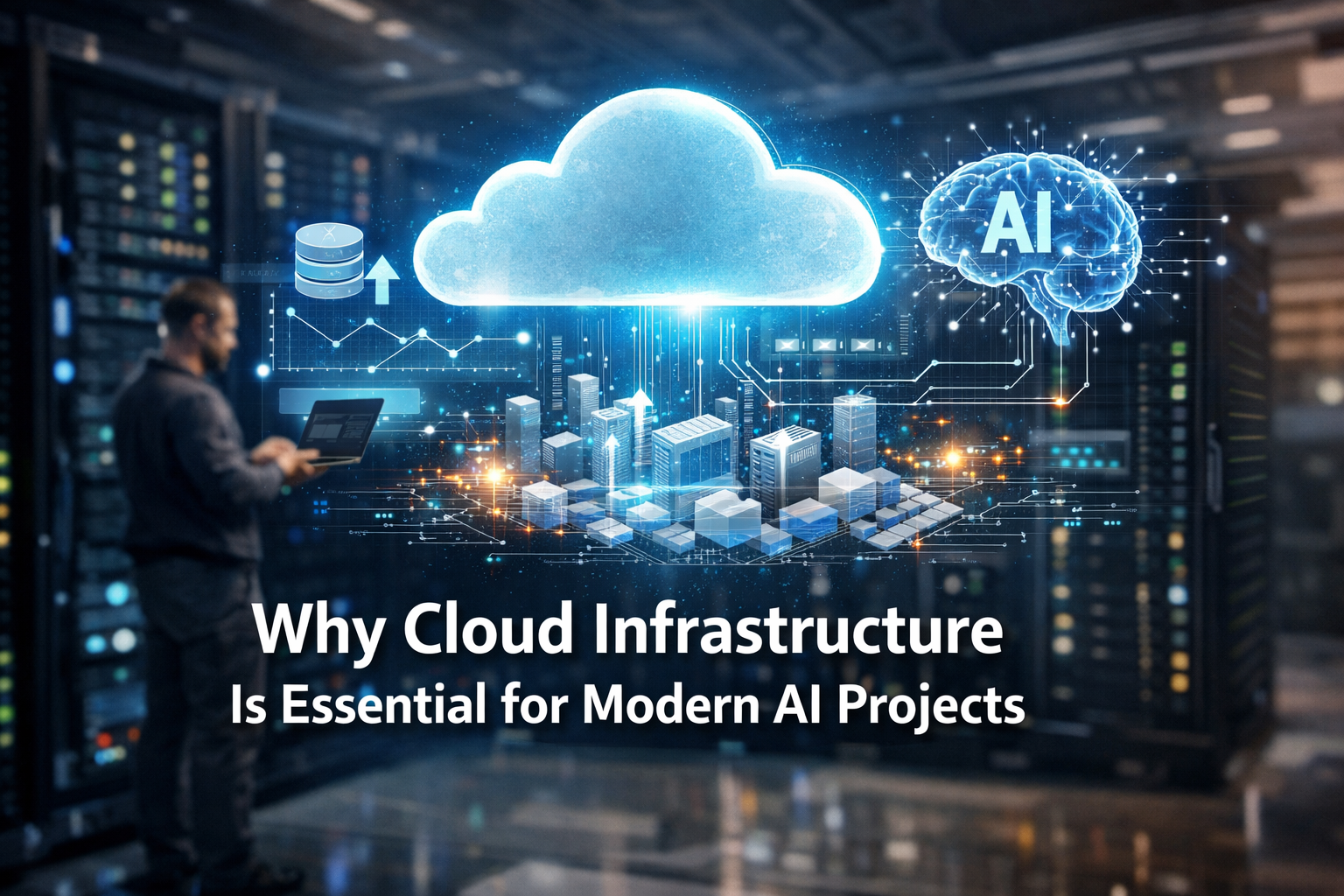
In today’s digital landscape, Artificial Intelligence (AI) is no longer a futuristic concept — it’s actively reshaping industries, powering automation, enabling intelligent decision‑making, and redefining how businesses create value. But behind the scenes of every successful AI initiative lies one foundational technology: cloud infrastructure.
Cloud computing has transitioned from being a cost‑effective storage solution to becoming the backbone of modern AI innovation. From scalable processing power to seamless data access and integrated AI tools, cloud infrastructure has become indispensable for organizations striving to harness the full potential of AI.
Meeting the Computational Demands of AI
AI workloads, especially in areas like deep learning and natural language processing (NLP), require immense computational power. Training advanced models such as GPT‑class systems or convolutional neural networks often involves processing terabytes of data and performing trillions of calculations — tasks that traditional on‑premises servers struggle to handle.
-
AI model training can require hundreds to thousands of GPUs.
-
A single large neural network training run can consume megawatt‑hours of electricity and weeks of continuous computation if not managed efficiently.
-
Cloud providers like AWS, Azure, and Google Cloud offer flexible access to powerful hardware such as NVIDIA A100 and H100 GPUs, enabling organizations to experiment without the upfront cost of hardware purchases.
Without cloud infrastructure, businesses would face prohibitive capital expenses simply to stand a chance of competing in AI innovation.
Scalability: Grow on Demand
One of the most powerful advantages of cloud infrastructure is scalability — the ability to expand or contract computing resources based on workload needs.
Consider a real‑world AI application like a customer support chatbot:
-
During an average day, the system may only need minimal processing power.
-
But during peak hours or product launches, demand can spike as users interact heavily with the AI.
On‑premises infrastructure would either be over‑provisioned (wasting money) or under‑powered (leading to slowdowns). Cloud infrastructure solves this by allowing:
-
Auto‑scaling, which provisions more resources during high traffic.
-
Pay‑as‑you‑go pricing, ensuring you only pay for what you use.
This elasticity is critical for maintaining performance without ballooning costs.
Data Access and Centralization
Data is the lifeblood of AI. Models are only as good as the data they learn from:
-
Structured data from transactional databases.
-
Unstructured data like texts, images, or logs.
-
Streaming data from IoT devices or online platforms.
Cloud platforms centralize data storage and make it accessible across distributed teams. With cloud data lakes and integrated analytics tools:
-
Data scientists can collaborate on shared datasets.
-
AI workflows are streamlined from ingestion to training to deployment.
-
Time spent wrangling data is minimized, speeding up innovation cycles.
According to Gartner, organizations that centralize data effectively are more than 3× as likely to succeed with AI compared to those with siloed data environments.
Read More: Top AWS Machine Learning Tools You Can’t Ignore In 2026
Integrated AI Services and Tools
Cloud vendors have invested heavily in AI services that abstract complex tasks into usable APIs and tools:
-
Pre‑built models for speech, vision, and language understanding.
-
AutoML tools to automatically train and optimize custom models.
-
Model monitoring and versioning to ensure reliability in production systems.
For many businesses, building an AI system from scratch is expensive and time‑intensive. Cloud AI services fast‑track development, allowing companies to:
-
Prototype quickly and inexpensively.
-
Focus teams on business problems instead of infrastructure challenges.
-
Deploy models with reliability and compliance built‑in.
Cost‑Effectiveness and Operational Efficiency
Switching to cloud infrastructure changes AI from a capital expense (CapEx) to an operational expense (OpEx). This shift delivers financial flexibility:
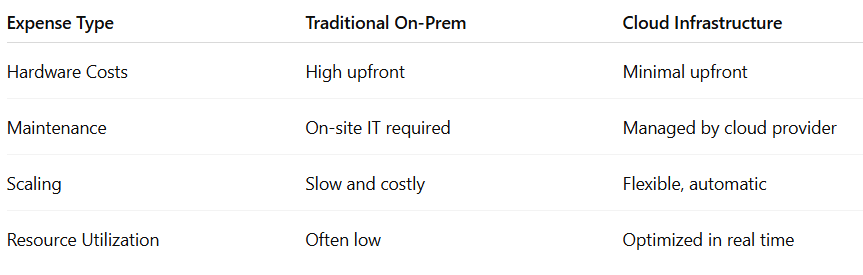
With cloud pricing models — such as spot instances, reserved capacity, and serverless computing — organizations can optimize costs while maintaining performance.
Security and Compliance Built‑In
Modern cloud providers invest billions in security, including:
-
Data encryption at rest and in transit
-
Identity and access management
-
Continuous security monitoring
-
Compliance certifications (e.g., ISO 27001, GDPR, HIPAA)
For AI projects that handle sensitive data — such as healthcare or finance — these features are essential to meeting regulatory requirements without building security solutions from scratch.
Conclusion
Cloud infrastructure is not just helpful for AI — it’s essential. It empowers organizations with:
-
Scalable compute power
-
Centralized data access
-
Cost‑effective pricing
-
Integrated tools and services
-
Strong security and compliance
In a world where AI is driving competitive advantage, cloud infrastructure ensures that companies — regardless of size — can innovate smartly, rapidly, and securely.

 Arabic
 Français
 Español
 Português
 Deutsch
 Türkçe
 Dutch
Dutch
 Italiano
 Russian
 Romaian