


CAPI Services Guide | Digital Field Data Collection Explained
CAPI Services: A Complete Guide to Digital Field Data Collection
In modern research environments, collecting data quickly is not enough. Organizations need structured, accurate, and decision-ready information gathered through reliable processes. Computer-Assisted Personal Interviewing (CAPI) has emerged as a preferred solution for high-quality field data collection.
This guide explains what CAPI services are, how they work, their advantages, and when they are most suitable.
What Are CAPI Services?
CAPI (Computer-Assisted Personal Interviewing) refers to interviewer-led, face-to-face surveys where responses are entered directly into a digital device such as a tablet, smartphone, or laptop during the interview.
Unlike traditional paper-based surveys, CAPI uses programmed questionnaires that improve accuracy, consistency, and efficiency throughout the research process.
Key Characteristics of CAPI:
-
Interviewer-administered, face-to-face format
-
Digital questionnaire programming
-
Built-in skip logic and validation checks
-
Real-time or near real-time data monitoring
-
Offline data capture capability
How CAPI Market Research Services Work
Professional CAPI research typically follows a structured workflow to ensure data quality and operational control.
1. Questionnaire Programming
Before fieldwork begins, the survey is digitally programmed with:
-
Skip logic and routing rules
-
Range and consistency validations
-
Mandatory response fields
-
Multi-language capabilities
-
Version control mechanisms
This ensures standardized execution and prevents outdated or incorrect questionnaires from being used in the field.
2. Field Data Collection (Online and Offline)
Trained interviewers conduct in-person surveys using secure digital devices.
One of CAPI’s major strengths is offline functionality. In areas with limited or no internet access, interviews can be completed offline and synced securely once connectivity becomes available. This allows uninterrupted data collection across urban and rural locations.
3. Monitoring and Quality Control
Supervisors and research teams can monitor fieldwork progress through dashboards and tracking systems. Monitoring may include:
-
Interview completion rates and quota tracking
-
Interview duration patterns
-
GPS location capture (where permitted)
-
Identification of inconsistent or suspicious responses
This structured oversight improves reliability and reduces operational risk.
4. Data Cleaning and Final Delivery
After fieldwork concludes, the dataset undergoes review and validation. Final deliverables typically include:
-
Clean, structured datasets
-
Codebooks and documentation
-
Quality-checked open-ended responses
The result is analysis-ready data suitable for immediate reporting and decision-making.
CAPI vs Other Survey Methods
Understanding how CAPI compares with other methods helps determine when it is most appropriate.
-
CAPI – Interviewer-led, face-to-face, digital entry
-
CATI – Interviewer-led telephone surveys
-
CAWI – Self-administered online surveys
-
PAPI – Paper-based interviews with manual data entry
CAPI combines the personal interaction of face-to-face research with the structure and control of digital data capture.
What are the main advantages of using CAPI services?
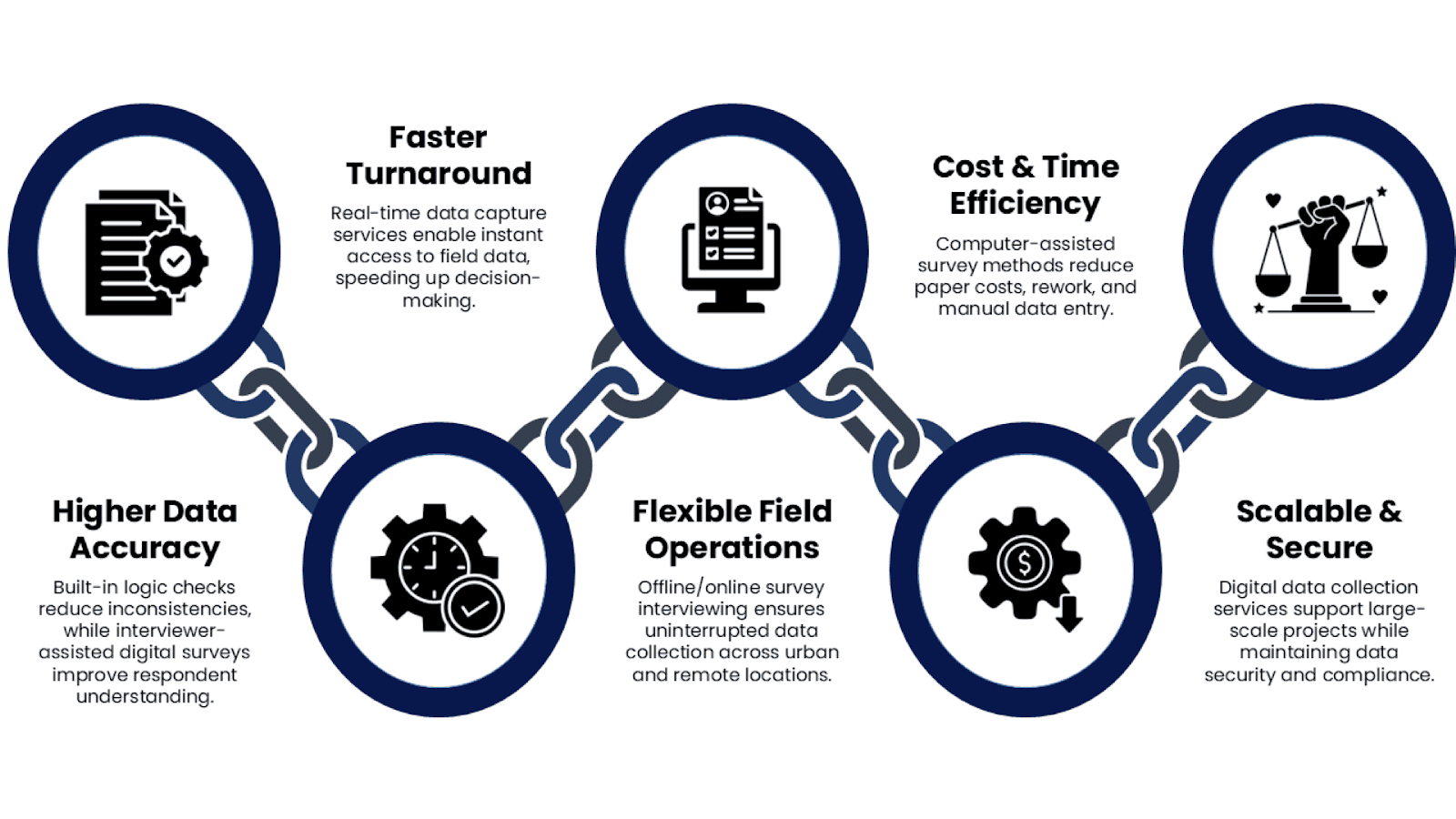
Advantages of Using CAPI Services
Organizations choose CAPI for several practical reasons:
-
Reduced manual data entry errors
-
Improved questionnaire consistency
-
Faster data turnaround
-
Stronger field supervision and monitoring
-
Support for complex and multi-language surveys
-
Reliable execution in low-connectivity environments
These advantages make CAPI especially useful for large-scale or quality-sensitive studies.
Industries That Benefit from CAPI Services
Market and Social Research
CAPI supports:
-
Consumer behavior studies
-
Brand tracking research
-
Usage and Attitude (U&A) studies
-
Multi-region, multi-language projects
Healthcare and Life Sciences
Common applications include:
-
Patient journey research
-
Healthcare professional (HCP) feedback
-
Facility assessments
-
Structured consent-based interviews
Government and Public Policy
CAPI is widely used for:
-
Household surveys
-
Rural and remote data collection
-
Social impact assessments
-
Large population studies requiring offline execution
When CAPI May Not Be the Best Fit
Although powerful, CAPI may not be ideal in every scenario. Alternatives may be more suitable when:
-
Budget constraints require ultra-low-cost, high-frequency surveys
-
Topics are highly sensitive and interviewer presence could influence responses
-
Target respondents are geographically dispersed and easier to reach online or by phone
Selecting the appropriate method depends on research objectives, audience accessibility, budget, and data sensitivity.
Why Professional CAPI Services Matter
Using experienced CAPI providers ensures:
-
Trained and supervised interviewer networks
-
Structured quality control frameworks
-
Secure data handling and device management
-
Consistent execution across locations
-
Clean and standardized final outputs
Professional oversight strengthens reliability and ensures that collected data is both verifiable and decision-ready.
Tell us what you are exploring, and we will propose a practical research plan and timeline.
Get connected with us today to learn how to turn your data into decisions and your decisions into success!
Related Blogs:
CATI: Turning Telephone Conversations into Reliable Research
Frequently Asked Questions (FAQs)
1. What are CAPI Services?
CAPI Services involve interviewer-led, face-to-face surveys where responses are recorded directly on digital devices, improving accuracy and reducing manual errors.
2. How are CAPI services different from PAPI?
PAPI uses paper-based questionnaires with manual data entry, while CAPI uses programmed digital surveys with built-in validations and monitoring systems.
3. Can CAPI surveys be conducted in low-connectivity areas?
Yes. CAPI supports offline data collection, allowing interviews to be completed without internet access and synchronized later.
4. Which industries use CAPI services?
CAPI is commonly used in market research, healthcare, government surveys, social research, and consumer studies.
5. Why choose professional CAPI market research services?
Professional providers offer trained interviewers, structured monitoring systems, and quality-controlled datasets that support reliable analysis and informed decision-making.
Conclusion
CAPI Services provide a structured, technology-enabled approach to face-to-face data collection. By combining interviewer engagement with digital controls, CAPI enhances accuracy, improves monitoring, and delivers reliable, analysis-ready datasets.
For organizations that require high-quality field research—particularly in complex or geographically diverse environments—CAPI remains a dependable and scalable solution.

 English
 Arabic
 Français
 Português
 Deutsch
 Türkçe
 Dutch
Dutch
 Italiano
 Russian
 Romaian