


Mudra Loan Project Report Format & Financials Explained
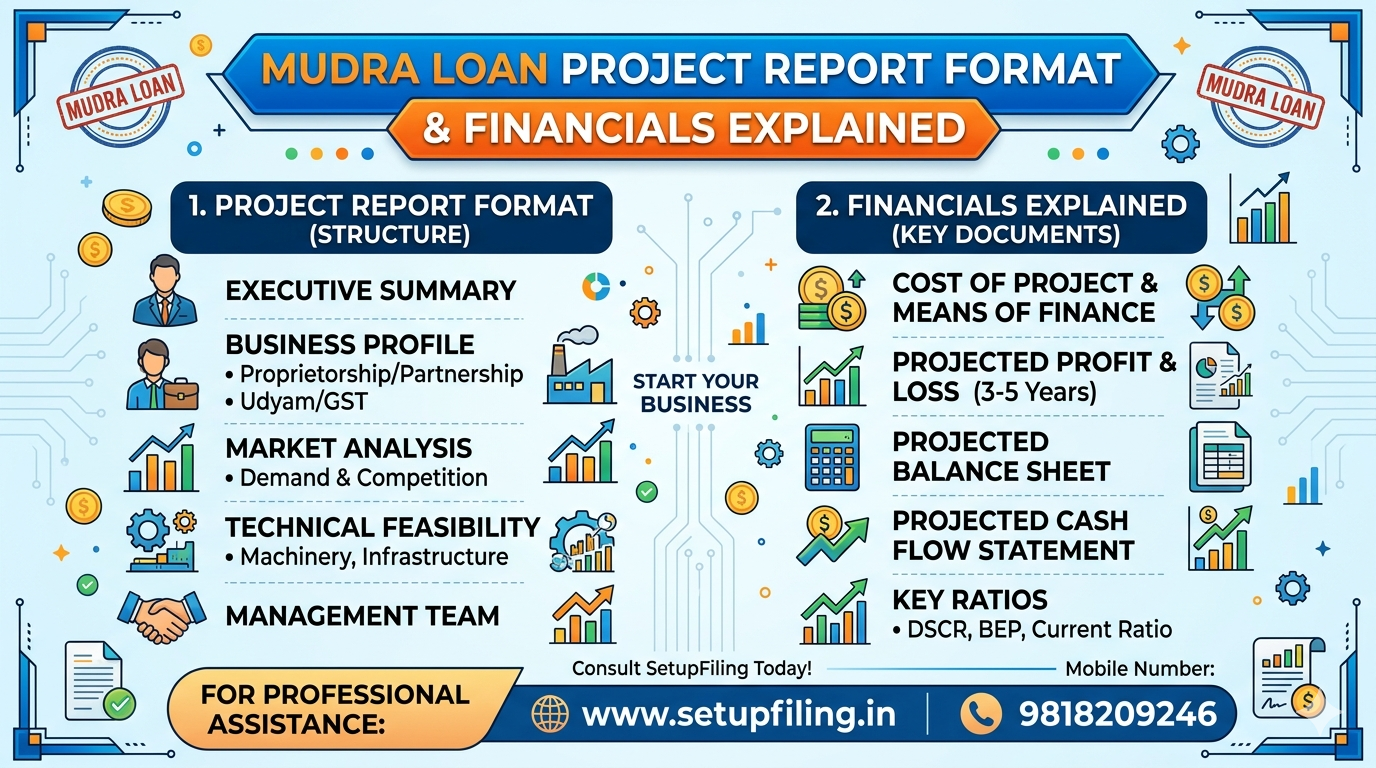
A Detailed Project Report (DPR) is a mandatory document for securing a Mudra Loan under the PMMY (Pradhan Mantri Mudra Yojana) scheme. Banks use this to assess the technical feasibility and financial viability of your business.
Below are the standard structure and the key financial components required for a professional submission.
1. Project Report Structure
A standard Mudra loan report is typically divided into two main parts: the Narrative (Project Profile) and the Financials.
I. Project Profile & Executive Summary
- Business Details: Name of the enterprise, constitution (Proprietorship/Partnership), and registration details (Udyam/GST).
- Promoter Profile: Educational background, experience in the field, and contact details.
- The Concept: What products or services are you offering? Who is your target audience?
- Infrastructure: Requirement of space (owned or rented), machinery, and raw materials.
- Manpower: Number of employees required and their roles.
II. Market Analysis
- Demand: Why is there a need for your business in your specific location?
- Competition: Brief mention of competitors and your unique selling point (USP).
2. Key Financial Components
This is the core of the report. Banks focus on these four statements to ensure you can repay the loan:
A. Cost of Project & Means of Finance
This table balances what you need versus where the money is coming from.
- Project Cost: Machinery, furniture, working capital, and rent deposits.
- Means of Finance: Your contribution (usually 10–25%) + the Mudra Loan amount requested.
B. Projected Profit & Loss (P&L) Statement
A 3-to-5-year projection showing:
- Revenue: Expected sales per month/year.
- Operating Expenses: Salaries, electricity, rent, and raw materials.
- Depreciation: Reduction in the value of machinery over time.
- Net Profit: Your "Take-Home" after all expenses and taxes.
C. Projected Balance Sheet
A snapshot of your business's health, listing:
- Assets: Cash in hand, inventory, and equipment.
- Liabilities: The Mudra Loan balance and any trade payables.
D. Cash Flow Statement
This tracks the actual movement of cash. It proves to the bank that you will have enough liquid cash every month to pay the EMI.
3. Financial Ratios (The "Banker's Checklist")
Banks look for specific "health markers" in your report:
- DSCR (Debt Service Coverage Ratio): > $DSCR = \frac{\text{Net Profit + Depreciation + Interest}}{\text{Interest + Principal Repayment}}$
- Goal: A ratio above 1.5 is generally preferred. It shows you earn 1.5 times more than your debt obligations.
Why is a Detailed Project Report (DPR) essential? Banks don’t just look at numbers; they want to see the complete picture. The DPR helps lenders evaluate both the technical feasibility and financial sustainability of your business. This, in turn, influences their confidence in your ability to repay the loan.
Section 1: Project Profile
This is the foundation of your report. Provide concise, factual details about your business.
- Business Identity: Include the name of your enterprise, its legal structure (e.g., Sole Proprietorship, Partnership Firm), and any existing registrations like Udyam Registration or GST.
- Promoter Profile: Highlight your qualifications, relevant experience in the industry, and your contact details. This demonstrates your capacity to manage the venture.
- The Concept: Explain clearly what your business does. What products or services do you offer? Who are your target customers?
- Infrastructure Needs: Detail your operational requirements, such as the total space needed (and whether it’s owned or rented), essential machinery, and main raw materials.
- Manpower: Outline your staffing needs. Who are the key employees, and what are their specific roles?
Important Mudra Categories
Ensure your financials align with the specific Mudra category you are applying for:
- Shishu: Loans up to ₹50,000 (Simplified 1-page format).
- Kishore: Loans from ₹50,001 to ₹5 Lakhs (Detailed report required).
- Tarun: Loans from ₹5,00,001 to ₹10 Lakhs (Comprehensive audited-style report required).
Note: For loans above ₹2 Lakhs, most banks prefer a professionally drafted CMA (Credit Monitoring Arrangement) data report alongside the narrative.

 English
 Arabic
 Français
 Español
 Português
 Deutsch
 Türkçe
 Dutch
Dutch
 Russian
 Romaian