


Labour Charge Explained: Meaning, Types, Calculation & Business Importance
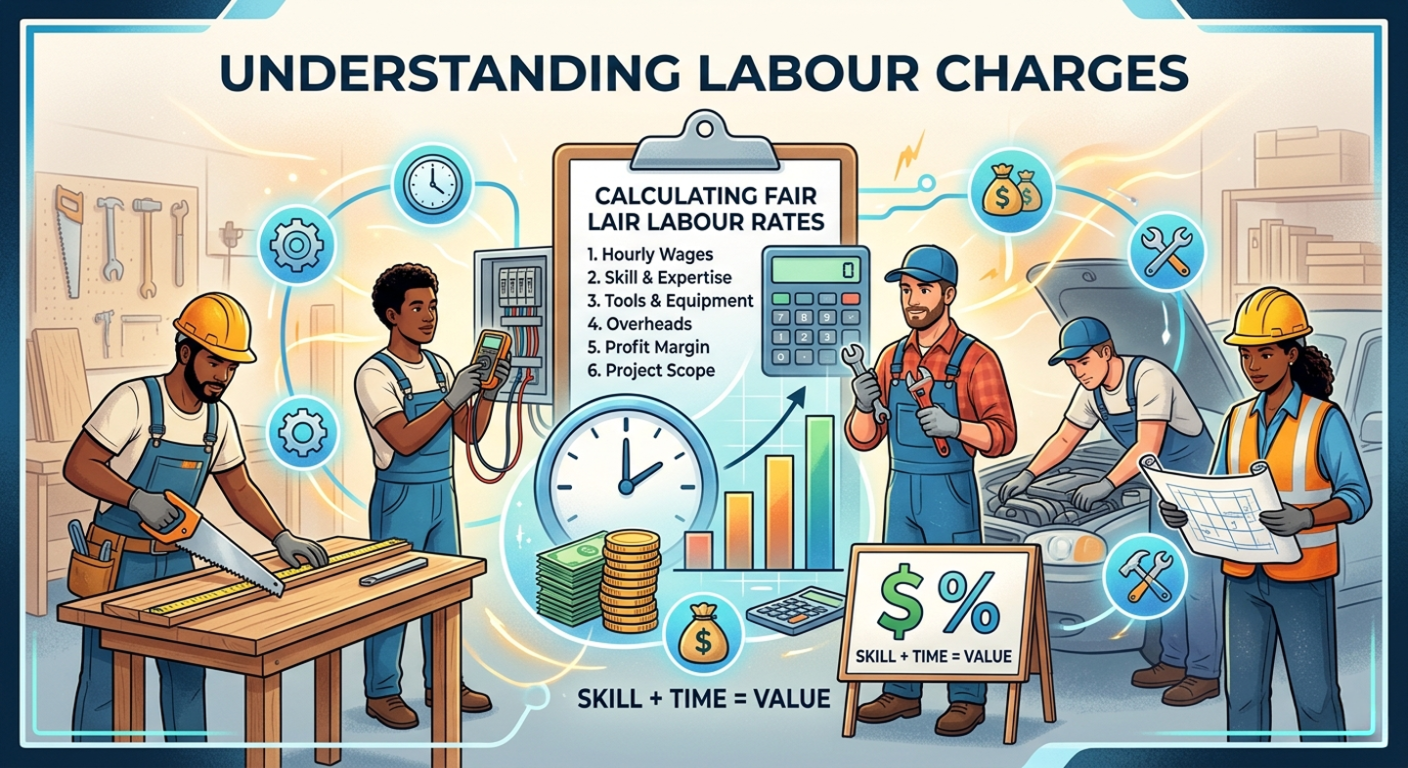
Whenever you hire someone to complete a task, there’s always a cost attached to their work. This cost is known as labour charge, and it plays a major role in determining your total expenses.
Whether you are running a small business or managing large projects, understanding labour charges helps you control costs and make smarter decisions.
Let’s break it down in a simple and practical way.
What is Labour Charge?
Labour charge is the payment made to workers for the time, effort, and skills they use to complete a job. It represents the cost of human work and does not include the price of materials, tools, or equipment.
In everyday terms, if someone performs a service for you, like repairing, building, or managing a task—the amount you pay for their work is considered a labour charge.
This cost can be calculated based on hours worked, days spent, or even on a fixed project basis, depending on the agreement.
Why Labour Charges Are Important for Businesses
Labour costs are one of the biggest components of business expenses. Managing them effectively can directly impact your success.
Helps in Accurate Budgeting
When you clearly know how much you are spending on labour, it becomes easier to create realistic budgets and avoid unexpected financial pressure during projects.
Supports Better Profit Margins
If labour costs are not calculated properly, they can reduce your profits. Proper planning ensures you price your services correctly and maintain healthy margins.
Improves Workforce Planning
Understanding labour expenses helps businesses decide the right number of employees needed for operations. This prevents both overstaffing and understaffing.
Ensures Legal Compliance
Tracking labour payments makes it easier to follow wage laws, tax regulations, and employee benefit requirements, reducing the risk of legal issues.
Builds Client Trust
Clear and well-defined labour charges make your pricing transparent, which helps build confidence among clients and avoids misunderstandings.
Different Types of Labour Charges
Labour charges can be grouped into various categories depending on how work is performed and compensated.
Direct Labour
This includes workers who are directly involved in creating products or delivering services. Their contribution is clearly visible in the final output.
Indirect Labour
These are employees who support operations but are not directly linked to production, such as administrative staff, supervisors, or maintenance teams.
Fixed Labour
Fixed labour costs refer to salaries that remain constant regardless of how much work is completed. These costs are stable and predictable over time.
Variable Labour
Variable labour costs change depending on workload or hours worked. For example, wages based on hourly work or overtime payments.
Skilled Labour
Workers with specialized training, knowledge, or expertise fall under this category. They typically earn higher wages due to their advanced capabilities.
Unskilled Labour
This type of labour involves basic work that does not require special training. As a result, the wages are usually lower compared to skilled labour.
Key Factors That Influence Labour Charges
Labour costs can vary widely depending on several conditions.
Experience and Skill Level
Highly experienced workers tend to charge more because they can deliver better results efficiently.
Type of Work
Jobs that are complex or require technical expertise generally come with higher labour costs compared to simple tasks.
Geographic Location
Labour rates differ from one place to another. Cities usually have higher costs than smaller towns due to differences in living expenses.
Working Time
Longer hours, overtime, or urgent tasks can increase labour charges significantly.
Industry Norms
Each industry has its own wage standards, which influence how much workers are paid.
Government Policies
Minimum wage laws, employee benefits, and statutory requirements also play a role in determining labour costs.
How to Calculate Labour Charges
Calculating labour charges correctly is essential for cost control and financial planning.
Basic Calculation Method
Labour Charge = Hourly Rate × Total Time Worked + Extra Expenses
The hourly rate is based on the worker’s skills and market rates, while total time reflects the duration of work.
Additional Costs to Consider
To get an accurate figure, you should also include:
- Overtime payments
- Incentives or bonuses
- Employee benefits
- Taxes and statutory deductions
- Training or onboarding costs
Example
Suppose a worker is paid ₹300 per hour and works for 40 hours. The base cost would be ₹12,000. If additional expenses add up to ₹3,000, the total labour charge becomes ₹15,000.
This approach ensures you capture the complete cost involved.
Labour Charges and Compliance in India
In India, labour charges are often associated with various tax and compliance requirements that businesses must follow carefully.
These may include GST on service-related work, TDS deductions for contract-based payments, and contributions towards employee welfare schemes such as Provident Fund and Employee State Insurance.
Proper handling of these components is essential to avoid penalties and maintain smooth business operations.
Role of HRMS Software in Managing Labour Costs
Handling labour costs manually can become complicated, especially as your business grows.
An HRMS (Human Resource Management System) helps simplify this process by automating tasks like payroll, attendance tracking, and compliance management.
With HRMS software, businesses can:
- Monitor employee working hours efficiently
- Automate salary and wage calculations
- Manage tax deductions and legal compliance
- Access detailed reports on labour expenses
This leads to better accuracy, reduced errors, and improved decision-making.
Conclusion
Labour charge is a fundamental part of any business expense structure. It reflects the value of the workforce and has a direct impact on overall profitability.
By understanding its types, influencing factors, and calculation methods, businesses can manage costs more effectively and improve operational performance.
In a competitive market, controlling labour expenses while ensuring fair compensation is key to long-term success.

 English
 Français
 Español
 Português
 Deutsch
 Türkçe
 Dutch
Dutch
 Italiano
 Russian
 Romaian