


How Parents Are Using AI to Create Social Stories for Children in 2026
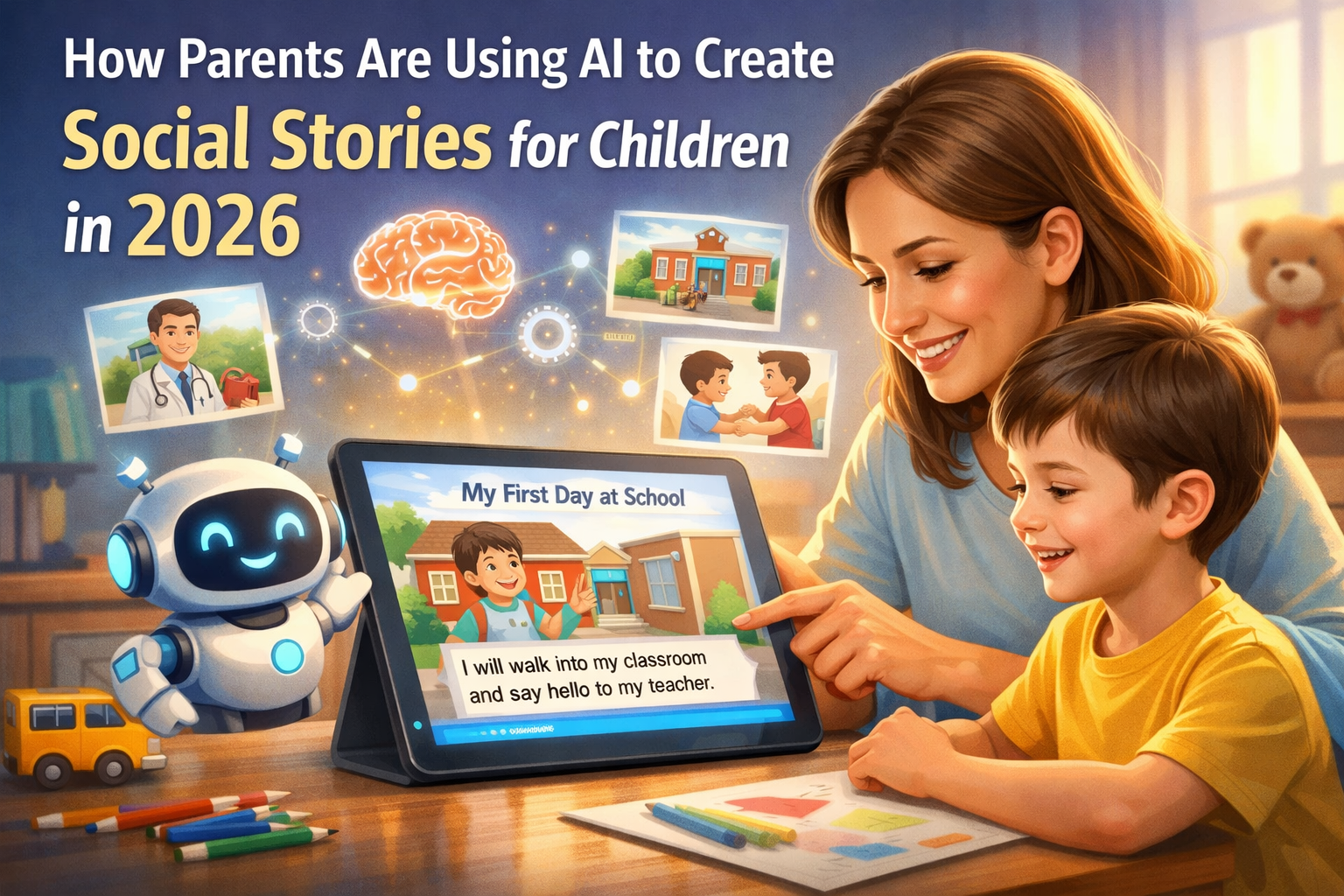
Every parent has faced moments when a child struggles to understand a situation. It could be the first day of school, sharing toys, visiting a doctor, or even following a bedtime routine. These everyday situations can feel overwhelming for children, especially when expectations are unclear.
This is where social stories for children have proven to be incredibly helpful. They break down complex social situations into simple, structured narratives that children can understand and relate to. What has changed in recent years is how these stories are created.
In 2026, many parents are now using artificial intelligence to create personalized social stories quickly and effectively. Instead of spending hours writing and refining stories, AI tools are helping parents generate meaningful, situation-specific content in minutes. This shift is not just about convenience. It is about making proven learning methods more accessible, consistent, and impactful.
What Are Social Stories for Children?
Before exploring the role of AI, it is important to understand the foundation of social stories and why they matter.
The Origin and Purpose of Social Stories
Social stories were developed by Carol Gray to help children understand social situations, expectations, and appropriate responses. These stories use simple language and clear structure to explain what will happen, why it happens, and how a child can respond.
They are widely used for children with autism, but their benefits extend to all children who need support in learning social and emotional skills.
Why Social Stories Are Effective
Social stories work because they simplify reality. Instead of expecting a child to interpret complex social cues, they present situations in a predictable and structured way.
This approach helps children:
-
Understand expectations before entering a situation
-
Reduce anxiety by knowing what comes next
-
Build confidence in social interactions
Over time, repeated exposure to these stories supports better emotional regulation and independent behavior.
The Science Behind Social Stories
The effectiveness of social stories is not just anecdotal. It is supported by research in child development and behavioral psychology.
What Research Says
Organizations like the Centers for Disease Control and Prevention highlight the importance of structured learning tools in helping children develop social and communication skills. Similarly, research referenced by the National Institute of Mental Health emphasizes how predictable narratives can reduce stress and improve understanding in children with developmental challenges.
Studies in autism intervention have consistently shown that structured storytelling methods can improve social interaction, communication, and behavior management. These findings make social stories a trusted method among educators and therapists.
Psychological Benefits for Children
From a psychological perspective, social stories offer three key benefits.
They create predictability, which reduces anxiety. Children feel more comfortable when they know what to expect.
They improve comprehension by breaking situations into manageable steps.
They reinforce positive behavior by modeling appropriate responses in a safe and understandable way.
The Challenges with Traditional Social Stories
Despite their benefits, traditional social stories come with limitations that many parents struggle with.
Creating a personalized story takes time and effort. Parents need to understand the situation deeply, choose the right words, and structure the story effectively. This process can be difficult, especially without guidance.
Another challenge is consistency. Children often need repeated exposure to different scenarios. Writing a new story for every situation is not practical for most families.
Customization is also limited. Every child is different, and a generic story may not fully address a child’s specific emotions or experiences.
These challenges have opened the door for a more efficient solution.
How AI Is Transforming Social Stories for Children
Artificial intelligence is changing how parents approach social learning at home. Instead of replacing traditional methods, it enhances them.
What AI Does Differently
AI tools can generate social stories instantly based on a parent’s input. A parent can describe a situation such as “my child is nervous about school,” and the AI creates a structured, age-appropriate story within seconds.
These tools can adjust tone, language, and complexity based on the child’s needs. This level of personalization was difficult to achieve manually.
AI also allows parents to create multiple stories quickly, making it easier to address different scenarios as they arise.
Real-Life Examples
Parents are now using AI to create stories for everyday situations such as:
-
Preparing for the first day of school
-
Learning how to share with others
-
Visiting a doctor or dentist
-
Managing bedtime routines
-
Handling emotions like anger or frustration
Each story is tailored to the child’s experience, making it more relatable and effective.
How Parents Are Using AI Tools in 2026
The adoption of AI tools among parents has grown rapidly because of their simplicity and effectiveness.
Step-by-Step Process
Most parents follow a simple process.
They start by describing a situation their child is facing. The AI then generates a structured story with clear explanations and positive guidance. Parents review the story, make small adjustments if needed, and share it with their child.
This process takes minutes instead of hours.
A Smarter Way to Create Personalized Stories
Today, many platforms are designed specifically to support this process. Instead of writing from scratch, parents can use tools that generate meaningful social stories for children based on real-life situations.
One example is a platform where parents can quickly create customized stories for different scenarios without needing expertise in child psychology or writing. This approach makes social learning more accessible and practical for everyday use.
Benefits of Using AI for Social Stories
The growing popularity of AI in this space is driven by clear and practical benefits.
Saves Time for Parents
Parents no longer need to spend hours crafting stories. AI reduces the effort required while maintaining quality and structure.
Personalized Learning Experience
Each story can be tailored to a child’s unique situation, making it more effective than generic content.
Consistency in Teaching
AI makes it easier to create multiple stories regularly, helping reinforce learning through repetition.
Accessibility for All Families
Even parents with no prior experience can create effective social stories. This removes a major barrier and allows more children to benefit from this method.
Are There Any Concerns with Using AI for Children?
While AI offers many advantages, it is important to approach it thoughtfully.
Screen Time and Balance
Parents should ensure that AI tools are used as a support system, not a replacement for real-world interaction. Reading and discussing stories together remains essential.
Importance of Parental Involvement
AI can generate content, but parents provide context and emotional connection. Active involvement helps children understand and apply what they learn.
Reviewing Content for Accuracy
Although AI is advanced, it is still important to review stories to ensure they align with the child’s needs and values.
Best Practices for Parents
To get the most out of AI-generated social stories, parents should focus on practical usage.
Keep stories simple and easy to understand. Use real-life situations that the child can relate to. Repeat stories regularly to reinforce learning. Encourage discussion after reading to help children process the message. Adjust stories over time as the child grows and develops new skills.
The Future of Social Stories with AI
The use of AI in parenting and education is still evolving. In the coming years, social stories are expected to become even more interactive and personalized.
We may see voice-based storytelling, visual customization, and deeper integration with educational platforms. These advancements will make it easier for parents and educators to support children in meaningful ways.
At the same time, the core principle will remain unchanged. The goal is to help children understand the world around them in a safe and supportive way.
Conclusion
Social stories have long been a trusted method for helping children navigate social situations. What has changed is how easily these stories can now be created and personalized.
AI is not replacing the role of parents. It is making a proven approach more accessible, efficient, and adaptable to everyday life. By combining research-backed methods with modern technology, parents in 2026 are better equipped to support their children’s social and emotional development.
For families looking to simplify this process, AI-powered tools offer a practical and effective way to create meaningful learning experiences.

 English
 Arabic
 Français
 Español
 Deutsch
 Türkçe
 Dutch
Dutch
 Italiano
 Russian
 Romaian