


Next-Gen Multi-Factor Authentication (MFA): Key Trends Driving Secure Digital Authentication
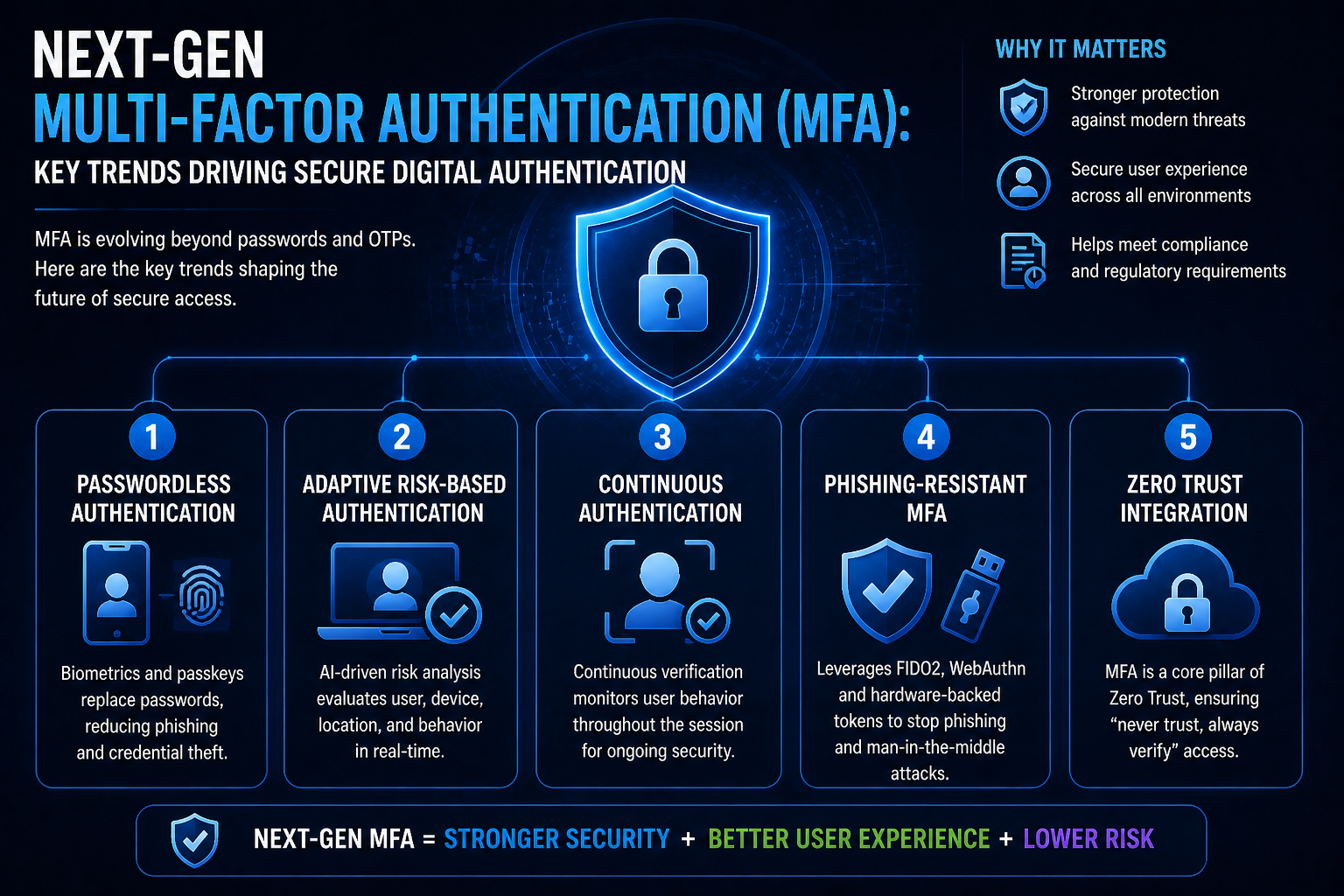
As cyber threats continue to evolve, traditional authentication methods are no longer sufficient to protect digital identities. Multi-Factor Authentication (MFA) has become a critical security layer, but even MFA is undergoing a transformation. Next-generation MFA is redefining how organizations secure access—balancing stronger protection with seamless user experience.
One of the most significant trends is the shift toward passwordless authentication. Instead of relying on passwords—which are often weak, reused, or stolen—organizations are adopting alternatives such as biometrics, hardware tokens, and passkeys. Technologies aligned with standards from the FIDO Alliance are enabling secure, phishing-resistant authentication methods that eliminate the risks associated with traditional credentials.
Another key trend is the rise of adaptive and risk-based authentication. Modern MFA systems analyze contextual signals such as user location, device type, behavior, and login patterns to determine the level of risk. If an attempt appears suspicious, additional verification steps are triggered. This dynamic approach enhances security while minimizing friction for legitimate users.
Biometric authentication continues to gain traction as a core component of next-gen MFA. Fingerprint scanning, facial recognition, and voice authentication provide a convenient and secure way to verify identity. Unlike passwords, biometric traits are unique to individuals, making them harder to replicate. When combined with other factors, biometrics significantly strengthen authentication systems.
The integration of AI and machine learning is also transforming MFA. AI-driven systems can detect anomalies, identify unusual login behavior, and respond in real time. For example, if a user suddenly logs in from an unfamiliar location or device, AI can flag the activity and enforce additional authentication measures. This proactive approach helps prevent unauthorized access before it occurs.
Another emerging trend is the adoption of Zero Trust security models, where no user or device is trusted by default. In this framework, MFA becomes a continuous process rather than a one-time verification. Users may be required to re-authenticate based on changing risk conditions, ensuring ongoing protection throughout a session.
Passkeys and device-based authentication are also gaining momentum. These methods store credentials securely on user devices, reducing reliance on passwords and improving resistance to phishing attacks. As major technology providers adopt passkey standards, this approach is expected to become mainstream.
Despite these advancements, challenges remain. Organizations must address privacy concerns, ensure interoperability across systems, and balance security with user convenience. Proper implementation and user education are essential to maximize the effectiveness of next-gen MFA.
In conclusion, next-generation MFA is reshaping digital authentication by combining security, intelligence, and usability. As cyber threats become more sophisticated, adopting these emerging trends will be critical for organizations aiming to protect identities and maintain trust in an increasingly digital world.
Read more : cybertechnologyinsights.com/
To participate in our interviews, please write to our Media Room at info@intentamplify.com

 English
 Arabic
 Español
 Português
 Deutsch
 Türkçe
 Dutch
Dutch
 Italiano
 Russian
 Romaian