


Is MongoDB Better Than SQL for Backend Development?
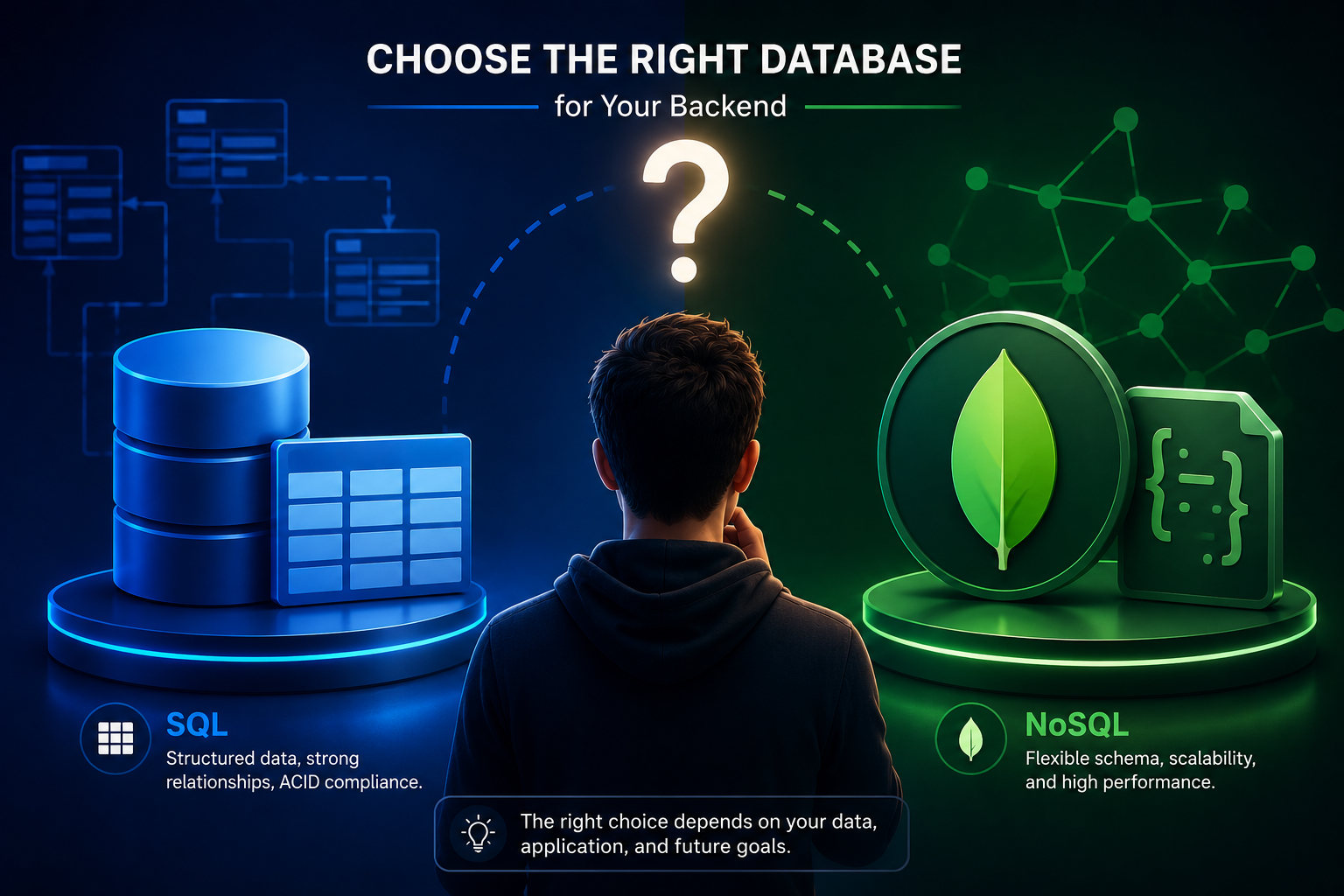
Most beginners entering backend development ask the wrong question.
They ask, “Which database is better?” when the real question should be, “Which database is better for the kind of application I want to build?”
That difference matters more than most developers realize.
The debate between MongoDB and SQL databases has existed for years, especially among developers learning backend technologies through a Node.js course or building APIs for the first time. Some developers believe MongoDB is the future because of its flexibility and developer-friendly structure. Others argue SQL databases remain unmatched for reliability, relationships, and large-scale business systems.
The truth is more interesting than either side admits.
According to the 2024 Stack Overflow Developer Survey, PostgreSQL remained one of the most commonly used databases among professional developers, while MongoDB also continued ranking among the most popular database technologies worldwide.
That popularity shows something important: modern backend development no longer revolves around one “perfect” database. Different systems solve different problems.
Understanding the Difference Between MongoDB and SQL
At a basic level, the difference comes down to structure.
SQL databases such as PostgreSQL and MySQL organize data in structured tables with predefined schemas. Relationships between data are clearly defined, which makes SQL extremely reliable for complex systems.
Unlike conventional databases,
MongoDB stores data using flexible JSON-like documents instead of rigid tables, and can adjust its data structure without needing to rebuild the
full set of database schemas. Within the Node.js ecosystem, its documents are highly compatible with JavaScript objects, enabling smooth data flow between backend APIs and the
database layer, which has made it widely popular among entry-level developers.
Why Many Beginners Prefer MongoDB?
MongoDB removes many of the barriers beginners encounter when learning databases. Unlike SQL, which requires new learners to master core concepts, including
-
tables
-
joins
-
relationships
-
normalization
-
structured queries
MongoDB allows users to store data quickly without following a strict schema in the early stages of learning. This leads to much faster progress during the learning phase when building blog APIs or e-commerce backends.
For this reason, most Node.js backend developer courses introduce MongoDB early, helping students focus on backend logic. However, this flexibility does not come without tradeoffs.
Where SQL Databases Still Dominate?
SQL relational databases still dominate vertical sectors that place extremely high demands
on data accuracy and correlation. All five common application scenarios—banking systems, financial applications, medical platforms, ERP software, and enterprise-level applications—rely heavily.
on these databases. Even as NoSQL products such as MongoDB have gained widespread popularity, SQL relational databases maintain their firm market position thanks to four core strengths:
-
Support for complex queries
-
Transaction reliability
-
Support for structured relationships
-
Compatibility with large-scale reports
A hypothetical case of defects in a payment system illustrates the value of SQL relational databases in more concrete terms, while also laying out clear logic for back-end developers to follow in their learning, practical work, and technology selection.
Is MongoDB Faster Than SQL?
This question is more complicated than most internet debates make it sound.
MongoDB can perform extremely well for applications handling large amounts of unstructured or rapidly changing data. Its flexible document model also works nicely for agile development environments where requirements change frequently.
However, SQL databases are often more efficient for:
-
relational data,
-
complex joins,
-
financial systems,
-
and transaction-heavy applications.
Performance depends less on internet hype and more on application architecture.
Poorly designed MongoDB systems can become slow.
Poorly optimized SQL systems can also perform terribly.
The database itself is only one part of backend performance.
Good backend engineers understand:
-
indexing,
-
query optimization,
-
caching,
-
and system design.
Those skills matter far more than blindly choosing one database over another.
Why Companies Use Both Today?
One interesting reality of modern backend development is that many companies no longer rely on a single database type.
Large systems often combine SQL and NoSQL databases.
For example:
-
SQL may handle payments and financial transactions.
-
MongoDB may manage user activity, analytics, or flexible content systems.
This hybrid approach allows companies to use each database where it performs best.
That is why developers learning backend engineering today benefit from understanding both relational and document-based databases, rather than becoming emotionally attached to a single technology.
Many professionals pursuing a Node.js certification eventually realize that backend development is less about tools and more about solving system-level problems effectively.
Which Database Is Better for Learning Backend Development?
For absolute beginners, MongoDB has a very low learning threshold. It is compatible with JavaScript, allows users to quickly build APIs, and does not create a sense of overwhelming learning pressure, which is why it is adopted by numerous Node.js beginner tutorials to develop various types of projects.
However, relying only on MongoDB can create long-term gaps in backend understanding.
SQL teaches developers how structured systems behave. It introduces concepts like relationships, normalization, joins, and transactional thinking — all of which are extremely important in professional backend development.
The strongest developers eventually become comfortable with both.
Because in real backend engineering, flexibility matters more than technology loyalty.
The Real Skill Companies Want
This study first debunks common misconceptions about the competencies required.
for back-end development. It lists the 5 core hiring competencies that enterprises.
use in their recruitment processes, compares the capability gaps between two categories of developers, rejects superficial learning that only focuses on memorizing database syntax, and advocates
for in-depth cultivation of expertise in underlying system design, and puts forward 4 implementable practical learning measures.
This is also why many learners today prefer a practical backend developer course that focuses on system design, architecture, and real-world backend problem solving instead of only theoretical coding exercises.
Final Thoughts
MongoDB is not automatically better than SQL.
SQL is not automatically outdated.
They are simply different tools built for different backend challenges.
MongoDB offers flexibility, rapid development, and simplicity for many modern applications. SQL offers structure, reliability, and powerful relational capabilities that businesses still depend on heavily.
The smartest backend developers in 2026 are not the ones arguing endlessly about which database is superior. They are the ones learning when to use each technology properly.
Because real backend engineering is not about following trends — it is about understanding systems deeply enough to choose the right solution when real-world complexity appears.

 English
 Arabic
 Español
 Português
 Deutsch
 Türkçe
 Dutch
Dutch
 Italiano
 Russian
 Romaian