


Common ITIL 5 Terms and Concepts Explained with Examples
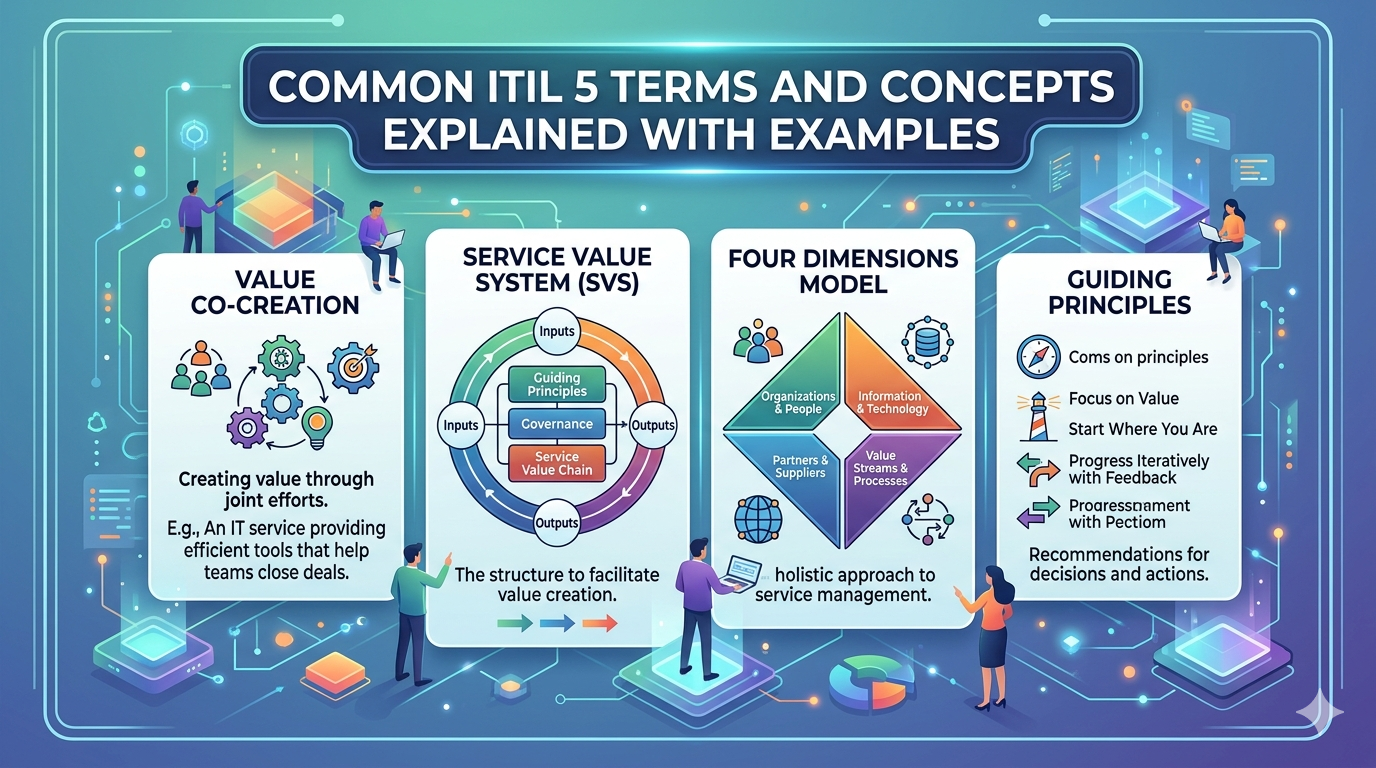
As organizations continue to modernize their IT operations, understanding ITIL concepts has become essential for IT professionals and businesses alike. Whether you are preparing for an Information Technology Infrastructure Library certification or planning to enroll in an ITIL 5 Course, knowing the fundamental terms can help you build a strong foundation in IT Service Management (ITSM).
This article explains some common ITIL 5 terms and concepts with simple examples.
What is ITIL 5?
ITIL 5 is the latest evolution of the IT Infrastructure Library framework that helps organizations improve service delivery, align IT with business goals, and enhance customer satisfaction. Many professionals pursue ITIL 5 Certification to improve their ITSM knowledge and career opportunities.
One of the major ITIL 5 Certification Benefits is that it helps organizations create efficient, scalable, and customer-focused IT services.
Service Value System (SVS)
The Service Value System is the core framework of ITIL 5. It explains how all organizational components work together to create value through IT services.
Example:
A company’s IT team uses monitoring tools, incident management processes, and customer feedback systems together to ensure uninterrupted online banking services.
The SVS connects every activity to business value creation.
Incident Management
Incident Management focuses on restoring normal service operations as quickly as possible when disruptions occur.
Example:
An employee cannot access their email account due to a server issue. The IT support team quickly resolves the issue to minimize downtime.
This concept is widely covered in every ITIL 5 Course because it directly impacts customer satisfaction and operational efficiency.
Problem Management
Problem Management identifies the root cause of recurring incidents and prevents them from happening again.
Example:
If employees repeatedly face Wi-Fi connectivity issues, the IT team investigates the underlying network problem instead of fixing each complaint individually.
This proactive approach is one of the important ITIL 5 Certification Benefits for organizations aiming to reduce recurring IT issues.
Change Enablement
Change Enablement ensures that IT changes are implemented with minimal risk and disruption.
Example:
Before upgrading company software, the IT team performs testing, risk assessment, and scheduling to avoid service outages during business hours.
Effective change management improves business continuity and system stability.
Service Desk
The Service Desk acts as the single point of contact between users and the IT team.
Example:
Employees contact the service desk to report password issues, software problems, or hardware failures.
A well-managed service desk improves communication and enhances the user experience.
Continual Improvement
Continual Improvement focuses on regularly enhancing services, processes, and performance.
Example:
An organization reviews customer feedback every quarter and updates its support processes to reduce response times.
This concept encourages businesses to adapt and improve continuously in a competitive environment.
Why Learn ITIL 5?
Learning ITIL 5 helps professionals understand modern IT service management practices and business-focused service delivery. Enrolling in an ITIL 5 Course can help individuals gain practical knowledge, improve operational efficiency, and prepare for certification exams.
Additionally, ITIL 5 Certification Benefits include better career growth, improved process management skills, higher earning potential, and global recognition in the IT industry.
Conclusion
Understanding common ITIL 5 terms and concepts is the first step toward mastering IT service management. Concepts such as Incident Management, Problem Management, Change Enablement, and Continual Improvement help organizations deliver reliable and customer-centric services. With the growing demand for ITSM professionals, earning an ITIL 5 Certification can be a valuable investment for both individuals and businesses.

 English
 Arabic
 Français
 Español
 Português
 Deutsch
 Türkçe
 Dutch
Dutch
 Italiano
 Romaian