


Safeguarding Corporate Assets with Next-Generation Encrypted Networks
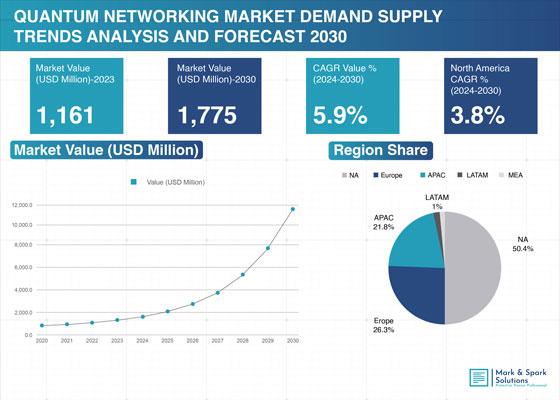
The rapid expansion of the Quantum Networking market reflects a collective corporate realization that current cryptographic frameworks have an expiration date. The Quantum Networking market was valued at USD 1,052 million in 2023 and is projected to grow to USD 11,060 Million by 2030, with a compound annual growth rate (CAGR) of 41.7% from 2024 to 2030. Security analysts have long warned about "harvest now, decrypt later" tactics, where malicious entities steal encrypted files today with the intention of cracking them once powerful quantum computers become available. Because of this looming threat, forward-thinking enterprises are investing in quantum networks immediately to protect their long-term data assets from future exposure. This preventative security spending is transforming quantum development from an experimental research project into a critical risk-management tool.
Implementing quantum cryptography requires a total re-evaluation of how data moves between distinct geographic facilities, such as corporate offices, backup storage systems, and cloud nodes. Quantum Key Distribution (QKD) provides a unique solution by using the natural laws of physics to guarantee data privacy, alerting operators if any third party attempts to observe the key generation process. If an unauthorized entity intercepts the photon stream, the delicate quantum state collapses, instantly spoiling the key and revealing the intrusion attempt. This physical security feature provides a level of protection that no mathematical algorithm can replicate, no matter how complex it is. As a result, QKD systems are becoming the preferred security choice for industries that manage highly confidential intellectual property.
Beyond data security, quantum networking is opening up new possibilities for distributed sensor networks, which will dramatically improve measurement precision in science and manufacturing. By connecting quantum sensors through entangled networks, researchers can achieve synchronization levels that were previously impossible with classical clock systems. This hyper-precise synchronization is critical for deep-space navigation, geological mapping, and creating more accurate global positioning systems. The commercial applications of these synchronized sensor networks will benefit maritime shipping, autonomous aviation, and macro-scale environmental monitoring projects. The growing demand for these industrial applications will continue to attract diverse corporate capital into the quantum space throughout the decade.
While corporate entities focus on protecting live data networks, public safety sectors are heavily investing in systems to analyze historical data and digital evidence trails. This focus on post-event analysis is a key driver for the expanding Forensic Technology market size, as modern criminal investigations rely heavily on digital evidence trails. From recovering corrupted mobile device data to verifying DNA profiles, forensic laboratories require reliable, high-tech tools to process heavy workloads efficiently. The continuous expansion of both communication networks and investigative technologies shows a broader global focus on comprehensive data management and security. Both industries are growing fast because modern society demands absolute clarity and safety across all digital platforms.
The future of global market leadership will likely belong to companies that successfully integrate these advanced networking principles into their core business models. As the marketplace moves closer to 2030, the organizations that rely on outdated encryption methods will find themselves dealing with escalating security premiums and regulatory penalties. Conversely, companies operating on quantum-secured lines will enjoy lower digital insurance costs and higher trust from their institutional clients. The capital flowing into this market will continue to accelerate as deployment barriers fall and standard hardware components become more affordable. Investing in quantum infrastructure today is no longer an optional luxury; it is a vital strategy for long-term corporate survival.

 English
 Arabic
 Français
 Español
 Português
 Deutsch
 Türkçe
 Dutch
Dutch
 Italiano
 Russian