


How Do Gold Buyers Calculate Jewelry Value? Expert Tips
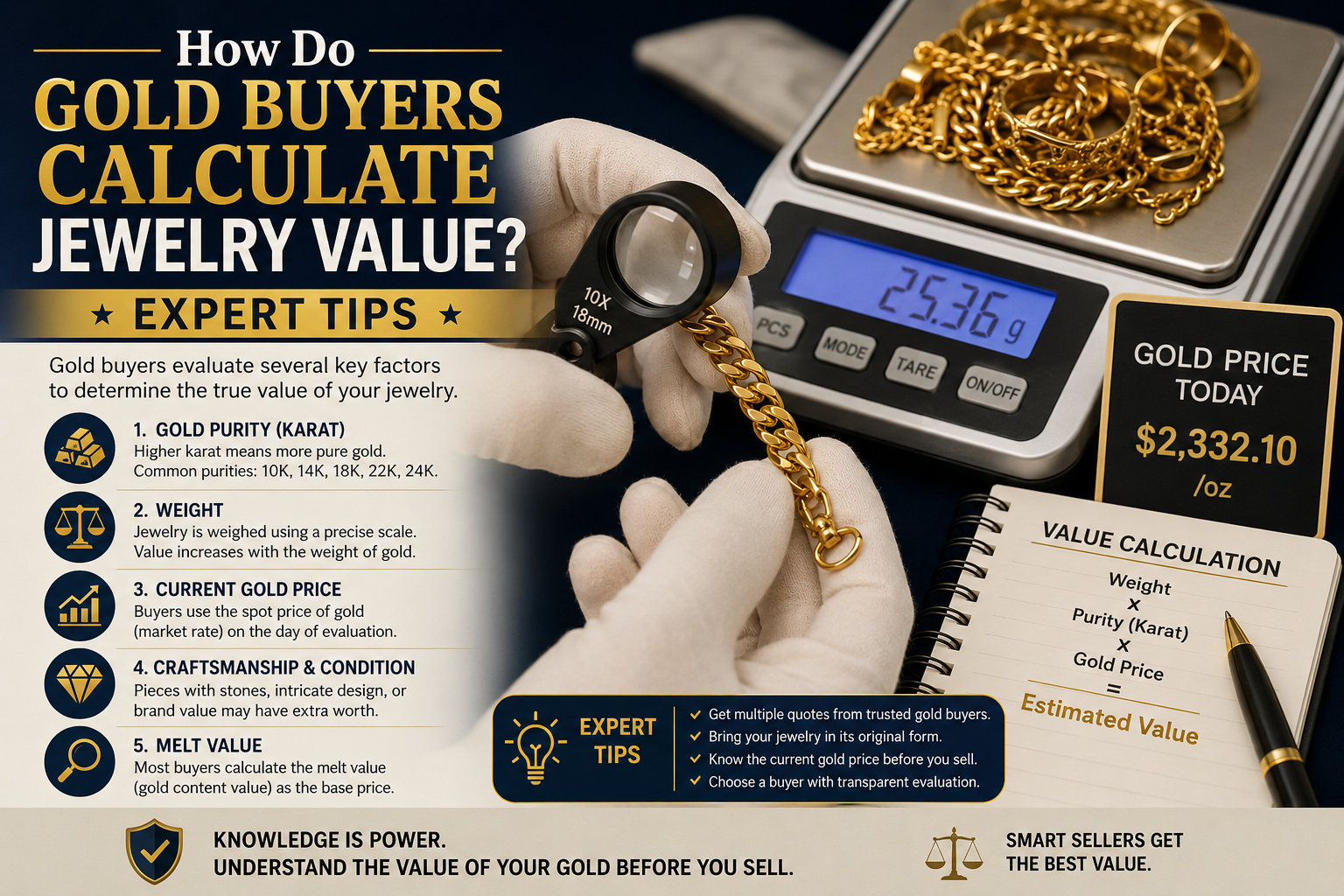
How Do Gold Buyers Calculate Jewelry Value? Expert Tips for More Money
Many people are surprised when they try to sell old jewelry. A gold necklace bought for thousands of dollars may only receive a much lower offer from gold buyers. This happens because the retail price and scrap value are very different.
Retail jewelry prices include design costs, branding, store rent, and marketing. But when you sell gold for cash, buyers mainly focus on the actual gold content and current market value.
The problem is that many sellers do not understand how gold buyers calculate jewelry value. Because of this, they often accept low offers and lose money.
This guide explains the exact process professional gold buyers use to price jewelry. You will learn how purity, weight, spot price, gemstones, and branding affect the final offer. By the end, you will know how to negotiate better and get the best price when you sell gold for cash.
The Core Math: How Melt Value is Found
Determining Gold Purity and Karats
The first thing gold buyers check is purity. Gold jewelry is rarely made from pure gold because pure gold is too soft for daily wear.
Gold purity is measured in karats:
-
24K Gold = 99.9% pure gold
-
22K Gold = 91.6% pure gold
-
18K Gold = 75% pure gold
-
14K Gold = 58.5% pure gold
-
10K Gold = 41.7% pure gold
The higher the karat, the more valuable the gold usually is.
Most jewelry has small stamps called hallmarks. These marks show the purity level. Common stamps include:
-
24K
-
18K
-
14K
-
585 (14K)
-
750 (18K)
However, professional gold buyers do not rely only on stamps. Some fake jewelry may have false markings. That is why buyers use special testing methods.
Acid Testing
Acid testing checks how the metal reacts to chemicals. Different acids are used for different karat levels.
XRF Scanner Testing
Many modern gold buyers now use XRF scanners. These machines use X-rays to check the exact metal content without damaging the jewelry.
This process helps buyers determine the true gold percentage before making an offer.
Weighing the Metal
After purity testing, buyers weigh the jewelry using digital scales.
Gold is usually measured in grams or troy ounces. One troy ounce equals about 31.1 grams.
Professional gold buyers only pay for the actual gold weight. This is called the net weight rule.
That means non-gold parts are removed from the calculation, including:
-
Diamonds
-
Gemstones
-
Clasps
-
Screws
-
Watch parts
Example
Imagine you want to sell gold for cash and you bring in a ring that weighs 10 grams.
-
Total ring weight = 10g
-
Diamond weight = 2g
-
Actual gold weight = 8g
The buyer will calculate payment based only on the 8 grams of gold.
This is why jewelry with large stones may not always receive the high offer sellers expect.
The Role of the Spot Price
Understanding the Live Market
The spot price is the current global market price of gold.
This price changes constantly because of:
-
Inflation
-
Economic uncertainty
-
Currency values
-
Interest rates
-
Global demand
In 2026, gold prices continue to move quickly due to world economic conditions and strong investment demand.
Professional gold buyers track live market prices throughout the day. Many shops update their rates every few minutes.
You can also check real-time gold prices online before visiting a buyer. This helps you understand whether the offer is fair.
The Buyer’s Profit Margin
One important thing to understand is that you will never receive 100% of the spot price.
Gold buyers need to make a profit after covering costs like:
-
Rent
-
Employee wages
-
Equipment
-
Refining fees
-
Insurance
-
Business taxes
Most gold buyers offer between 70% and 95% of the melt value.
The payout percentage depends on:
-
Gold purity
-
Weight
-
Market conditions
-
Competition in the area
-
Item demand
For example:
-
Melt value = $1,000
-
Buyer payout = 85%
-
Final offer = $850
Trusted gold buyers are usually transparent about how they calculate this margin.
Beyond the Metal: When Artistry Adds Value
Designer Brands and Luxury Labels
Not all jewelry is valued only for gold content.
Luxury brands can significantly increase value.
For example, a Cartier bracelet may sell for much more than a generic gold bracelet with the same weight.
Popular luxury brands include:
-
Cartier
-
Tiffany & Co.
-
Van Cleef & Arpels
-
Bulgari
These brands have strong resale demand.
When you sell gold for cash, original packaging can also increase value, including:
-
Boxes
-
Certificates
-
Receipts
-
Warranty cards
Some collectors are willing to pay premium prices for complete sets.
Rare Vintage and Antique Appeal
Vintage jewelry may also be worth more than its melt value.
Older jewelry styles often include detailed hand craftsmanship that is difficult to reproduce today.
Popular collectible styles include:
Art Deco Jewelry
-
Geometric patterns
-
Bold shapes
-
Popular in the 1920s and 1930s
Victorian Jewelry
-
Romantic designs
-
Floral details
-
Popular during Queen Victoria’s era
Experienced gold buyers sometimes work with antique specialists to determine collector value.
Melting antique jewelry without checking its historical value first can be a costly mistake.
The Impact of Gemstones and Diamonds
The Four Cs Evaluation
Diamonds are usually valued separately from the gold setting.
Professional buyers use the famous Four Cs:
-
Cut
-
Color
-
Clarity
-
Carat Weight
Large high-quality diamonds can add major value.
However, many sellers wrongly believe every stone automatically increases the offer.
In reality, small low-quality stones may add little or no extra value.
Treatment and Synthetic Stones
Modern technology has changed the gemstone market.
Lab-grown diamonds are now very common and usually worth less than natural diamonds.
Gold buyers use testing equipment to identify:
-
Synthetic stones
-
Treated diamonds
-
Fake gemstones
-
Simulants like cubic zirconia
Some buyers completely ignore tiny accent diamonds called melee stones because removing them costs more than their resale value.
This is another reason why jewelry resale prices can vary greatly.
Red Flags and How to Get the Best Price
Warning Signs of a Bad Buyer
Not all gold buyers are trustworthy.
Watch for these warning signs:
Flat-Rate Offers
Avoid buyers who offer the same price for every item without testing purity or weight properly.
Hidden Scales
If the buyer refuses to show the scale, walk away immediately.
Transparent gold buyers always explain the weighing process clearly.
“No Questions Asked” Cash Deals
Shops offering extremely fast cash without proper evaluation may not provide fair prices.
Professional buyers should explain how the value is calculated.
Pro Tips for Better Offers
Here are smart ways to maximize value when you sell gold for cash.
Clean Your Jewelry
Clean jewelry looks more attractive and professional during inspection.
Know the Basics
Write down:
-
Weight
-
Purity
-
Brand name
-
Stone details
This helps you compare offers confidently.
Get Multiple Quotes
Always visit at least three gold buyers before making a decision.
Offers can vary significantly between shops.
Check the Spot Price
Knowing today’s gold rate helps you understand if the offer is reasonable.
Bring Original Documents
Receipts, certificates, and brand packaging can increase value for luxury jewelry.
Understanding how gold buyers calculate jewelry value gives you a major advantage.
The basic formula is simple:
(Weight × Purity × Spot Price) – Buyer Margin
However, many other factors also affect the final offer, including:
-
Brand name
-
Antique value
-
Diamonds
-
Craftsmanship
-
Market demand
The best way to sell gold for cash is to focus on transparency instead of rushing for quick money.
Always compare offers, understand the math, and check today’s spot price before visiting a buyer.
With the right knowledge, you can avoid low offers and get the best possible value for your gold jewelry.

 English
 Arabic
 Français
 Português
 Deutsch
 Türkçe
 Dutch
Dutch
 Italiano
 Russian
 Romaian