


If you are an employer, a safety officer, or just someone who has been asked to “sort out the first aid training” at your workplace, you have probably realised that the rules are not as simple as you hoped. How many first aiders do you actually need? What qualification should they hold? How often do they need to refresh? And what happens if you get it wrong? Irish First Aid works with hundreds of Irish businesses every year, from small cafes to large manufacturing plants, and they see the same confusion again and again. This guide is designed to cut through the noise and give you a clear, practical roadmap to meeting your legal obligations while actually keeping your people safe. Let me walk you through the requirements step by step, without the jargon and without the guesswork.
The Legal Foundation: What the Safety, Health and Welfare at Work Act Requires
The primary piece of legislation governing workplace first aid in Ireland is the Safety, Health and Welfare at Work Act 2005, along with the General Application Regulations 2007. These laws do not give you a nice tidy number like “one first aider per fifty employees.” Instead, they use the phrase “adequate and appropriate” first aid provision based on a risk assessment. That flexibility is both a blessing and a curse. It allows small low-risk offices to get by with basic arrangements, but it also means larger or higher-risk workplaces cannot hide behind a simple formula. Irish First Aid advises employers to start with a written risk assessment that considers the number of employees, the nature of the hazards, the distance to the nearest accident and emergency department, and any shift patterns or out-of-hours working. This document becomes the foundation for every first aid decision you make.
Determining How Many First Aiders Your Workplace Needs
While there is no universal number, the Health and Safety Authority provides clear guidance that most employers can follow. For a low-risk workplace like a small office or retail shop with fewer than twenty-five employees, one trained first aider is usually sufficient. For twenty-five to fifty employees in low-risk environments, you should consider two first aiders. For high-risk environments like construction sites, warehouses, or manufacturing facilities, the HSA recommends one first aider for every ten to twenty employees. But these are minimums. Irish First Aid also considers factors like floor space, building layout, and employee mobility. A single first aider on the third floor does little for a person who collapses in the basement. Similarly, shift patterns mean you need first aiders on every shift, not just during normal business hours. A good rule of thumb is to train more people than you think you need. First aiders take holidays, get sick, or leave the company. Having a buffer prevents gaps in your coverage.

The Mandatory Qualification: QQI Level 5 First Aid Response
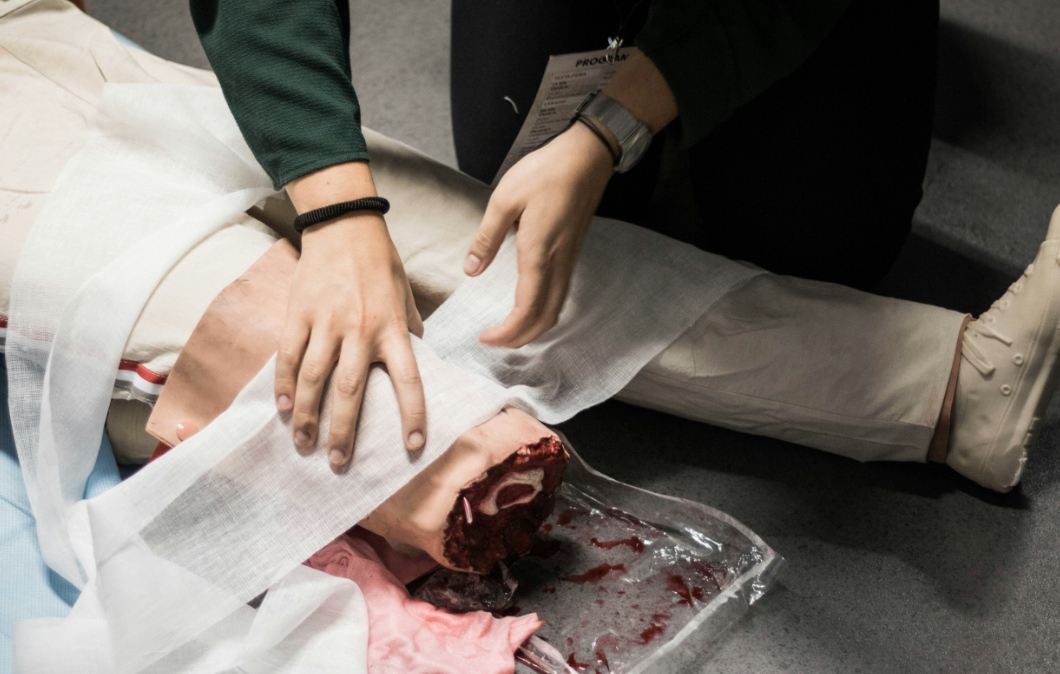
Here is the non-negotiable standard. For a designated workplace first aider, the HSA expects the QQI Level 5 First Aid Response (FAR) certificate. This is a two-day, fourteen to sixteen hour course that covers CPR, AED use, choking, bleeding control, fractures, burns, medical emergencies, and patient assessment. It is the only qualification that gives you a recognised credit on the National Framework of Qualifications. Irish First Aid is very clear about this point. Shorter courses, online-only certificates, or generic “safety awareness” courses do not meet the legal standard for a workplace first aider. If an HSA inspector visits your site and asks to see your first aider’s credentials, a half-day CPR certificate will not satisfy them. You can face improvement notices, fines, or in serious cases, prosecution. The extra cost and time of the full FAR course is not optional. It is the minimum standard for doing the job properly.
First Aid Equipment and Facility Requirements
Trained people are useless without the right tools. Irish First Aid safety course always reminds employers that certification is only half the equation. You must also provide a suitably stocked first aid kit that is easily accessible, clearly marked, and regularly checked for expired or used items. The HSA publishes guidance on first aid kit contents, but a typical workplace kit should include bandages, plasters, antiseptic wipes, gloves, scissors, tape, and a face shield for CPR. For high-risk environments, you may also need burn dressings, eye wash stations, and trauma bandages. If your workplace has more than fifty employees or is located more than thirty minutes from emergency services, you should consider an automated external defibrillator. Irish First Aid offers site audits where an instructor visits your premises, reviews your risk assessment, and makes specific recommendations about equipment placement and quantities. This service has saved many businesses from buying expensive equipment they did not need or missing critical items they did.
Record Keeping and Incident Logs
Many employers overlook this duty, but it matters more than you might think. Every time your workplace first aider provides treatment, you should record the incident in a dedicated first aid log. The log should include the date, time, location, nature of the injury or illness, the treatment given, and the name of the first aider. If the person is sent to hospital or takes time off work, that information should also be recorded. These logs serve multiple purposes. They help you spot patterns that might indicate a larger safety problem. They provide evidence to the HSA that you are managing incidents properly. And they protect both the employee and the first aider if questions arise later about what happened. Irish First Aid provides free downloadable first aid log templates to all their corporate clients, along with guidance on how long to keep records and when to report incidents to the HSA under the Reporting of Injuries, Dangerous Occurrences and Serious Accidents regulations.
The Two-Year Renewal Cycle and Refresher Training
A first aid certificate is valid for two years from the date of issue. After that, the first aider is no longer legally recognised, even if they remember everything perfectly. Irish First Aid strongly recommends that employers track certificate expiry dates in a central register and set reminders three months before each expiry. The refresher course is a one-day session that recertifies the first aider for another two years. It focuses on practical skills renewal and updates on any changes to guidelines. Many employers make the mistake of letting certificates lapse and then having to send staff for the full two-day course again, which costs more time and money. A proactive approach with scheduled refreshers is far more efficient. Some Irish businesses have started rotating refresher dates so that not all first aiders expire in the same month, ensuring continuous coverage.
On-Site Training as a Cost-Effective Solution for Larger Teams
For businesses with six or more employees needing training, Irish First Aid recommends considering on-site courses. An instructor comes to your premises with all the equipment, and the training is delivered in your environment. This has several advantages beyond convenience. The scenarios can be tailored to your specific hazards. The instructor can walk your actual floor and point out where first aid kits and AEDs should be located. Employees train together as a team, which builds familiarity and trust. And you avoid travel time and costs for your staff. The per-person price for on-site training is often lower than public courses once you factor in these savings. Irish First Aid delivers on-site training across Ireland to businesses of all sizes. They will work with you to schedule dates that minimise disruption to your operations, including weekend and evening sessions if needed. The only requirement is a room large enough for everyone to kneel on the floor and practice their skills.

 Arabic
 Français
 Español
 Português
 Deutsch
 Türkçe
 Dutch
Dutch
 Italiano
 Russian
 Romaian