


How Enterprise Data Integration Strategy Drives Business Growth
Introduction
Modern businesses are generating more data than ever before. From customer transactions and supply chain logs to real-time sensor feeds and cloud applications, the volume and variety of information flowing through an organization have grown dramatically. Yet data alone does not create value — what truly matters is whether that data can be accessed, understood, and acted upon across every department and system.
This is precisely where a well-defined enterprise data integration strategy becomes not just a technical priority but a genuine competitive advantage. Organizations that treat data integration as a strategic initiative — rather than a series of disconnected IT projects — consistently outperform those that rely on siloed systems and manual data transfers.
This article walks through the key components, common pitfalls, and practical approaches that define a mature and scalable integration framework for enterprise environments.
Why Data Integration Can No Longer Be an Afterthought
For years, data integration was treated as a backend concern — something the IT team handled quietly while the rest of the organization focused on business outcomes. That model no longer holds up. As cloud platforms, SaaS tools, and real-time analytics have become standard operating infrastructure, the gaps between systems have turned into genuine business liabilities.
Disconnected data environments create delays in decision-making, lead to inconsistent reporting, and make compliance audits far more painful than they need to be. Sales teams work from different customer records than finance. Marketing attribution data never quite matches up with CRM entries. Operations cannot get a live view of inventory because warehouse systems don't speak the same language as the ERP.
A coherent enterprise data integration strategy addresses each of these friction points by creating a unified framework that governs how data moves, transforms, and arrives where it is needed — reliably and on time.
Core Pillars of a Scalable Enterprise Data Integration Strategy
There is no universal blueprint, but high-performing organizations tend to share several foundational principles when they design their integration architecture.
Centralized data governance. Before any pipeline is built, the organization needs clear ownership of data assets. Who defines data standards? Who approves schema changes? Governance answers these questions and ensures that integration work does not create technical debt that compounds over time.
API-first architecture. Modern integration frameworks favor APIs as the primary mechanism for data exchange. APIs are versioned, documented, and decoupled from underlying system changes — making them far more maintainable than point-to-point database connections or file-based transfers.
Real-time and batch processing balance. Not every use case demands real-time data. A thoughtful enterprise data integration strategy maps use cases to the appropriate processing model — streaming for operational triggers, batch for reporting and analytics — rather than forcing everything through a single pipeline pattern.
Master data management (MDM). Inconsistent identifiers across systems are one of the biggest blockers to clean integration. MDM establishes a single authoritative source for key entities — customers, products, vendors — so downstream systems always reference the same record.
Common Mistakes Organizations Make During Data Integration
Even well-resourced teams can get integration wrong. The most common failure patterns tend to fall into a few recognizable categories.
Over-engineering the initial design is a frequent trap. Teams spend months architecting a theoretically perfect integration layer, only to find that business requirements shift before a single pipeline goes live. Iterative delivery — starting with high-value, high-pain data flows and expanding from there — consistently produces better outcomes.
Underestimating data quality issues is another major pitfall. Systems can be technically connected while still exchanging garbage data. Transformation logic must account for nulls, duplicates, format mismatches, and encoding inconsistencies. Skipping this step pushes the quality problem downstream, where it is much harder and more expensive to fix.
Neglecting documentation creates long-term risk. Integration pipelines that are not properly documented become tribal knowledge — understood by one or two engineers and completely opaque to everyone else. When those engineers move on, the organization loses critical institutional memory.
Aligning Enterprise Data Integration Strategy to Business Goals
Technical excellence in integration is only meaningful when it maps directly to business outcomes. The most effective enterprise data integration strategy initiatives are not driven purely by IT — they are co-owned by business stakeholders who define what decisions the data needs to support.
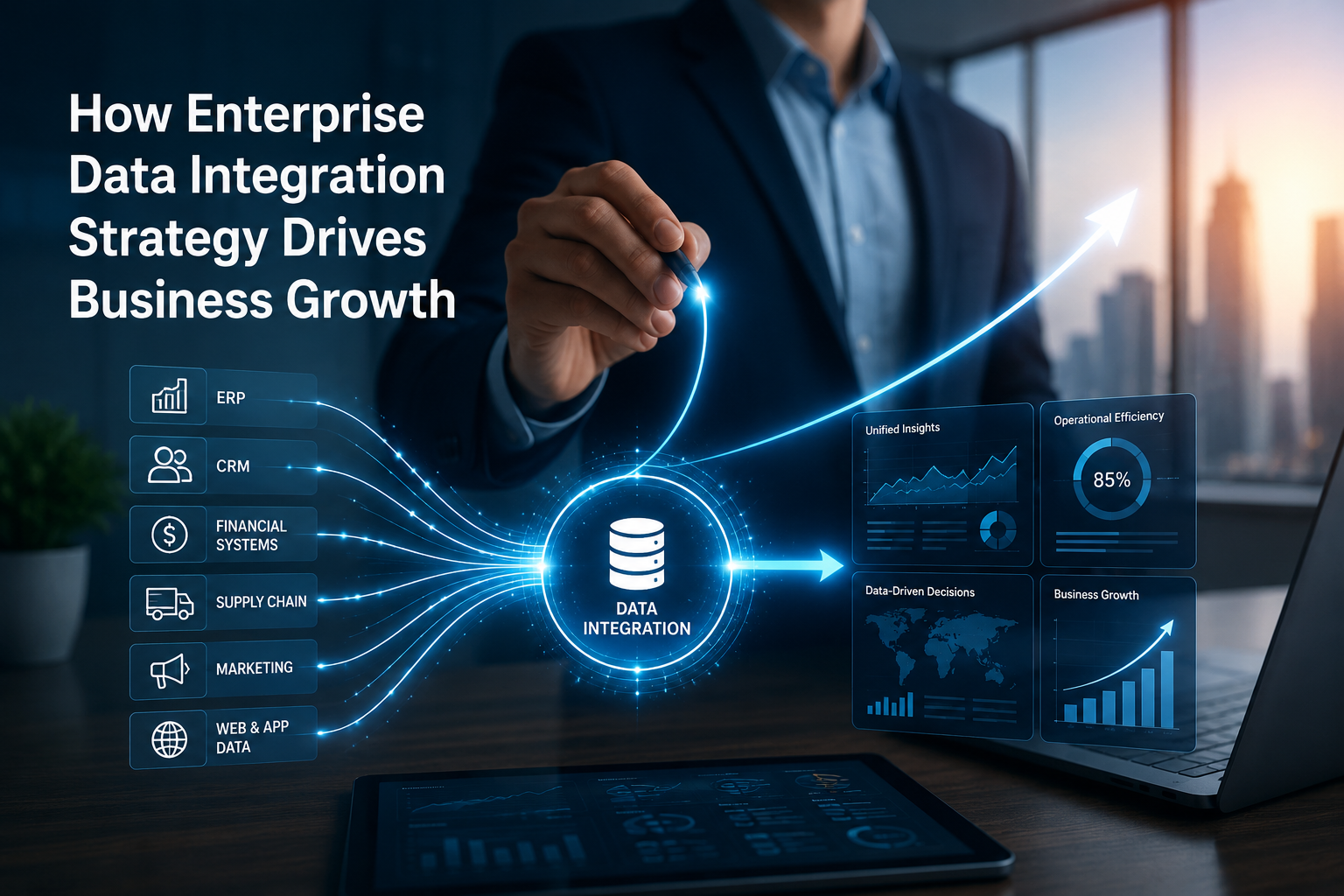
A customer-facing organization might prioritize integrating CRM, support ticketing, and behavioral analytics platforms to create a 360-degree customer view. A manufacturer might focus on connecting ERP, IoT sensor data, and logistics platforms to enable predictive maintenance and just-in-time supply chain operations.
In both cases, the integration architecture follows the business question, not the other way around. This business-first orientation also makes it much easier to justify investment in integration infrastructure, because the ROI can be expressed in concrete terms — reduced churn, faster order fulfillment, lower downtime — rather than abstract technical metrics.
Choosing the Right Tools for Your Integration Needs
The market for integration tools has expanded significantly. Organizations today can choose from traditional ETL platforms, modern ELT tools optimized for cloud data warehouses, iPaaS (integration platform as a service) solutions, and event streaming platforms like Apache Kafka.
The right choice depends on several factors: the latency requirements of the use case, the technical sophistication of the team, the existing vendor ecosystem, and the long-term scalability needs of the organization. There is no tool that wins every comparison — the best platforms are the ones that align with how your team actually works and what your data actually demands.
Regardless of which tools are selected, the underlying enterprise data integration strategy should remain vendor-agnostic at the design level. This prevents lock-in and preserves the flexibility to swap components as the technology landscape evolves.
Final Thoughts
Data integration is no longer a back-office IT function. It is a strategic capability that enables faster decisions, better customer experiences, and more resilient operations. Organizations that invest in a thoughtful enterprise data integration strategy — one grounded in governance, aligned to business goals, and built for change — are positioning themselves to extract lasting value from their data assets.
The path forward does not require a complete system overhaul. It starts with honest assessment of where integration friction is costing the business the most, a clear framework for addressing it, and the discipline to build incrementally rather than wait for a perfect solution that never arrives.

 English
 Arabic
 Français
 Español
 Deutsch
 Türkçe
 Dutch
Dutch
 Italiano
 Russian
 Romaian