


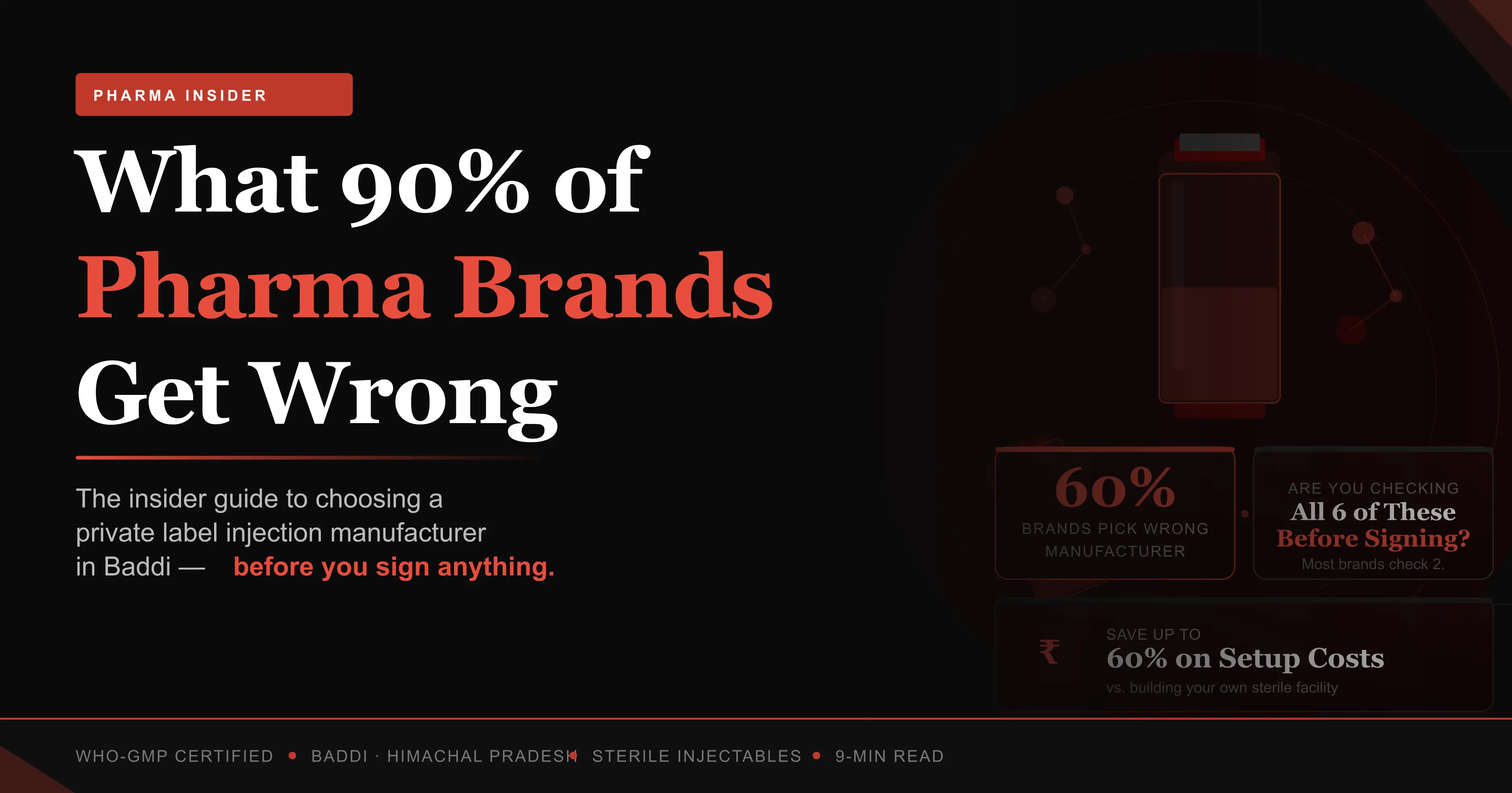
How to Choose the Right Private Label Injection Manufacturing Partner in Baddi — A Buyer’s Guide for Pharma Brands
Author: [Pharmaceutical Industry Expert | 12+ Years in Sterile Injectable Manufacturing]
Published: June 2026 | Reading Time: ~ 9 minutes
Category: Pharmaceutical Manufacturing | Contract & Private Label
Key Takeaway: Baddi (Himachal Pradesh) hosts over 600 licensed pharmaceutical units, making it Asia's largest drug-manufacturing cluster, but not every injection manufacturer here is built for private label partnerships. This guide tells you exactly what separates the best from the rest.
Why Baddi Has Become India's Injectable Manufacturing Capital
If you're a pharma brand evaluating where to source private label injectables, Baddi is not just an option; for most Indian businesses, it's the logical starting point.
Nestled in the Solan district of Himachal Pradesh, the Baddi-Barotiwala-Nalagarh (BBN) industrial zone generates roughly ₹12,000 crore+ in annual pharma output, a figure that has grown steadily year-on-year. The region earned its pharmaceutical dominance through a convergence of rare advantages:
-
Central excise benefits that significantly reduce finished goods costs
-
Proximity to raw material corridors running through Punjab and Haryana
-
A pool of 10,000+ trained pharmaceutical technicians concentrated within a 30-km radius
-
Direct connectivity to Chandigarh, Delhi, and Amritsar via NH-21
-
International testing labs including NABL-accredited facilities within the industrial belt
For a pharma brand looking to launch or scale injectable products without building its own sterile manufacturing facility, which typically requires ₹8–20 crore in infrastructure investment alone — partnering with a private label injection manufacturing company in Baddi cuts time-to-market by 30–60 days and startup capital by over 60%.
But the density of manufacturers also creates a genuine due-diligence challenge. Not every plant with a GMP certificate operates to the same standard, and in sterile injectable manufacturing, the margin for error is zero.
The 6 Non-Negotiables When Evaluating a Private Label Injectable Manufacturer
1. WHO-GMP Certification — Beyond the Certificate
A WHO-GMP certificate is the baseline, not the differentiator. What matters is how the facility lives its GMP compliance day-to-day.
Ask to see:
-
Batch Manufacturing Records (BMRs) from recent production runs
-
Environmental monitoring logs for cleanrooms (particulate counts, microbial data)
-
Annual Product Review (APR) reports — these reveal how consistent the manufacturer is across batches
A private label injection manufacturer in Baddi operating under genuine WHO-GMP + ISO 9001:2015 compliance should be able to share these without hesitation. If documentation requests are deflected, walk away.
Also verify DCGI (Drug Controller General of India) registration and state drug license from Himachal Pradesh FDA. For export-linked brands, check whether the facility holds WHO prequalification or any USFDA/EU-GMP compliance documentation.
2. Separate Cleanroom Zones — The Cross-Contamination Question
This is where many manufacturers in Baddi reveal their limitations. Not all injectables can be manufactured in the same room.
A compliant facility must maintain physically segregated manufacturing areas for:
|
Injectable Category |
Why Segregation Is Critical |
|
Beta-lactam antibiotics (Penicillin, Amoxicillin) |
Cross-contaminate easily; cause severe allergic reactions |
|
Hormonal injectables (Testosterone, progesterone, and Insulin analogs) |
Volatile at trace levels; endocrine disruption risk |
|
Oncology / Cytotoxic products |
Extremely toxic to operators and equipment |
|
Standard sterile injectables |
Liquid vials, dry powder, lyophilized products |
A top-tier private label hormonal injection manufacturer in Baddi will have a completely isolated hormonal unit with dedicated HVAC, personnel flow, and gowning rooms. Anything less is a regulatory red flag — and a liability for your brand.
When you conduct a facility audit (always audit in person, never just on paper), trace the production flow for a hormonal or antibiotic product from raw material entry to finished goods dispatch. The segregation should be physical, not just procedural.
3. Lyophilization (Freeze-Drying) Capability
Lyophilization, the process of freeze-drying liquid biologics and heat-sensitive drug substances into a stable powder form, is a specialized, capital-intensive capability that separates mid-tier manufacturers from premium ones.
If your product portfolio includes:
-
Protein-based injectables
-
Certain antibiotics (e.g., Amphotericin B, Vancomycin)
-
Vaccines or peptide drugs
-
Biologics requiring extended shelf life
...then your manufacturer must have a validated lyophilizer integrated into a Class 100 (ISO 5) cleanroom environment.
Private label dry powder injection manufacturing facilities that offer lyophilization typically invest ₹3–8 crore in equipment alone. This capability is not available at most small-to-mid-sized contract manufacturers in Baddi, shortlist only those who can demonstrate validated lyophilization cycles with existing product case studies.
4. Aseptic Filling Line Quality — The Heart of Sterile Manufacturing
The aseptic filling line is where contamination risk is highest and where equipment quality makes the biggest difference.
Look for:
-
Isolator-based or RABS (Restricted Access Barrier System) technology rather than older open-grade filling
-
High-speed automatic filling lines with in-line nitrogen purging (critical for oxygen-sensitive molecules)
-
100% leak testing equipment for vials post-fill
-
Automated visual inspection systems with validated rejection algorithms
A facility relying entirely on manual visual inspection or operating filling lines that are more than 10 years old without upgrades should be weighed carefully against newer alternatives.
The best injectable manufacturers in Himachal Pradesh have made substantial investments in equipment that reduces human intervention in the aseptic zone — because in sterile manufacturing, human hands are the primary contamination vector.
5. Financial Model Transparency
Private label manufacturing economics in Baddi vary considerably. Understanding the real cost structure before signing a toll agreement is critical.
Typical batch economics (2025–26):
|
Batch Type |
Approximate Minimum Batch Cost |
MOQ Range |
|
Liquid vials (standard antibiotics) |
₹50,000 – ₹150,000 |
5,000–10,000 units |
|
Dry powder vials (cephalosporins) |
₹80,000 – ₹250,000 |
3,000–8,000 units |
|
Lyophilized products |
₹200,000 – ₹800,000 |
1,000–5,000 units |
|
Hormonal injectables |
₹150,000 – ₹500,000 |
2,000–6,000 units |
Watch out for hidden cost structures:
-
Regulatory dossier preparation fees (ask upfront)
-
Stability study charges (ICH Q1A-compliant studies can take 6–12 months)
-
Artwork and master batch document revision fees
-
Post-approval change management fees
The best manufacturers in Baddi offer all-inclusive toll manufacturing quotes with itemized breakdowns. Demand this before signing.
6. Distribution Infrastructure and Cold Chain Competency
Your injected product is only as good as its delivery chain. Many brands overlook this at the partnership stage and face supply disruptions that cost them hospital or institution contracts.
Evaluate:
-
Whether the manufacturer has temperature-controlled (2–8°C) dispatch bays
-
Their pan-India logistics partners and typical transit timelines to major cities
-
Whether GPS-tracked cold chain shipments are available for biologics
-
Their track record for on-time delivery to institutional buyers (hospitals, nursing homes, government tenders)
A reliable private label injectable manufacturing company in Baddi should have established cold chain corridors to Delhi, Mumbai, Kolkata, Chennai, and Hyderabad, at minimum.
EEAT Corner: Understanding the Regulatory Framework (What Buyers Often Miss)
For brand owners who are new to injectable outsourcing, here is the regulatory reality:
To legitimately market private-label injectables in India, your entity must hold the following:
-
Wholesale Drug License (Form 21) — issued by your state drug licensing authority
-
GST Registration — mandatory for commercial pharma transactions
-
Loan License (Form 25) if you don't own the manufacturing facility but market the product under your brand
-
Drug Master File (DMF) or Technical Package — created by your manufacturer but required to be in your name or with your permission for the product
The manufacturer handles manufacturing license compliance; you are responsible for marketing authorization and pharmacovigilance for products bearing your brand name.
Under Schedule M of the Drugs and Cosmetics Act, 1940, both the manufacturer and the brand owner share accountability for product quality. This legal nuance makes choosing a compliant manufacturer a commercial and legal imperative — not just a quality preference.
What Makes a Private Label Partnership Different from Regular Third-Party Manufacturing
The terms are often used interchangeably in the Indian market, but there are meaningful differences:
|
Parameter |
Third-Party Manufacturing |
Private Label Manufacturing |
|
Product ownership |
The manufacturer retains formulation IP |
You own the brand and may hold formulation rights |
|
Branding flexibility |
Usually limited to your name on packaging |
Full branding, artwork, and pack design control |
|
Regulatory filings |
Often manufacturer-led |
Usually brand-owner-led with manufacturer support |
|
MOQ flexibility |
Often higher (volume-driven model) |
Often lower for niche or specialty products |
|
Customization |
Limited to available formulations |
Can include custom formulations or molecules |
For brands building a critical care injectable portfolio, private label manufacturing is almost always the better commercial model, because it protects brand equity, allows premium pricing, and establishes the foundation for eventual in-house manufacturing if the brand scales.
Questions to Ask During a Facility Audit (Checklist)
Use these during your in-person visit:
-
[ ] Can I see the environmental monitoring data for the last six months?
-
[ ] Is the hormonal/beta-lactam unit physically segregated from the general sterile area?
-
[ ] What is your average out-of-specification (OOS) rate per batch?
-
[ ] How do you handle batch failures — what is the recall and deviation procedure?
-
[ ] Can you provide three client references in my product category?
-
[ ] What is your average batch-to-dispatch lead time?
-
[ ] Do you have an in-house stability chamber, or do you outsource stability studies?
-
[ ] What change control process applies if I want to modify the formulation after the first batch?
-
[ ] Is your NABL-accredited lab available for third-party testing verification?
Any manufacturer who becomes evasive or defensive at these questions is not ready for a serious private label partnership.
Intelico Pharmaceuticals — A Credible Option in Baddi's Injectable Landscape
Among the licensed private label injection manufacturing companies in Baddi, Intelico Pharmaceuticals (Motia Plaza, Baddi, Solan – HP 173205) positions itself specifically for brands seeking WHO-GMP-certified sterile injectable manufacturing with access to lyophilization technology and dedicated hormonal production units.
Key attributes relevant to private label buyers:
-
WHO-GMP and ISO 9001:2015-certified sterile manufacturing facility
-
Dedicated hormonal injectable unit — physically separated from general sterile manufacturing
-
Lyophilization capability for freeze-dried injectable products
-
Starting batch economics from ₹50,000 — accessible for brands at early commercial stages
-
NABL-validated in-house QC laboratory with chromatographic testing capability
-
Pan-India distribution network with cold chain logistics support
-
Comprehensive product range: liquid vials, dry powder injectables, ampoules, prefilled syringes, oncology (anti-cancer) formulations
For pharma brands building critical care, anti-infective, or hormonal injectable portfolios, Intelico represents the type of manufacturer worth including in your shortlist — particularly given their focus on brands rather than institutional bulk supply.
📞 Contact: +91-9896868985
📍 Address: Showroom No. 6, Block B, Motia Plaza, Baddi, Solan (HP) 173205.
🌐 Website: www.intelicopharmaceuticals.com
Frequently Asked Questions
Q: Is it legally allowed to sell injectables under my brand name if I don't own a manufacturing plant?
Yes. Under India's Drugs and Cosmetics Act, you can market injectables under your brand via a loan license (Form 25), provided you hold a valid wholesale drug license and work with an appropriately licensed manufacturer.
Q: How long does it take to get the first batch from a new private label manufacturer in Baddi?
For existing formulations, 30–45 days (including batch documentation and quality release). For new or custom formulations, add 60–90 days for development and validation batches.
Q: Why do hormonal injectable manufacturers in Baddi charge a premium?
Hormonal compounds require dedicated, physically isolated manufacturing environments, specialized HVAC systems, and operators trained in working with endocrine-active substances. These facilities are expensive to build and maintain — the premium reflects that infrastructure investment.
Q: What is the difference between a lyophilized injection and a dry powder injection?
A dry powder injection is simply a sterile powder filled under aseptic conditions (e.g., reconstituted cephalosporins). Lyophilized injections go through a freeze-drying cycle that stabilizes heat-sensitive or moisture-sensitive molecules — it requires a lyophilizer, which is significantly more capital-intensive equipment.
Q: Can a startup pharma brand work with WHO-GMP manufacturers in Baddi, or is it only for large companies?
Baddi's private label ecosystem is specifically suited to small and mid-size brands. Most manufacturers offer flexible MOQs starting from 3,000–5,000 vials per batch, making entry-level commercialization viable without large upfront commitments.
Final Word: Due Diligence Is the Real Competitive Advantage
In Baddi's crowded injectable manufacturing market, the brands that win long-term are not necessarily those who find the cheapest manufacturer — they're the ones who do rigorous, in-person due diligence and build partnerships with manufacturers whose quality systems, technical capability, and business transparency align with their brand's standards.
The checklist in this guide gives you a structured framework. Use it. Visit at least two or three facilities before committing. Ask the hard questions. And prioritize manufacturers who answer them directly.
Your brand's reputation, ultimately, rests on every vial that goes out under your label.
This article is intended for pharmaceutical business owners, brand managers, and healthcare entrepreneurs evaluating contract injectable manufacturing partnerships in India. For regulatory advice specific to your product or license situation, consult a qualified pharma regulatory consultant or drug licensing authority.
Related Resources:
 Deutsch
 English
 Arabic
 Français
 Español
 Português
 Türkçe
 Dutch
Dutch
 Italiano
 Russian
 Romaian