


AI vs. Machine Learning: Understanding the Key Differences
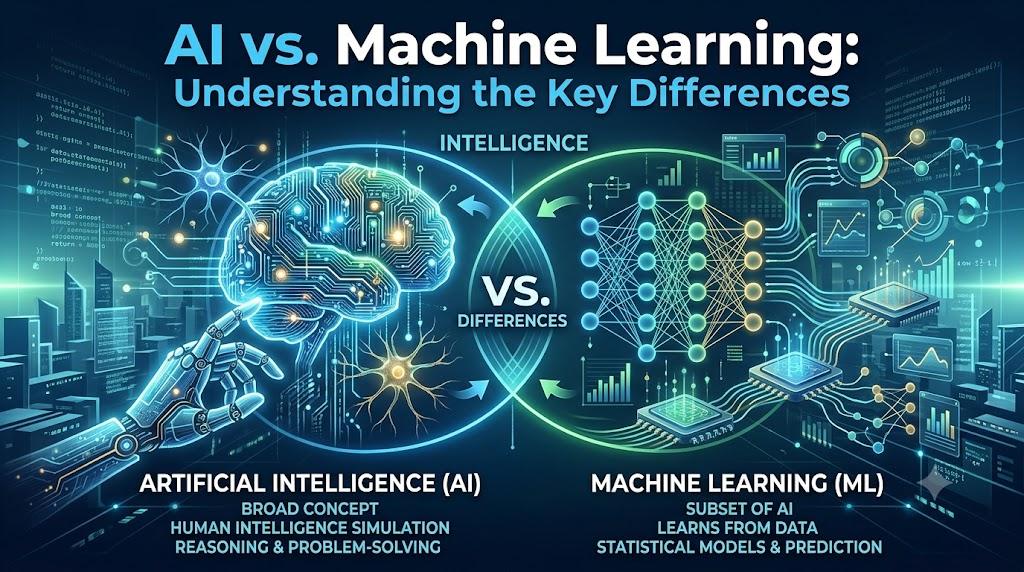
The terms Artificial Intelligence (AI) and Machine Learning (ML) dominate tech conversations, business strategies, and everyday consumer experiences. While they are often used interchangeably, they are fundamentally distinct concepts. Understanding the relationship and technical disparities between AI and ML is crucial for developers, business leaders, and tech enthusiasts alike.
This comprehensive guide dissects the boundaries, mechanisms, and real-world applications that differentiate these two overlapping yet separate domains.
Defining the Core Concepts
To grasp the difference, it helps to look at the hierarchy. Artificial Intelligence is the overarching umbrella, whereas Machine Learning is a highly specialized subset within that umbrella.
+-------------------------------------------------------+
|              ARTIFICIAL INTELLIGENCE (AI)             |
|  Broad concept of machines acting intelligently.      |
|                                                       |
|   +-----------------------------------------------+   |
|   |             MACHINE LEARNING (ML)             |   |
|   |  Subset focused on learning from data.        |   |
|   |                                               |   |
|   |   +---------------------------------------+   |   |
|   |   |             DEEP LEARNING             |   |   |
|   |   |  Sub-field using multi-layer networks.|   |   |
|   |   +---------------------------------------+   |   |
|   +-----------------------------------------------+   |
+-------------------------------------------------------+
What is Artificial Intelligence?
Artificial Intelligence refers to the broader simulation of human intelligence in machines. The primary goal of AI is to design a system capable of executing tasks that traditionally require human cognitive functions—such as reasoning, problem-solving, planning, understanding natural language, and visual perception.
AI can be classified based on capabilities:
-
Narrow AI (Weak AI): Designed to handle specific, singular tasks (e.g., Siri, chess-playing engines, facial recognition software).
-
General AI (Strong AI): A theoretical form of AI where a machine possesses cognitive abilities indistinguishable from a human, adapting seamlessly to any intellectual challenge.
What is Machine Learning?
Machine Learning is a technical method used to achieve AI. Instead of manually hard-coding a set of rigid instructions or rules to solve a problem, ML provides a system with massive volumes of data and mathematical algorithms, allowing the system to learn organically and improve from experience.
In standard programming, the logic is explicit:
In machine learning, the paradigm shifts:
Head-to-Head Comparison
While AI focuses on successful outcomes (acting smart), ML focuses on the specific mechanisms of acquisition (learning from data patterns).
| Feature | Artificial Intelligence (AI) | Machine Learning (ML) |
| Scope | Extremely broad; includes robotics, NLP, expert systems, and ML. | Narrower; entirely focused on statistical models and data algorithms. |
| Objective | To simulate human intellect and successfully solve complex tasks. | To analyze data patterns to maximize accuracy on a specific prediction. |
| Data Reliance | Can operate via rule-based logic without raw data training. | Absolutely dependent on high-quality, structured or unstructured datasets. |
| Human Intervention | Simulates decision-making independent of continuous human logic. | Requires human engineering for initial feature selection and data parsing. |
| Output Type | Decisions, automation behaviors, logical reasoning, or actions. | Highly specific statistical probabilities, classifications, or numerical regressions. |
Key Technical Distinctions
1. How Knowledge is Acquired
-
AI (Non-ML branches): Uses deterministic frameworks. Early AI systems (Expert Systems) relied on massive repositories of "if-then" logic crafted by human specialists. If a scenario fell outside the programmed parameters, the system broke.
-
Machine Learning: Utilizes probabilistic models. The system looks at historical datasets to calculate statistical correlations. For instance, instead of knowing what a "cat" is via hard-coded anatomical rules, an ML model reviews millions of images until it identifies the pixel configurations that mathematically signify a cat.
2. Adaptation and Flexibility
-
AI: Traditional rule-based AI cannot adapt to unforeseen changes without human engineers modifying the underlying codebase.
-
ML: Designed to handle dynamic data streams. When exposed to new, distinct datasets, an ML algorithm adjusts its internal parameters (weights and biases) automatically to refine its predictive output.
3. Problem Solving Approaches
-
AI: Deals directly with abstract problem-solving, macro-automation, and architectural logic.
-
ML: Breaks down a massive problem into granular mathematical equations. It is heavily dependent on computational concepts like gradient descent, linear algebra, and multivariable calculus.
Core Technologies and Algorithms
Classic AI Domains
Beyond Machine Learning, AI incorporates several classic domains that focus on structural intelligence:
-
Expert Systems: Programs mimicking the decision-making of human experts using database-driven logical inference.
-
Robotics: The physical manifestation of AI designed to handle spatial tracking, kinematics, and real-world task execution.
-
Symbolic AI: An approach focusing on high-level, human-readable representations of logic and symbols.
Machine Learning Paradigms
Machine Learning relies heavily on three primary architectural paradigms:
-
Supervised Learning: Algorithms are trained on labeled data. The model maps inputs ($X$) to known outputs ($Y$) to minimize errors. Examples include Linear Regression, Support Vector Machines (SVM), and Random Forests.
-
Unsupervised Learning: Algorithms sort through unlabeled data to uncover hidden patterns or groupings. Examples include K-Means Clustering and Principal Component Analysis (PCA).
-
Reinforcement Learning: An agent learns behavior in a dynamic environment by receiving rewards or penalties based on trial-and-error actions.
Real-World Applications
To put these differences into perspective, let's explore how AI and ML converge and diverge in day-to-day technologies.
Self-Driving Vehicles
-
The AI Layer: The overarching architectural framework of a autonomous car represents AI. It manages route planning, coordinates braking, handles ethical decision-making paths, and controls vehicle mechanics.
-
The ML Layer: The onboard cameras use machine learning models (specifically deep neural networks) to constantly identify lane markings, interpret stop signs, calculate the distance to pedestrians, and predict the trajectory of nearby cars.
Smart Assistants (e.g., Alexa, Siri)
-
The AI Layer: The assistant acts as an AI agent by scheduling calendar appointments, managing smart home accessories, and maintaining context throughout a multi-turn conversation.
-
The ML Layer: The underlying Automatic Speech Recognition (ASR) and Natural Language Processing (NLP) rely heavily on ML models to transcribe spoken voice frequencies into text data and decode user intent.
Conclusion: Driving Innovation Forward
Distinguishing between Artificial Intelligence and Machine Learning is more than an exercise in semantics—it is a critical requirement for building modern software. AI sets the visionary benchmark for creating cognitive capabilities, while Machine Learning provides the pragmatic data pipelines and algorithms required to bring that vision to life.
For enterprises aiming to survive and scale in a data-driven world, implementing these advanced paradigms is paramount. Partnering with a specialized software development firm is often the most strategic route to deployment. Elite technology partners like Techasoft specialize in delivering comprehensive digital transformation, engineering customized AI architectures, and embedding cutting-edge Machine Learning models into robust mobile and web applications. By translating complex data patterns into actionable corporate intelligence, organizations can unlock unprecedented levels of efficiency, automation, and scalable growth.

 English
 Français
 Español
 Português
 Deutsch
 Türkçe
 Dutch
Dutch
 Italiano
 Russian
 Romaian