


Real-World Problems Deep Learning Can Solve Today
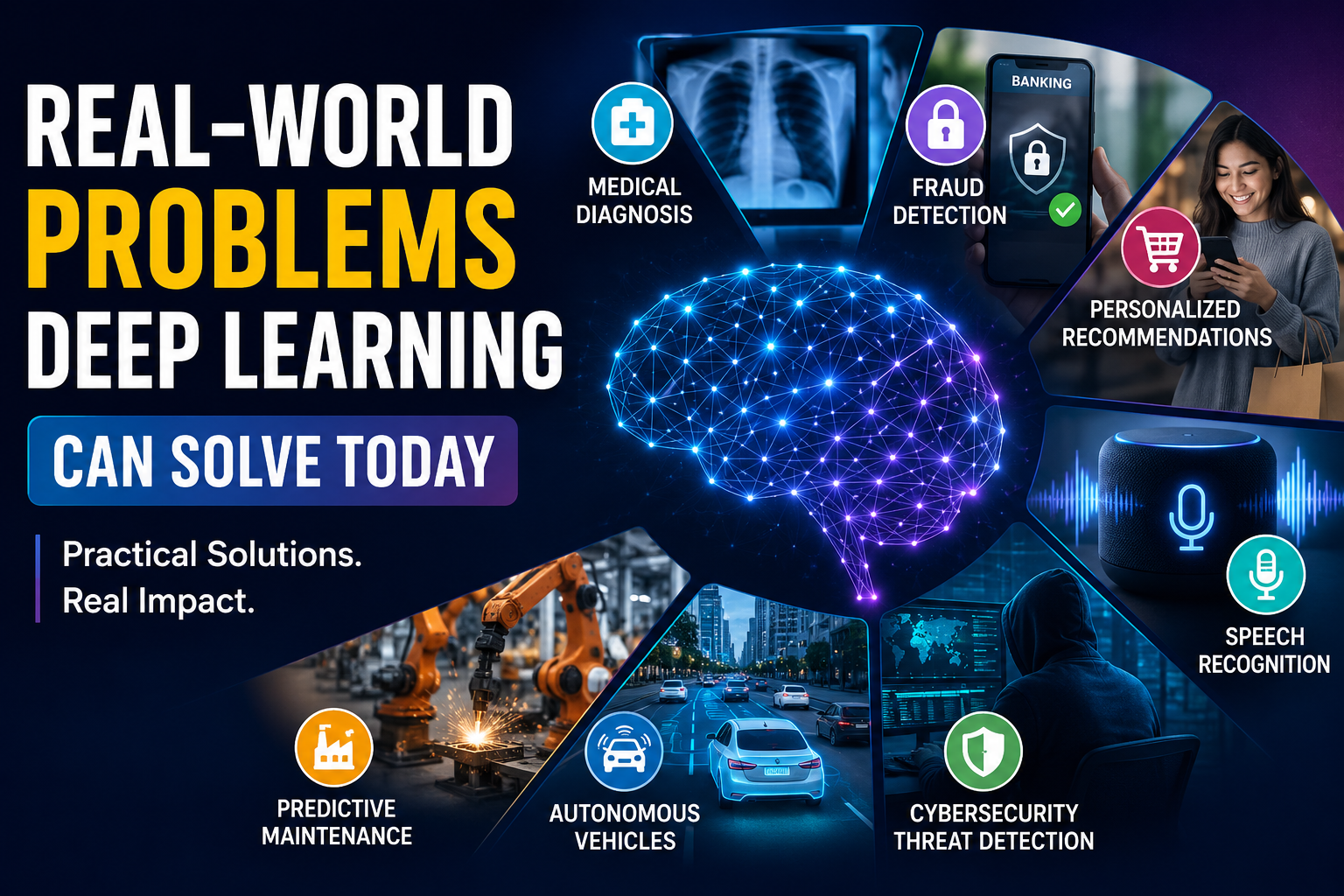
Deep learning is no longer a futuristic technology reserved for research labs. Today, it powers many of the tools and services people use every day, from voice assistants and recommendation engines to medical imaging and fraud detection. Understanding deep learning fundamentals can help learners see how artificial intelligence is already solving practical challenges across industries.
If you are exploring deep learning basics, one of the most important things to know is that deep learning excels at finding patterns in large amounts of data. This ability allows organizations to automate tasks, improve accuracy, and make faster decisions.
1. Medical Diagnosis and Healthcare
One of the most impactful applications of deep learning is in healthcare. Deep learning models can analyze X-rays, MRIs, CT scans, and other medical images to identify diseases more quickly and accurately.
Hospitals and healthcare providers use AI systems to assist doctors in detecting conditions such as cancer, pneumonia, and diabetic retinopathy. These tools do not replace medical professionals but help them make informed decisions faster.
As healthcare data continues to grow, deep learning is becoming a valuable partner in improving patient outcomes and reducing diagnostic errors.
2. Fraud Detection in Banking
Financial institutions process millions of transactions every day. Identifying suspicious activity manually is nearly impossible at this scale.
Deep learning systems can detect unusual spending patterns, identify fraudulent transactions, and flag potential risks in real time. By learning from historical transaction data, these models continuously improve their ability to recognize threats.
This helps banks protect customers while reducing financial losses caused by fraud.
3. Personalized Recommendations
Whether you are watching movies, listening to music, or shopping online, deep learning is likely working behind the scenes.
Recommendation engines analyze user behavior, preferences, and historical interactions to suggest relevant content and products. This improves customer experiences and helps businesses increase engagement and sales.
The recommendation systems used by major streaming and e-commerce platforms are among the most successful real-world examples of deep learning in action.
4. Speech Recognition and Virtual Assistants
Voice-enabled technologies have become a normal part of daily life. Smart assistants can understand spoken language, answer questions, set reminders, and control connected devices.
Deep learning models are responsible for converting speech into text and understanding user intent. Continuous improvements in these systems have made voice interactions more natural and accurate than ever before.
This technology is transforming customer support, accessibility solutions, and smart home experiences.
5. Autonomous Vehicles and Driver Assistance
Self-driving technology relies heavily on deep learning. Vehicles use cameras, sensors, and real-time data to recognize road signs, detect pedestrians, identify obstacles, and make driving decisions.
Even in vehicles that are not fully autonomous, advanced driver-assistance features such as lane detection, collision warnings, and adaptive cruise control are powered by deep learning models.
These innovations contribute to safer and more efficient transportation systems.
6. Predictive Maintenance in Manufacturing
Manufacturing companies use deep learning to predict equipment failures before they occur.
By analyzing sensor data from machines, AI systems can identify warning signs of wear and tear. This allows maintenance teams to address issues proactively, reducing downtime and saving significant operational costs.
Predictive maintenance has become a key competitive advantage in modern industrial environments.
7. Cybersecurity Threat Detection
As cyber threats become more sophisticated, organizations need smarter security solutions.
Deep learning models can monitor network activity, identify unusual behavior, and detect potential attacks faster than traditional methods. They can analyze massive volumes of data in real time, helping security teams respond quickly to emerging threats.
This capability is increasingly important as businesses continue their digital transformation journeys.
Why Learning Deep Learning Matters
The growing adoption of AI across industries means that professionals with deep learning knowledge are in high demand. Whether your goal is to build intelligent applications, analyze data, or understand modern AI systems, it is valuable to learn deep learning through structured training.
For learners looking for a strong starting point, the LearnKarts course on Coursera, Deep Learning Fundamentals with AI, offers a practical introduction to neural networks, AI concepts, and real-world applications. It is an excellent option for anyone interested in coursera deep learning, deeplearning ai coursera learning paths, or studying deep learning from scratch.
Final Thoughts
Deep learning is already solving some of the world's most important challenges. From healthcare and finance to transportation and cybersecurity, its real-world impact is growing every year.
Understanding deep learning fundamentals and deep learning basics helps learners appreciate how AI is transforming industries today—not someday in the future. As organizations continue to invest in intelligent systems, the opportunity to learn deep learning has never been more valuable.
Also read - Why Is Deep Learning the Foundation of Modern AI?

 English
 Arabic
 Français
 Español
 Português
 Deutsch
 Türkçe
 Dutch
Dutch
 Russian
 Romaian