


Learning Through Play: Sorting & Sequencing – Aligning Fun & Learning
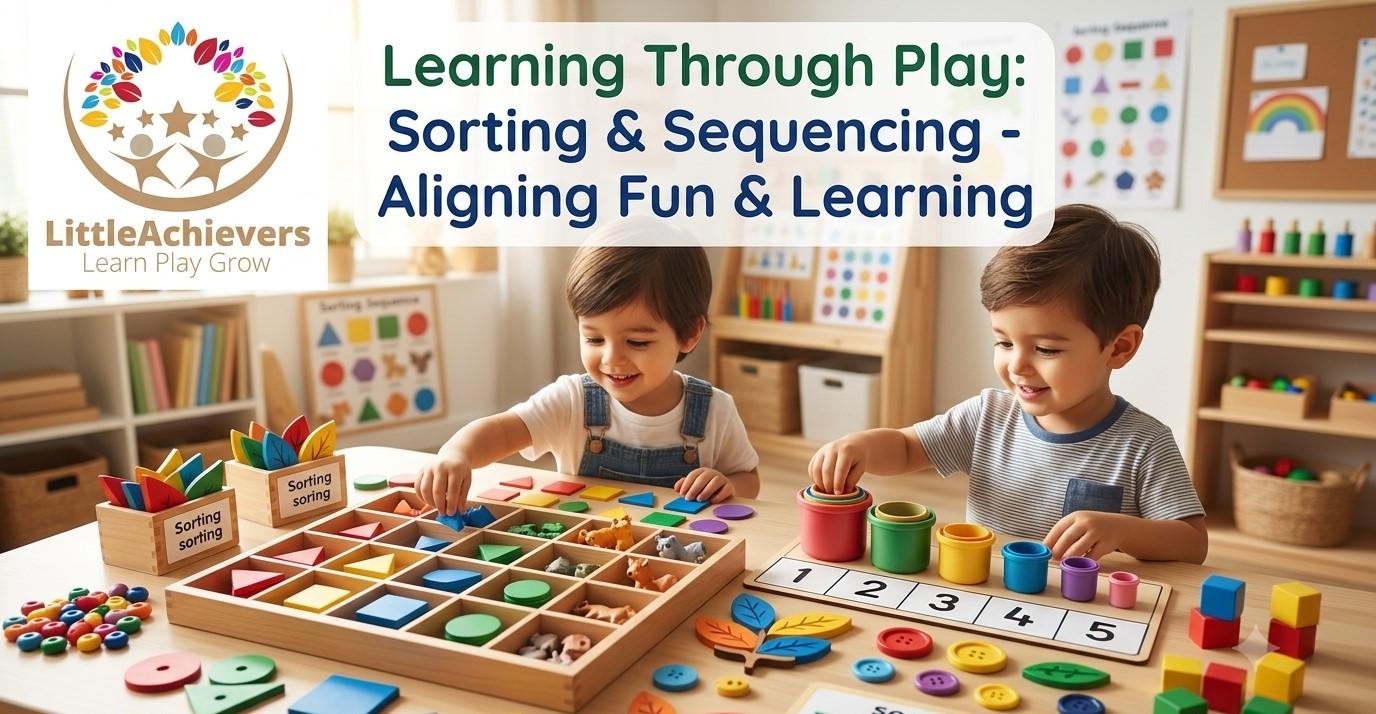
Children learn an immense amount when they are happy, interested and having a good time. This principle, called play-based learning, is a huge part of contemporary early education centre.
Sorting and sequencing are easily some of the simplest, most important types of child development and learning game formats accessible to any of the number of assorted types of child-oriented modern games ready for our playroom for today.
In an early childhood development centre, instructors play games involving sorted and sequenced items daily with young children. They will naturally and playfully encourage children to participate in sorting and sequencing games by blending play with planned instruction; children start laying the groundwork for later school years.
Understanding Sorting and Sequencing
Sorting means placing similar objects together – anything from sorting by colour, shape, size, texture or purpose. Sequencing simply implies arranging a group of things or items in a defined order.
For example, arranging objects from smallest to largest or placing tasks in order from most to least important (usually chronologically). When your child learns these things, he learns how to see similarities and differences and look for patterns and relationships between events and objects.
Instead of sitting down to do a worksheet or being taught by a more adult-focused centre, in a play-based environment, your child will gain experience with sorting and sequencing more organically.
Why Sorting and Sequencing Matter
Such activities serve development in numerous areas at the same time. For example:
- Cognitive Development
The process of sorting objects promotes closer examination, comparison, classification and choice-making skills. Sequencing games develop higher-order cognitive skills that teach cause-and-effect reasoning.
For instance, sequencing picture cards to show the stages of seed planting helps the child understand sequence, order and a logical connection between one event and the next. Through these kinds of activities, the child is sharpening his critical-thinking ability, which is crucial for later reading, writing and mathematical learning.
- Early Mathematical Skills
Learning these concepts is critical for future development, providing the basic mathematical skills of classifying, pattern, measurement, and order. By engaging in these simple, tactile activities in early learning settings, children will quickly gain an intuitive grasp of these key mathematical concepts through manipulating counters, beads, blocks, or even natural objects found outdoors. The more children get to handle these objects, the more sense mathematical concepts make.
- Language Development
Conversation is also an integral component of both sequencing and sorting learning activities. Through the use of sorting activities, children discover a variety of new words as they name objects and discuss patterns and attributes. Sorting activities help develop an array of words for the new vocabulary, including 'first', 'next', 'after', 'before', 'last', 'same' and 'different'.
Children debate why they have chosen to sort items into different groups. This also contributes to the enhancement & development of a child’s ability to use language & build his confidence in expressing his views, as well as the build-up of his overall confidence.
Learning Through Play
Play is natural for kids – it makes sense for their bodies and minds to explore the world and its ideas in a safe and exciting way. They normally are not about the final product but about the actual process of creation. Children learn things best through exploration.
Playing games like sorting animal figures (by habitat, by number of legs, by size, etc.), ordering story pictures (and tell-a-story), and classifying the leaves they find during outside play makes learning fun.
While a traditional learning centre activity can use these materials to teach a similar lesson, a play-based classroom will allow much more creativity, exploration, and student-initiated activity.
Everyday Sorting and Sequencing Activities
Parents and educators help with learning using simple practices to weave into everyday life.
Some examples include:
- Sorting laundry by colour or size
- Organising toys into categories
- Arranging books by height
- Creating patterns with blocks or beads
- Sequencing steps in a recipe
- Retelling stories in the correct order
- Organising daily routines from morning to bedtime
They are experiences that assist our children in seeing learning exists all around us and not just within classroom walls. When parents are searching for top-quality child care Mount Druitt, providers look for the care services; they might include the above-mentioned real and tangible learning experiences as part of their daily programs.
Young children are more eager to learn, more captivated, and less inclined to remember new ideas when they do this through genuine, real, and tangible interaction.
Building Confidence and Independence
Sorting and sequencing games help kids feel confident in their skills. They’ll feel capable as they get on top of things on their own. Some games can foster group work, and this may have youngsters collaborating and collaborating with each other. This supports the growth of social skills like resilience, co-operation, perseverance, and also communication.
Several different games, as well as various other activities, will have a chance to aid your little kids in producing a few abilities in some social aspects as well as their way of self-sharing aid to their growth as they're developing on the planet like that!
A quality early education centre knows childcare isn’t regarding learning maths, literacy, or numeracy; it’s regarding making the child build up confidence in his/her capabilities and the level of resilience and an awareness for curiosity as well as for life.
Creating a Strong Foundation for Future Success
This helps children build their pre-read and pre-math skills. A child who is able to see patterns and sequence information is more ready for the more academic concepts, as children progress in school.
They become engaged learners as they associate play with a joy of discovery; learning does not have to be hard. This is actually quite crucial and significant that they can utilise their students' abilities to create special and valuable experiences.

 English
 Français
 Español
 Português
 Deutsch
 Türkçe
 Dutch
Dutch
 Italiano
 Russian
 Romaian