


Integration Testing: A Comprehensive Guide for Building Reliable Software Systems
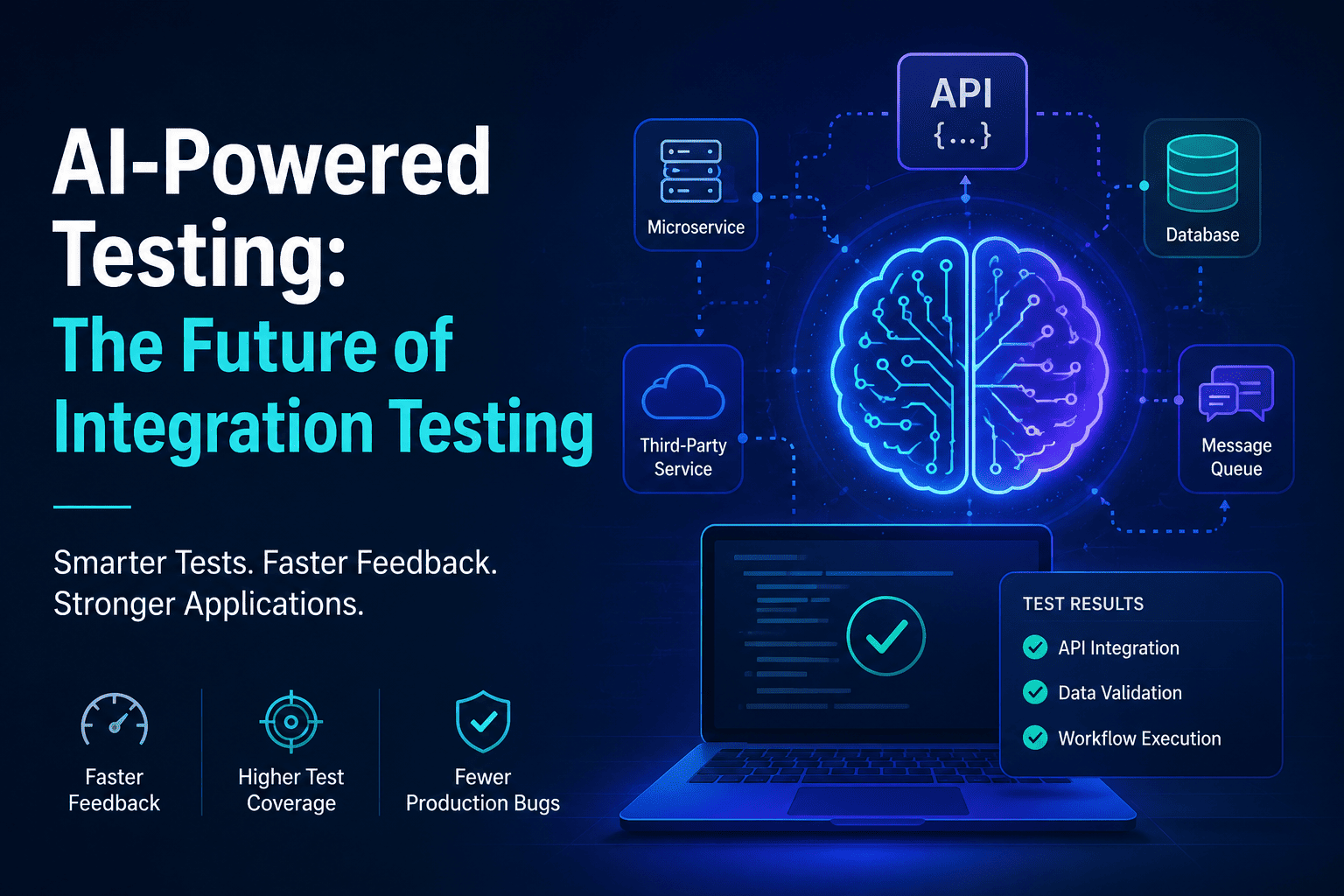
Modern software applications rarely operate as a single, isolated component. Instead, they consist of multiple services, APIs, databases, third-party integrations, and microservices working together to deliver functionality. While unit tests verify individual components, they cannot guarantee that these components interact correctly with one another. This is where integration testing becomes essential.
Integration testing helps development teams verify that different parts of an application communicate properly and function as expected when combined. It serves as a critical bridge between unit testing and end-to-end testing, ensuring that interconnected systems work together before software reaches production.
In this article, we'll explore what integration testing is, why it matters, common approaches, best practices, and how modern tools help automate the process.
What Is Integration Testing?
Integration testing is a software testing technique that validates the interactions between individual modules, services, or components of an application.
Rather than testing a single function in isolation, integration tests focus on verifying that:
-
APIs communicate correctly
-
Databases return expected data
-
Services exchange information properly
-
External systems behave as anticipated
-
Business workflows function across multiple components
The primary goal is to identify defects that occur when different modules are integrated.
For example, an e-commerce application may have separate components for user authentication, inventory management, payment processing, and order fulfillment. Integration testing ensures that these components work together seamlessly throughout the purchasing process.
Why Integration Testing Is Important
Many software failures occur not because individual components are broken, but because they fail to communicate properly.
Integration testing helps organizations:
Detect Interface Defects Early
Issues often arise when data is passed between systems. Integration testing identifies these problems before production deployment.
Improve Software Reliability
Validating interactions between components reduces unexpected failures.
Support Agile Development
As applications evolve, integration testing ensures new changes do not disrupt existing functionality.
Reduce Production Risks
Early detection of integration issues minimizes costly post-release fixes.
Increase Deployment Confidence
Teams can release software more frequently when integrations are thoroughly tested.
Integration Testing vs Unit Testing
Although both testing methods are essential, they serve different purposes.
Unit Testing
Unit tests focus on individual functions, classes, or methods in isolation.
Characteristics:
-
Fast execution
-
Limited dependencies
-
Developer-focused
-
Tests small code units
Integration Testing
Integration tests verify interactions between multiple components.
Characteristics:
-
Broader scope
-
Involves real dependencies
-
Validates communication paths
-
Detects integration-related defects
Both testing types complement each other and should be part of a comprehensive testing strategy.
Types of Integration Testing
There are several approaches to integration testing depending on project requirements.
1. Big Bang Integration Testing
In this approach, all modules are integrated simultaneously and tested as a complete system.
Advantages:
-
Simple setup
-
Suitable for smaller projects
Disadvantages:
-
Difficult debugging
-
Late defect discovery
2. Top-Down Integration Testing
Testing begins with higher-level modules while lower-level components are replaced using stubs.
Advantages:
-
Early validation of core workflows
-
High-level logic tested first
Disadvantages:
-
Requires stub creation
-
Lower modules tested later
3. Bottom-Up Integration Testing
Lower-level components are tested first, using drivers to simulate higher-level functionality.
Advantages:
-
Strong validation of foundational services
-
Easier defect isolation
Disadvantages:
-
User-facing workflows tested later
4. Sandwich (Hybrid) Integration Testing
This method combines top-down and bottom-up approaches.
Advantages:
-
Balanced testing strategy
-
Faster defect identification
Disadvantages:
-
More complex implementation
Common Integration Testing Scenarios
Integration testing is applicable across many software architectures.
API Testing
Verify that API endpoints communicate correctly and return expected responses.
Database Integration
Ensure application services can read, write, and update database records properly.
Third-Party Service Integration
Validate interactions with payment gateways, authentication providers, and external APIs.
Microservices Communication
Test message passing and data consistency between distributed services.
Event-Driven Systems
Verify event publishing and consumption across system components.
Challenges in Integration Testing
Despite its benefits, integration testing introduces unique challenges.
Environment Complexity
Multiple services and dependencies must be configured correctly.
Test Data Management
Maintaining realistic and consistent test data can be difficult.
External Dependencies
Third-party systems may be unavailable or produce unpredictable results.
Longer Execution Times
Integration tests often take longer than unit tests.
Flaky Tests
Network delays and infrastructure instability can create inconsistent results.
Organizations must adopt effective testing strategies to overcome these challenges.
Best Practices for Integration Testing
Test Early and Frequently
Run integration tests continuously throughout development.
Automate Testing
Automated integration testing improves consistency and reduces manual effort.
Use Realistic Data
Test scenarios should reflect actual user behavior and business processes.
Isolate Test Environments
Dedicated testing environments reduce interference from unrelated changes.
Monitor Test Coverage
Ensure critical communication paths are adequately tested.
Include Negative Scenarios
Validate how systems behave when dependencies fail or return unexpected data.
Integration Testing in CI/CD Pipelines
Modern DevOps teams integrate testing directly into continuous integration and deployment workflows.
Benefits include:
-
Faster feedback loops
-
Earlier defect detection
-
Improved software quality
-
Reduced release risks
-
Greater deployment confidence
A typical CI/CD workflow may include:
-
Code Commit
-
Unit Testing
-
Integration Testing
-
Regression Testing
-
Deployment Validation
-
Production Release
This automated process helps maintain software reliability even as applications evolve rapidly.
How Keploy Simplifies Integration Testing
One of the biggest challenges in integration testing is creating and maintaining test cases.
Keploy addresses this challenge by automatically generating test cases from real application traffic. Instead of manually writing extensive integration tests, developers can capture actual API interactions and replay them during testing.
Key benefits include:
-
Automatic test generation
-
Reduced manual effort
-
Faster regression testing
-
Improved API validation
-
Seamless CI/CD integration
By leveraging real-world traffic patterns, Keploy helps teams create more accurate integration tests while accelerating development workflows.
Integration Testing in Microservices Architectures
As organizations increasingly adopt microservices, integration testing becomes even more important.
Microservices introduce challenges such as:
-
Network communication failures
-
Service dependencies
-
Data consistency issues
-
Version compatibility concerns
Effective integration testing ensures that distributed services continue functioning correctly as systems grow in complexity.
Common strategies include:
-
Contract testing
-
API testing
-
Service virtualization
-
End-to-end workflow validation
Combining these techniques improves confidence in microservices-based applications.
The Future of Integration Testing
The testing landscape continues to evolve with advancements in automation and AI.
Emerging trends include:
-
AI-assisted test generation
-
Continuous testing platforms
-
Shift-left testing practices
-
Cloud-native testing environments
-
Automated service mocking
Organizations embracing these innovations can reduce testing overhead while increasing software quality.
Conclusion
Integration testing plays a crucial role in modern software development by ensuring that different application components work together as intended. It helps teams detect communication issues, improve reliability, and reduce production risks before software reaches end users.
Whether you're working with APIs, databases, microservices, or third-party services, a robust integration testing strategy is essential for delivering high-quality applications. Combined with automation tools like Keploy, development teams can streamline testing workflows, improve coverage, and release software with greater confidence.

 English
 Arabic
 Français
 Español
 Português
 Deutsch
 Türkçe
 Dutch
Dutch
 Italiano
 Romaian