


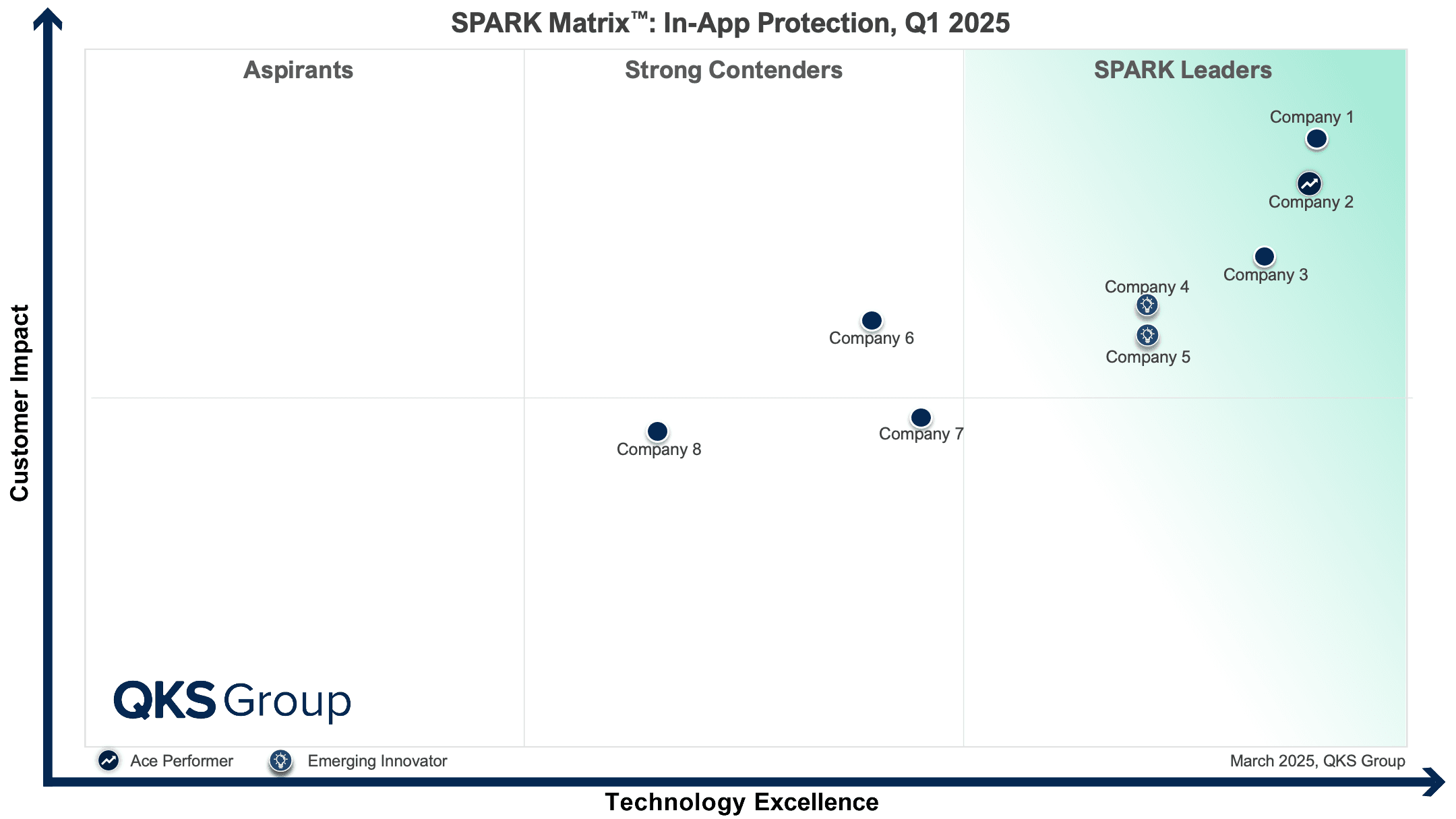
SPARK Matrix™: In-App Protection
The global In-App Protection market is rapidly evolving as organizations prioritize application-level security in an increasingly complex digital ecosystem. According to research by QKS Group, the market is witnessing significant growth driven by emerging cyber threats, evolving regulatory frameworks, and the rising adoption of mobile and web applications.
This blog explores In-App Protection market trends, growth drivers, technology innovations, and vendor landscape, helping technology vendors and enterprises make informed strategic decisions.
What is In-App Protection?
In-App Protection is a proactive cybersecurity approach that integrates advanced security mechanisms directly into the application during the software development lifecycle (SDLC). Unlike traditional perimeter-based security, it safeguards applications from within.
It protects against:
- Runtime attacks
- Reverse engineering
- Unauthorized access
- Code tampering and exploitation
By embedding protection into the app itself, organizations ensure resilience even in untrusted or compromised environments.
Key In-App Protection Market Trends
1. Shift Toward Runtime Application Self-Protection (RASP)
One of the most significant trends is the adoption of Runtime Application Self-Protection (RASP). This technology enables real-time threat detection and mitigation within applications without relying on external tools.
2. Growing Demand for Mobile App Security
With mobile apps becoming central to business operations, companies are investing heavily in mobile app shielding, anti-tampering, and anti-debugging technologies.
3. Integration with DevSecOps
Modern enterprises are integrating In-App Protection into DevSecOps pipelines, ensuring security is embedded from development to deployment.
4. Rise of AI-Driven Threat Detection
Artificial Intelligence and Machine Learning are being used to detect anomalies, predict threats, and automate responses within applications.
5. Increased Focus on Data Privacy Compliance
Global regulations like GDPR and regional data protection laws are pushing organizations to adopt robust application-level security frameworks.
Market Growth Drivers
Several factors are accelerating the adoption of In-App Protection solutions:
- Increase in sophisticated cyberattacks targeting applications
- Expansion of digital transformation initiatives
- Growing use of APIs and microservices architectures
- Demand for secure digital customer experiences
- Regulatory compliance requirements
Competitive Landscape: SPARK Matrix Analysis
The research includes a detailed evaluation of leading vendors using the SPARK Matrix, a proprietary framework that assesses vendors based on technology excellence and customer impact.
Leading In-App Protection Vendors: Appdome, Build38, Digital.ai, Guardsquare, OneSpan, Promon, Verimatrix, and Zimperium.
These vendors are shaping the competitive landscape by offering innovative solutions such as code obfuscation, runtime monitoring, encryption, and threat intelligence integration.
Technology Innovations in In-App Protection
The market is seeing continuous innovation in the following areas:
- Code Obfuscation & Encryption – Protects intellectual property and prevents reverse engineering
- Anti-Tampering Mechanisms – Detects and prevents unauthorized code modifications
- Secure App Shielding – Adds multiple layers of defense within applications
- Behavioral Analytics – Monitors user and app behavior for anomaly detection
- Zero Trust Application Security – Ensures continuous verification within applications
Future Outlook of the In-App Protection Market
The future of the In-App Protection market looks promising, with strong growth expected over the next few years. Key predictions include:
- Wider adoption across industries such as banking, healthcare, retail, and fintech
- Increased integration with cloud-native and containerized environments
- Expansion of AI-driven and automated security frameworks
- Growing importance of user-centric security models
Organizations will increasingly prioritize application-layer security as cyber threats become more sophisticated and targeted.
Why In-App Protection Matters for Businesses
Implementing In-App Protection solutions enables organizations to:
- Strengthen application security posture
- Protect sensitive user and business data
- Reduce risk of breaches and financial losses
- Enhance customer trust and brand reputation
- Ensure compliance with global security standards
Conclusion
The In-App Protection market is becoming a critical component of modern cybersecurity strategies. As applications remain a primary target for cyberattacks, embedding security directly into applications is no longer optional—it’s essential.
With insights from QKS Group and the SPARK Matrix analysis, businesses can better understand vendor capabilities, identify competitive differentiation, and align their strategies with evolving market trends.

 English
 Français
 Español
 Português
 Deutsch
 Türkçe
 Dutch
Dutch
 Italiano
 Russian
 Romaian