


White-Label Delivery App: A Practical Guide for Startups to Launch a Delivery Business
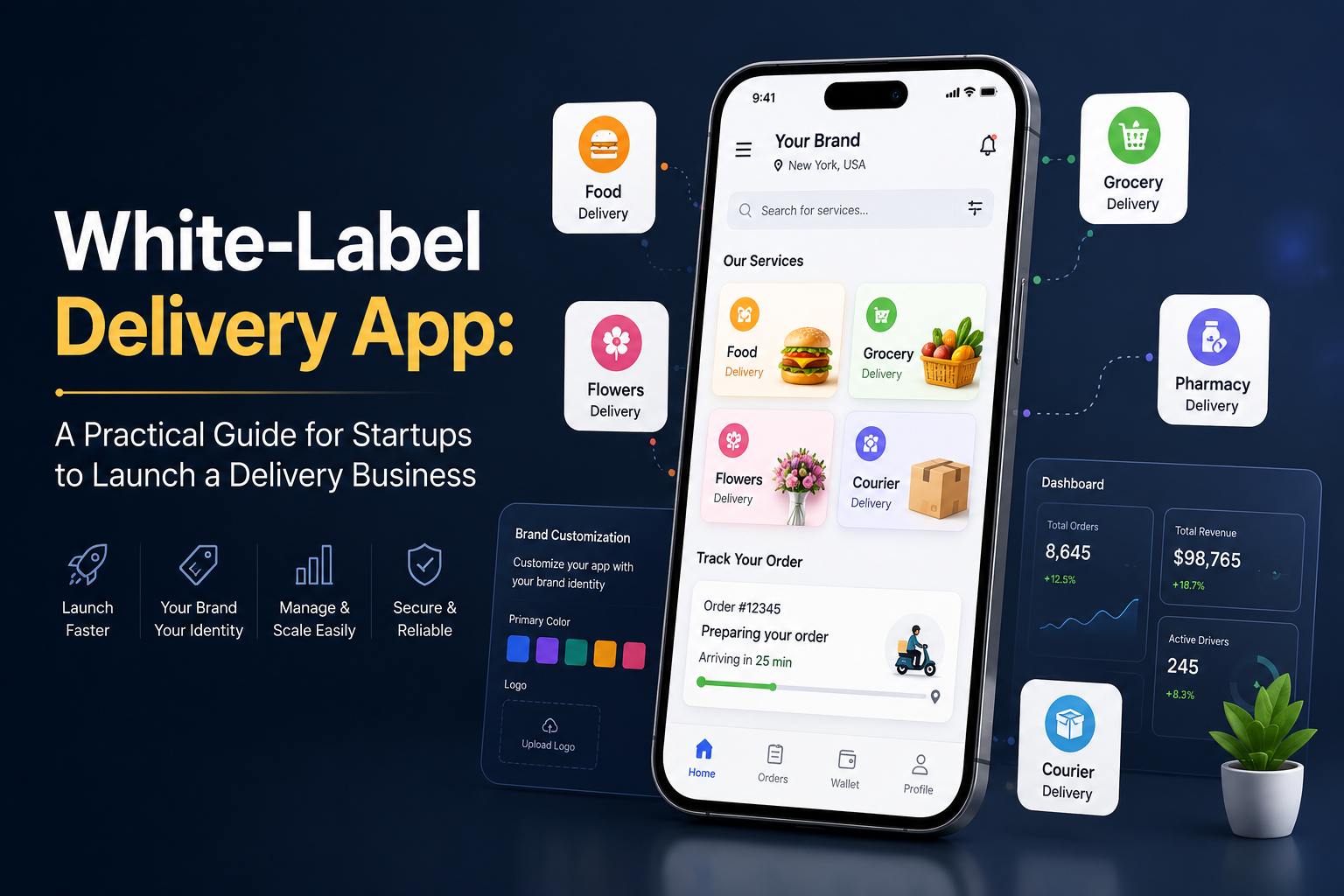
Starting a delivery business often requires more than just an idea. You need a reliable app, customer management system, delivery tracking, payment integration, and tools to handle daily operations. A White-Label Delivery App helps startups enter the delivery market by using a ready-built platform that can be customized with their own brand identity.
Instead of spending months building everything from the beginning, businesses can customize an existing delivery app solution and focus more on operations, customers, and growth. In this guide, we will understand how white-label delivery apps work, their benefits, important features, and what startups should consider before choosing this approach.
What Is a White-Label Delivery App?
A White-Label Delivery App is a ready-made delivery application that businesses can customize and launch under their own brand name. The core technology is already developed, but companies can modify branding elements such as the logo, colors, app design, and business settings according to their requirements.
This type of solution is commonly used by startups, restaurants, grocery businesses, logistics companies, and entrepreneurs who want to start a delivery business without building every part of the platform from zero.
A white-label delivery app usually includes multiple applications or panels:
-
Customer app for placing orders
-
Delivery partner app for managing deliveries
-
Admin panel for controlling operations
The main idea is simple: the technology provider creates the foundation, while the business uses it as its own platform.
How a White-Label Delivery App Model Works
Suppose an entrepreneur wants to start a local food and grocery delivery service. Building a complete on-demand delivery app from scratch requires hiring developers, designing the system, testing features, and managing updates.
With a white-label model, the entrepreneur can choose an existing platform, add their branding, select required features, connect payment options, and launch the service.
For example, a startup in a city may customize the app for local restaurants, add delivery zones, onboard delivery partners, and manage orders through the admin panel. The app works as their own delivery platform, even though the base technology was already developed.
Why Startups Choose White-Label Delivery Apps
Startups usually have limited time, budget, and resources. A white-label delivery app helps them focus on building their business model instead of spending most of their effort creating technical infrastructure.
Faster Market Entry
Developing a complete delivery platform requires planning, development, testing, and improvements. A white-label solution reduces the initial development workload, allowing startups to launch their idea faster.
This can be useful when a business wants to test demand in a specific market before making a larger technology investment.
Lower Development Effort
Creating a delivery app involves multiple systems working together, including order management, payments, user accounts, tracking, and notifications.
A ready-made delivery app solution already includes many essential components, reducing the amount of technical work required from the startup team.
Customization Options
A common misunderstanding is that white-label apps cannot be customized. In reality, many platforms allow businesses to adjust important elements such as:
-
Brand identity
-
App interface
-
Service categories
-
Delivery settings
-
Pricing models
This allows a startup to create a platform that matches its business requirements.
Easier Business Expansion
A delivery business may start with one service and later expand into other categories.
For example, a food delivery company may later add grocery, pharmacy, or courier services. A scalable white-label platform can support this type of expansion.
Key Features a White-Label Delivery App Should Have
Choosing a white-label delivery solution is not only about getting an app. The platform should include features that support daily business operations and provide a good experience for customers, delivery partners, and administrators.
Customer App Features
The customer app is where users interact with the delivery business. It should make ordering simple and convenient.
Important customer features include:
Easy Registration and Profile Management
Customers should be able to create accounts, save addresses, manage personal details, and view order history easily.
A simple account experience helps users return and place future orders without unnecessary steps.
Order Browsing and Management
Customers should be able to explore available services, select products, add items to carts, and place orders smoothly.
For a multi-service delivery platform, categories and search options become especially important because users need a clear way to find what they need.
Real-Time Order Tracking
Tracking allows customers to understand their order status, from confirmation to delivery.
It reduces uncertainty and improves trust between customers and the delivery business.
Multiple Payment Options
A reliable delivery app should support different payment methods such as online payments, cards, wallets, or cash options depending on the target market.
Delivery Partner Features
Delivery partners handle the physical movement of orders, so their app needs to support quick decision-making.
Useful features include:
Order Request Management
Delivery partners should receive order notifications and have the option to accept or manage assigned deliveries.
Navigation Support
Integrated maps and route guidance help delivery partners find locations efficiently.
Delivery Status Updates
Partners should be able to update order progress, such as picked up, on the way, or delivered.
This keeps customers and administrators informed.
Admin Management Features
The admin panel controls the complete delivery operation.
Important admin features include:
Order and User Management
Admins should be able to monitor orders, customers, delivery partners, and service providers from one place.
Analytics and Reports
Business insights help startups understand order trends, customer behavior, and operational performance.
Service and Pricing Control
Admins should have control over categories, commissions, delivery charges, and business settings.
White-Label Delivery App vs Custom App Development
Both approaches can work depending on business goals.
A white-label delivery app is generally suitable for startups that want to launch quickly, test their business idea, or avoid heavy initial development costs.
Custom app development may be better for companies that need highly unique features, complex workflows, or complete control over the technology architecture.
Here is a simple comparison:
|
Factor |
White-Label Delivery App |
Custom App Development |
|
Development time |
Usually faster |
Takes more time |
|
Initial investment |
Generally lower |
Usually higher |
|
Customization |
Depends on platform flexibility |
Complete customization |
|
Maintenance |
Often easier with provider support |
Managed by the business team |
|
Best for |
Startups and market testing |
Businesses with unique requirements |
The right choice depends on the business model, budget, and long-term plans.
How to Start a Delivery Business Using a White-Label App
Starting a delivery business with a white-label platform requires more than just launching an app. The business strategy also matters.
The first step is choosing the right delivery model. A startup should decide whether it wants to focus on food delivery, grocery delivery, pharmacy delivery, courier services, or a multi-service approach.
After deciding the model, the business can select the required features. Not every startup needs every possible feature at the beginning. It is better to start with features that support the main customer journey.
Next comes customization. The app should match the brand identity, including design elements, business settings, and service structure.
Before launch, testing is necessary. The startup should check the ordering process, payment flow, delivery management, and user experience.
After launching, businesses should collect feedback and improve the platform based on real customer behavior.
Things to Consider Before Choosing a White-Label Delivery Solution
Choosing the right platform can affect the long-term success of a delivery business. Startups should evaluate several factors before making a decision.
Scalability
The platform should support business growth. A startup may begin with a small customer base but require more users, delivery partners, and services later.
Customization
A good white-label solution should allow enough flexibility to match business needs instead of forcing every company into the same structure.
Technology Quality
Check whether the platform provides stable performance, regular updates, security practices, and reliable integrations.
A delivery app handles important information such as customer details, payments, and order data, so technology quality matters.
Support and Maintenance
Launching an app is only the beginning. Businesses may need technical support, troubleshooting, and improvements as they grow.
Security
The platform should follow proper security practices for user accounts, payments, and business data.
Conclusion
A White-Label Delivery App can be a practical option for startups that want to enter the delivery market without building an entire platform from the beginning. It allows entrepreneurs to focus on their customers, services, and business operations while using ready-built technology.
However, choosing the right solution requires careful evaluation. Startups should look beyond the app itself and consider scalability, customization, security, and long-term business needs before investing.
FAQs
What is a white-label delivery app?
A white-label delivery app is a ready-made delivery platform that businesses can customize with their own branding and use to run their delivery services.
How does a white-label delivery app work?
It works by providing a pre-built delivery system that includes customer, delivery partner, and admin features. Businesses customize the platform and launch it under their own brand.
How much does it cost to build a white-label delivery app?
The cost depends on factors such as features, customization level, platform requirements, and technology provider. Basic solutions usually cost less than fully customized applications.
Is a white-label delivery app better than building from scratch?
A white-label app can be better for startups that want faster launch and lower development effort. Custom development may be better for businesses needing unique features.
Can a white-label delivery app support multiple delivery services?
Yes, many white-label platforms can support multiple services such as food, grocery, pharmacy, and courier delivery depending on their features and structure.
How long does it take to launch a white-label delivery app?
The timeline depends on customization, testing, and business requirements. Since the base platform already exists, it is usually faster than building an app completely from scratch.

 English
 Arabic
 Français
 Español
 Português
 Deutsch
 Türkçe
 Italiano
 Russian
 Romaian