


GEO Ranking Factors That Influence How AI Shopping Assistants Recommend Products
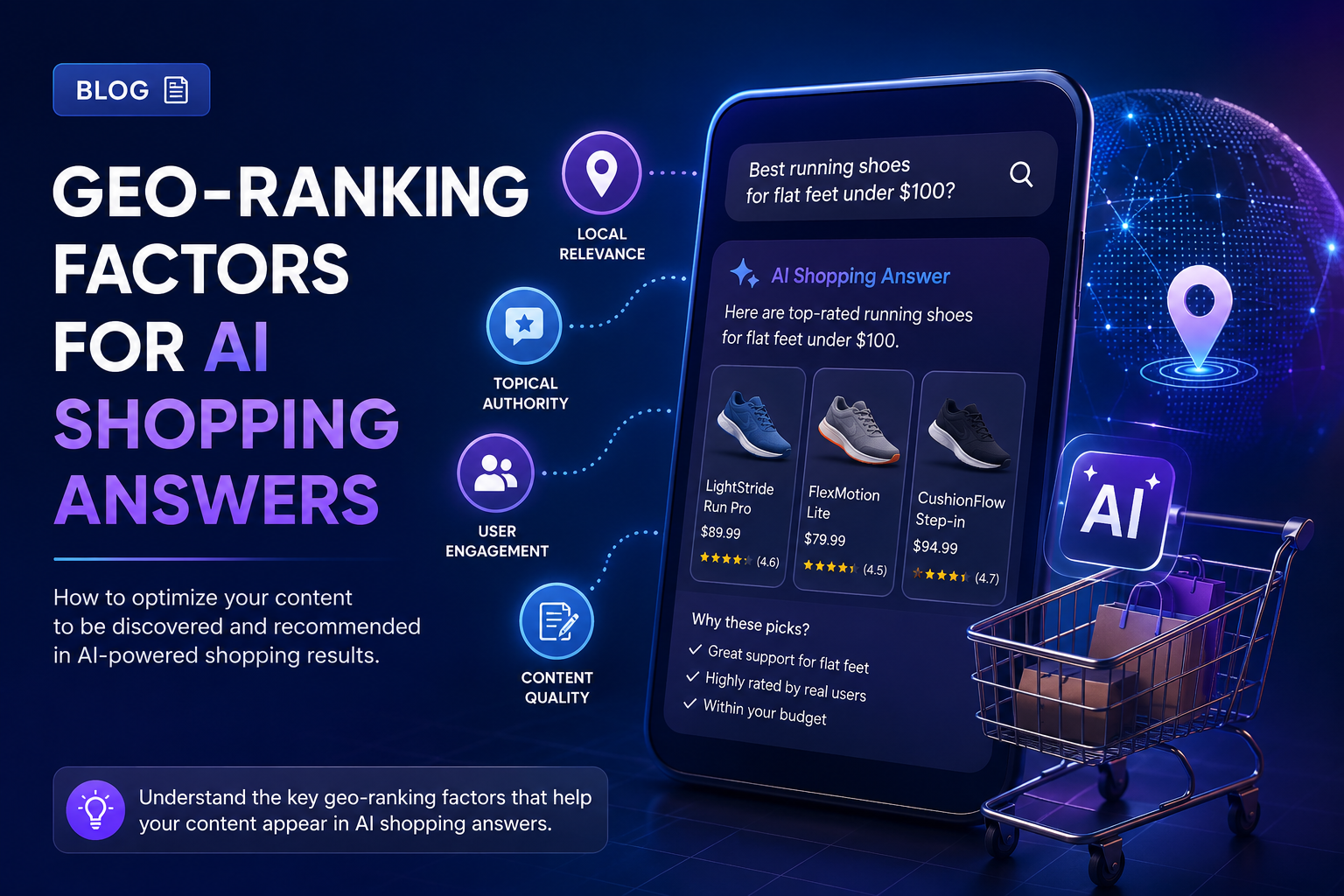
GEO Ranking Factors Are Transforming AI Shopping Experiences
Shopping online has always involved searching, comparing, and evaluating products before making a purchase. Today, that process is becoming much shorter. Instead of opening multiple tabs or scrolling through countless product pages, shoppers are asking AI assistants questions like, "What's the best ergonomic office chair for working from home?" or "Which protein powder is suitable for beginners?"
The response is often immediate, with only a handful of products making the final recommendation. This is where GEO ranking factors are beginning to influence digital commerce. They help AI systems determine which products and brands deserve to appear when shoppers are looking for answers rather than links.
For ecommerce businesses, this represents a significant shift. Success is no longer measured only by ranking on search engines. It also depends on whether AI shopping assistants understand your products well enough to recommend them.
How GEO Ranking Factors Help AI Understand Products
GEO ranking factors are becoming increasingly important because AI assistants need context before they can confidently recommend a product. Unlike traditional search engines that match keywords, AI attempts to understand what a shopper is actually looking for.
If someone searches for a "laptop for video editing," the AI isn't simply looking for pages containing those words. It evaluates information that explains processor performance, graphics capability, memory requirements, display quality, battery life, and intended use.
The businesses that provide complete, structured, and meaningful product information make it easier for AI to understand exactly where their products fit. That understanding increases the chances of appearing in AI-generated shopping recommendations.
Product Pages Should Answer Questions Before Customers Ask Them
Many ecommerce product pages focus almost entirely on selling. They highlight discounts, promotions, and attractive visuals but often overlook the questions shoppers ask before making a purchase.
A customer looking for hiking shoes may want to know whether they're waterproof, suitable for rocky terrain, comfortable for long-distance trekking, or ideal for beginners. If that information isn't available, AI assistants have less context to evaluate the product.
The strongest product pages don't just describe a product. They explain when it should be used, who it is designed for, and what problems it solves.
This approach naturally supports generative AI search engine optimization because AI platforms can better understand the product's purpose instead of relying only on specifications.
Why Product Relationships Matter More Than Individual Products
A common mistake ecommerce brands make is treating every product as a standalone page. AI shopping assistants, however, often look for relationships between products to understand an entire catalog.
For example, a furniture retailer selling office chairs should also help AI understand how those chairs relate to standing desks, monitor arms, ergonomic accessories, and workspace organization products.
When products are connected through categories, collections, buying guides, and comparison content, AI gains a clearer picture of the shopping experience the business offers.
Instead of recognizing isolated products, AI begins recognizing an entire product ecosystem.
Buying Guides Help AI Build Shopping Confidence
Many brands underestimate the importance of buying guides because they don't directly generate sales. In reality, they often provide some of the strongest context available for AI-powered shopping.
Imagine someone asking an AI assistant:
"Which coffee machine is better for a small office?"
A buying guide comparing machine capacity, maintenance requirements, operating costs, and coffee output provides far more context than a simple product description.
Comparison Content Helps AI Differentiate Products
When businesses explain the differences between similar products, they make recommendation decisions easier for AI assistants.
Rather than forcing AI to interpret specifications independently, comparison content highlights practical distinctions that matter to buyers.
This creates better shopping recommendations while also helping customers make faster purchasing decisions.
Educational Content Reduces Buying Friction
Educational articles explaining product categories, terminology, or purchasing considerations help AI understand the shopping journey.
Instead of viewing products individually, AI begins connecting educational content with product information, creating a richer understanding of the catalog.
Missing Product Context Can Reduce AI Discoverability
One overlooked issue in ecommerce is incomplete product information. A page may include dimensions, pricing, and technical specifications while leaving out practical buying details.
Imagine a skincare brand launching a new moisturizer. The product page explains the ingredients but never mentions whether it suits dry skin, oily skin, sensitive skin, or combination skin.
For a human shopper, this means extra research.
For an AI assistant, it creates uncertainty.
Without clear context, the product becomes harder to recommend because the intended use isn't fully understood.
Small gaps in information can have a significant impact when AI is deciding between similar products.
AI Shopping Rewards Helpful Merchandising
Traditional merchandising focused on arranging products to encourage purchases. AI merchandising extends this idea by organizing information so machines can understand buying relationships.
Businesses can strengthen their product experience by providing:
- Clear product categories
- Detailed product attributes
- Helpful comparison pages
- Buying guides for different customer needs
- Consistent product terminology
These improvements benefit shoppers while making catalogs easier for AI systems to interpret.
Many generative engine optimization best practices encourage businesses to think about content as product knowledge rather than marketing copy.
Category Pages Are Becoming Strategic Assets
Category pages are often treated as navigation tools, but they can become valuable information hubs for AI shopping assistants.
Instead of listing products with minimal descriptions, category pages can explain who the products are designed for, when customers should choose one option over another, and what features matter most.
A running shoe category page, for example, can explain differences between road running shoes, trail running shoes, racing shoes, and everyday trainers.
This additional context helps AI understand not only the products but also the relationships between them.
Product Reviews Add Valuable Decision Context
While specifications explain what a product is, reviews often explain how it performs in real-world situations.
Customers frequently describe comfort, durability, ease of use, installation experiences, and long-term satisfaction. These insights provide additional context that AI shopping assistants can use when evaluating products.
Businesses should encourage authentic reviews and respond to customer feedback where appropriate. Consistent review quality helps create a richer product profile that supports better AI understanding.
Several generative engine optimization techniques focus on strengthening these supporting signals because they improve the overall quality of product information rather than relying on optimization alone.
Preparing Ecommerce Stores For AI Shopping
AI shopping assistants are still evolving, but one trend is already becoming clear. They perform best when businesses organize information around shopper needs instead of marketing campaigns.
Brands that explain products clearly, maintain accurate catalogs, connect related products, and publish useful buying resources create a stronger foundation for AI-powered discovery.
Rather than optimizing for algorithms alone, successful businesses are beginning to optimize for conversations.
That shift will become increasingly important as AI shopping continues to influence purchasing decisions across ecommerce.
Final Thoughts
The future of ecommerce is moving toward recommendation-driven shopping, and GEO ranking factors are becoming an essential part of that transformation. Businesses that help AI understand their products through better context, stronger catalogs, detailed buying guides, and meaningful customer information will be better positioned to earn visibility.
Following generative engine optimization best practices, investing in generative AI search engine optimization, and applying the top generative engine optimization strategies for AI visibility is no longer just about improving discoverability. It is about making products easier for AI shopping assistants to understand, compare, and confidently recommend.
FAQs
1. Why do AI shopping assistants recommend only a few products instead of showing hundreds?
AI assistants are designed to reduce decision fatigue. Instead of presenting every available option, they analyze available information and recommend products they believe best match the shopper's request.
2. Do buying guides improve AI product recommendations?
Yes. Buying guides explain product differences, ideal use cases, and purchasing considerations, giving AI assistants additional context that simple product pages often lack.
3. Can two similar products receive different AI visibility?
Absolutely. If one product has richer descriptions, complete specifications, comparison content, and better contextual information, AI can understand it more confidently and may recommend it more often.
4. Should ecommerce brands create content around product categories instead of only individual products?
Yes. Category pages, collections, and educational resources help AI understand how products relate to one another, improving overall catalog comprehension.
5. What is the biggest mistake brands make when preparing for AI shopping?
Many brands focus on promotional messaging while overlooking product context. AI shopping assistants need detailed, structured information that explains when, why, and for whom a product is the right choice.

 Arabic
 Français
 Español
 Português
 Deutsch
 Türkçe
 Dutch
Dutch
 Italiano
 Russian
 Romaian