


Deep Learning vs Machine Learning: Key Differences
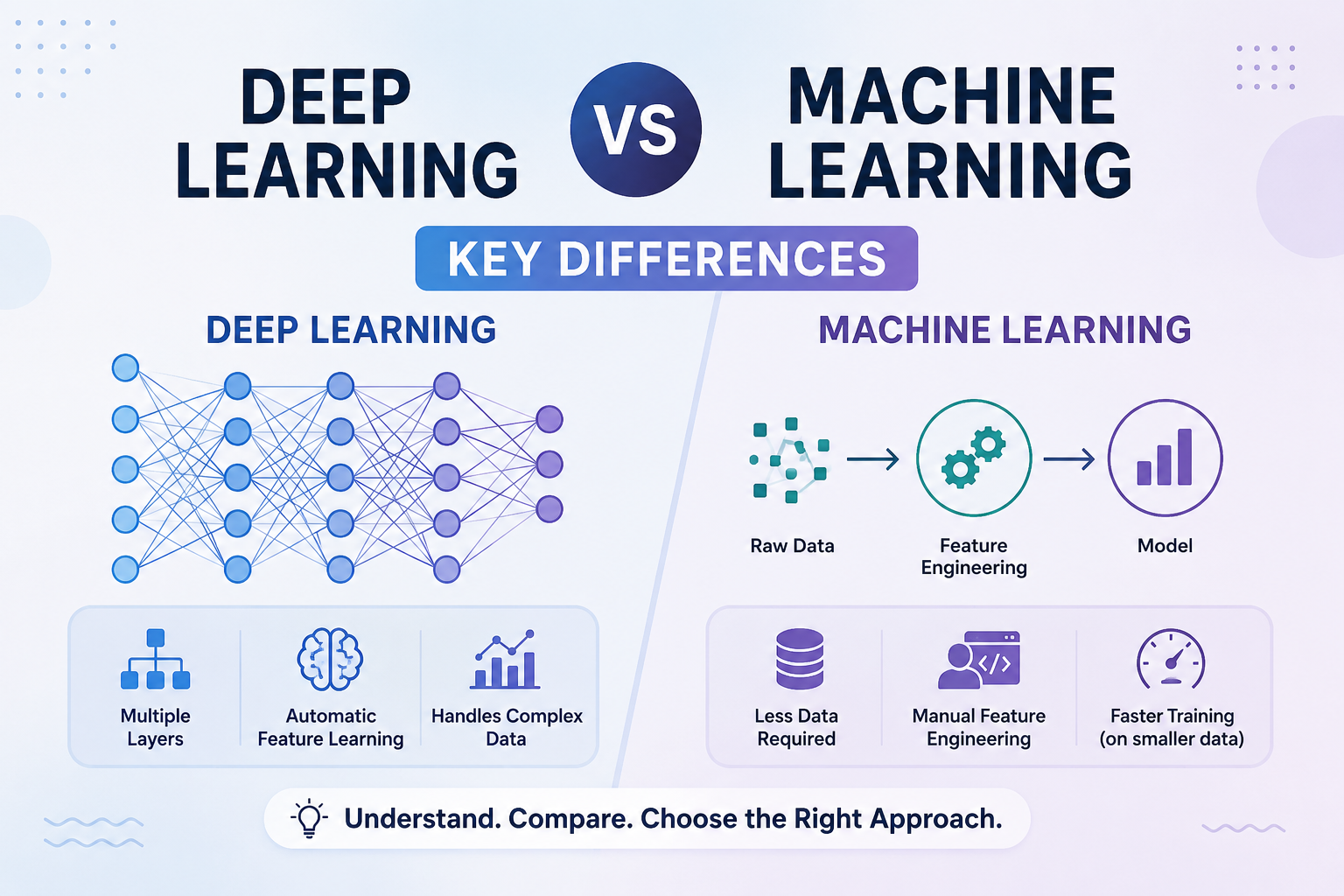
Ever wondered why some AI systems can recognize faces, translate languages, or even drive cars while others are better at predicting trends and detecting spam?
The answer lies in understanding the difference between Machine Learning and Deep Learning.
Although these terms are often used interchangeably, they're not the same. Deep Learning is a subset of Machine Learning, and each has its own strengths, limitations, and real-world applications.
In this guide, we'll break down the difference between the two in the simplest way possible.
What Machine Learning Really Means?
Machine Learning is a branch of AI that enables computers to learn from data instead of following fixed instructions. Instead of programming every rule, you train the model using examples, allowing it to identify patterns and make predictions on its own.
The only downside is that the model often needs a little help from humans. You must tell it which information is important before it starts learning. Once it has that information, it can find patterns and make accurate predictions. This is one of the biggest differences between Machine Learning and Deep Learning.
What Deep Learning Actually Is?
Deep Learning is a type of Machine Learning that uses artificial neural networks to learn from data. Unlike traditional Machine Learning, it doesn't need you to tell it which information is important. Instead, it figures that out on its own.
That's why understanding Deep Learning fundamentals is so valuable. Whether it's working with images, text, or audio, a Deep Learning model learns patterns directly from raw data. As it processes more data, it becomes better at making accurate predictions and decisions.
The Core Differences That Actually Matter
Check the following points for detailed differences between the two.
-
Data requirements: Machine learning works fine with smaller datasets. Deep Learning, on the other hand, needs massive amounts of data to perform well.
-
Feature engineering: Machine learning needs humans to select relevant features manually. Deep Learning automates this entirely through its layered structure.
-
Hardware needs: Machine learning models can often run on a standard CPU. Deep Learning usually demands GPUs for faster processing, especially with large neural networks.
-
Training time: Machine learning models typically train faster. Deep Learning models can take hours or even days depending on complexity.
-
Interpretability: Machine learning models are usually easier to explain and interpret. Deep Learning often works like a black box, making decisions hard to trace.
-
Problem complexity: Machine learning handles structured, simpler problems. Deep Learning shines with unstructured data like images, speech, and natural language.
See how each point tells a slightly different story? That's exactly why picking the right approach depends entirely on your project's goals.
Why This Distinction Actually Matters for You?
Choosing between machine learning and Deep Learning isn't just an academic exercise. If you're building something like a spam filter, simple ML models often do the job perfectly well, and they're way cheaper to run.
But if you're working with facial recognition, voice assistants, or self-driving car systems, you need the pattern-recognition power that only Deep Learning brings. Picking the wrong tool wastes time, money, and honestly, a lot of your patience.
This is where structured learning helps. Platforms offering courses to learn Deep Learning give you a roadmap instead of leaving you to figure everything out through trial and error.
How to Start Learning Deep Learning the Right Way
Getting started with Deep Learning can feel overwhelming at first. With so many concepts, tools, and tutorials available, it's easy to lose direction. The best approach is to follow a structured learning path that builds your knowledge step by step.
A great place to begin is the Deep Learning Fundamentals course on Coursera. It introduces core concepts in a beginner-friendly way, helping you understand neural networks, model training, and real-world AI applications without feeling overwhelmed.

Common Myths That Confuse Beginners
A lot of confusion around these terms comes from myths that just won't die. Let's clear a few up quickly, because misinformation here really slows down learners.
Myth one: Deep Learning always beats machine learning. Not true. For small, structured datasets, traditional ML often performs just as well, sometimes better, with far less computational cost.
Myth two: Deep Learning is only for tech giants with huge budgets. Not true, as Cloud computing and free-tier GPU access have made this technology accessible to independent learners and small teams too.
Machine Learning vs Deep Learning: Which One Should You Choose?
Machine Learning and Deep Learning aren't competing technologies—they're both essential parts of modern AI.
While Machine Learning is ideal for solving structured problems with less data, Deep Learning excels at handling complex tasks like image recognition, speech processing, and natural language understanding.
If you're just getting started, begin with Machine Learning. It's easier to understand and helps you build a strong foundation before moving on to Deep Learning and neural networks.
Most importantly, don't rush the learning process. Focus on mastering the basics first, and the advanced concepts will become much easier to understand as you progress. A strong foundation today will help you build smarter AI solutions tomorrow.

 English
 Arabic
 Français
 Español
 Deutsch
 Türkçe
 Dutch
Dutch
 Italiano
 Russian
 Romaian