


Creative Learning Games Parents Can Play With Their Children
Introduction
Ask any parent, and they'll tell you the same thing—children have endless energy and curiosity. One moment they're asking questions about animals, and the next they're turning a cardboard box into a spaceship. The challenge isn't getting children interested in learning. It's finding ways to make learning feel exciting and natural.
The good news is that some of the best learning opportunities don't require expensive classes or complicated setups. Simple games played at home can help children build creativity, confidence, communication skills, and problem-solving abilities while having fun.
More importantly, these activities create valuable family moments. In a world filled with screens and distractions, spending quality time together has become just as important as the learning itself.
Let's explore some creative learning games that parents can easily play with their children at home.
Why Learning Through Play Works So Well
Children learn differently from adults. They don't usually absorb information by sitting quietly and listening for long periods. Instead, they learn by doing, exploring, experimenting, and making mistakes.
Play allows children to engage all their senses while developing important life skills. Whether they're solving a puzzle, building a tower, or inventing a story, they're constantly learning without even realising it.
That's one reason many parents today are choosing hands-on activities and educational wooden toys that encourage active participation rather than passive entertainment.
1. Shape Hunt Around the House
This game is simple but surprisingly effective.
Ask your child to find objects around the house that match different shapes. A clock can represent a circle, a book might be a rectangle, and a slice of toast could resemble a square.
As children search for shapes, they improve observation skills and begin connecting classroom concepts with real-world objects. It also encourages movement, making it perfect for energetic children who don't enjoy sitting still.
2. Memory Matching Challenge
Memory games help children improve concentration and attention to detail.
Create matching cards using pictures, letters, numbers, or household items. Place them face down and take turns finding matching pairs.
Children quickly learn to focus, remember positions, and recognise patterns. It's also one of those games that becomes more enjoyable as their skills improve.
3. Build a Story Together
Children have incredible imaginations when given the chance.
Start a story with a single sentence and ask your child to continue it. You can take turns adding new twists and characters until the story becomes a fun adventure.
One day your story might feature a flying elephant. Another day it could involve a magical train travelling through space. There are no limits.
This activity strengthens creativity, vocabulary, and communication skills while giving children confidence to express their ideas.
4. Indoor Treasure Hunt
Few activities create excitement like a treasure hunt.
Hide small objects around the house and create clues that lead children from one location to another. Younger children can follow pictures, while older children can solve simple riddles.
As they search, children practise critical thinking, observation, and problem-solving skills. The final discovery feels like a reward for all their effort.
5. Alphabet Detective Game
Choose a letter and challenge your child to find objects around the house that begin with that sound.
For example, the letter "B" might lead them to discover a book, ball, basket, or bottle.
This simple activity helps improve vocabulary, phonics awareness, and language development while encouraging children to pay closer attention to their surroundings.
6. Sorting and Grouping Activities
Give children a collection of everyday items and ask them to organise them into groups.
They might sort objects by colour, size, shape, or texture. You may even be surprised by the creative categories they invent themselves.
Sorting activities strengthen logical thinking and introduce basic mathematical concepts in a natural and engaging way.
7. Creative Art Challenge
Art activities give children the freedom to explore their imagination.
Provide paper, crayons, paints, stickers, or craft supplies and challenge them to create something unique. Perhaps they design their dream house, invent a new animal, or create a superhero with special powers.
There is no correct answer, which is exactly what makes creative activities so valuable.
8. Puzzle Solving Activities
Puzzles continue to be one of the most effective educational games for young children.
Whether children are matching shapes, assembling pictures, or solving challenges, they learn patience, focus, and logical thinking.
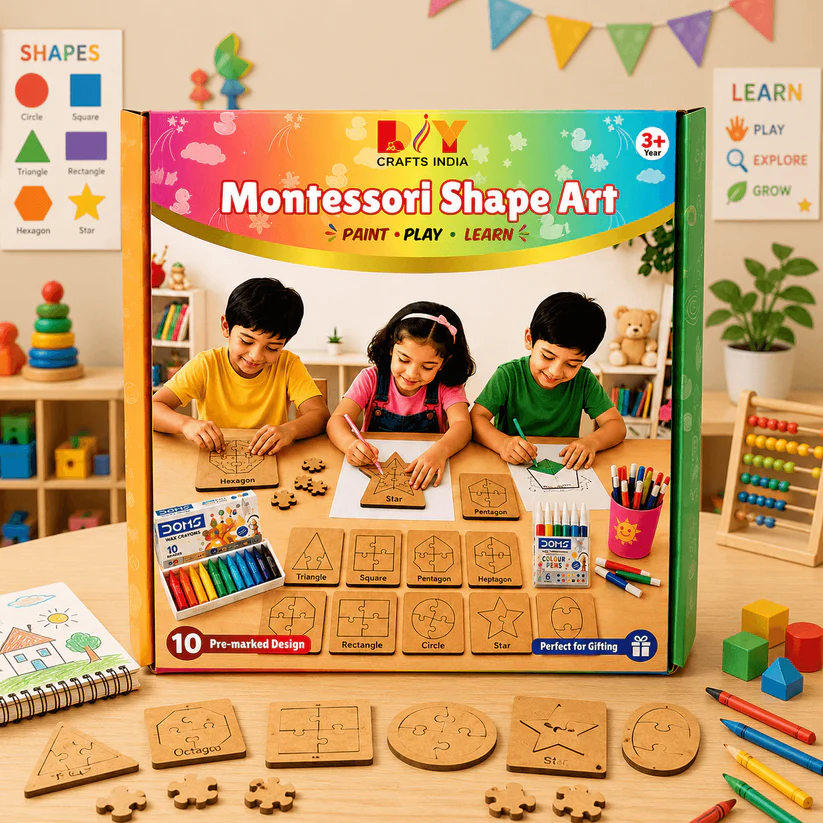
Many parents choose wooden puzzles for preschoolers because they combine learning with hands-on play. Puzzle activities help children develop problem-solving skills while keeping them engaged for longer periods.
9. Mystery Bag Game
Place a familiar object inside a cloth bag and ask your child to identify it using only their sense of touch.
They might feel a toy car, spoon, block, or ball and try to guess what it is without looking.
Children love the mystery aspect of this activity, and it helps strengthen observation and descriptive language skills.
10. Build and Create Challenge
Give your child building materials such as blocks, cardboard, or craft supplies and challenge them to create something specific.
They might build a tower, a bridge, a vehicle, or even an entire imaginary city.
Open-ended building activities encourage creativity, planning, and problem-solving while introducing early engineering concepts.
The Importance of Screen-Free Learning
While technology certainly has its place, children also need opportunities to interact with the physical world.
Screen-free games encourage children to think independently, communicate effectively, and engage their imagination. They also create opportunities for genuine family interaction that often gets lost in digital environments.
The goal isn't necessarily to eliminate screens altogether. It's to create a healthy balance that allows children to experience different ways of learning and growing.
Conclusion
The best learning experiences often happen when children don't realise they're learning at all.
Whether you're organising a treasure hunt, solving puzzles, creating stories, or exploring shapes together, these activities help children develop valuable skills while strengthening family bonds.
The beauty of learning through play is that it feels natural. Children stay engaged, parents stay involved, and everyone enjoys the process. Sometimes the simplest games create the biggest opportunities for growth.

 Arabic
 Français
 Español
 Português
 Deutsch
 Türkçe
 Dutch
Dutch
 Italiano
 Russian
 Romaian