


How to Stop Fixing People and Start Understanding Them
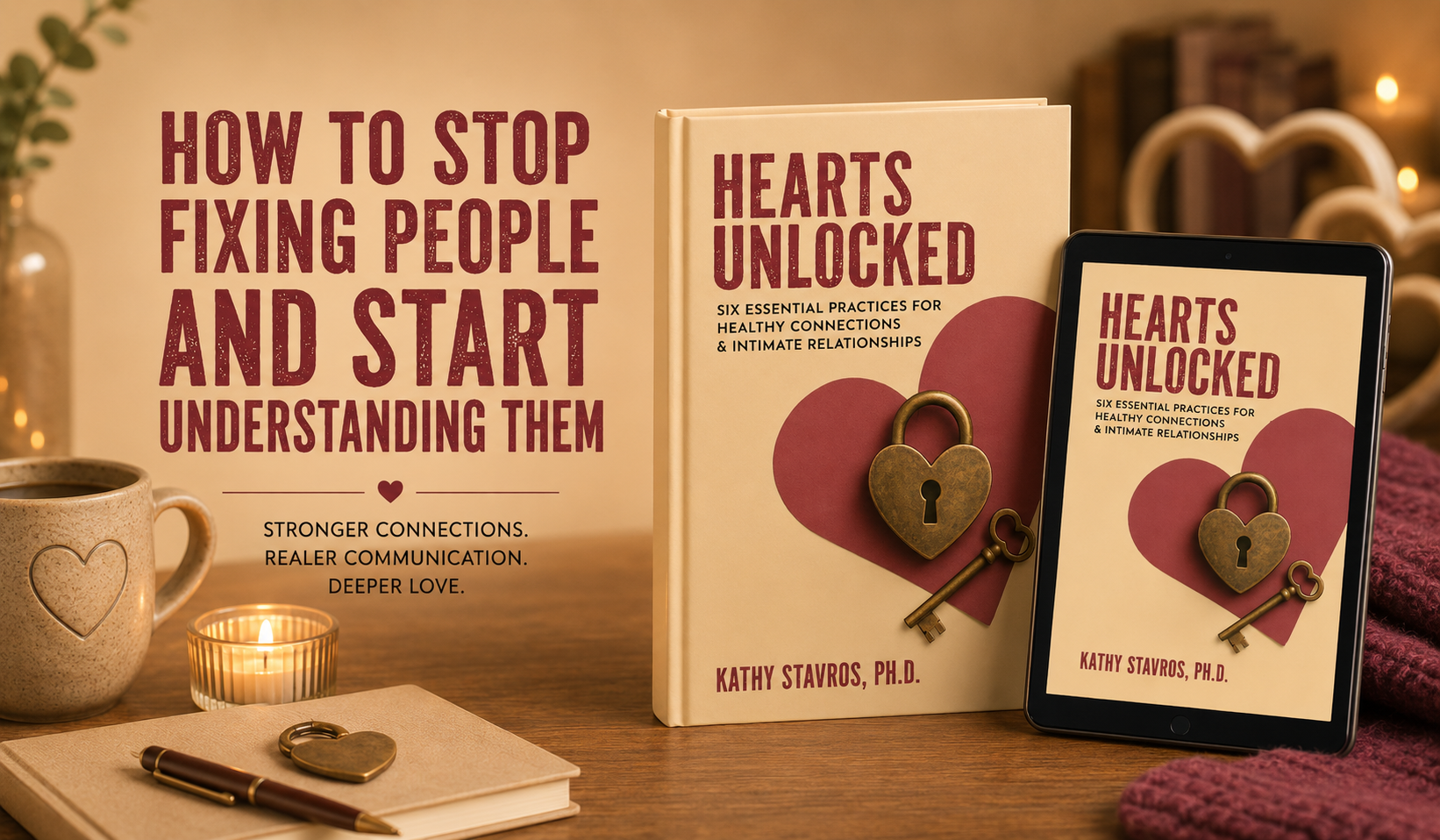
The Empathy Paradox
Most people enter relationships with good intentions.
When someone we care about is struggling, our natural instinct is often to help. We want to ease their pain, solve their problems, offer advice, and guide them toward a better outcome. Whether it is a partner overwhelmed by work, a friend navigating heartbreak, or a family member facing uncertainty, our immediate response is usually the same: How can I fix this?
Amazon: Hearts Unlocked: Six Essential Practices for Healthy Connections and Intimate Relationships
At first glance, this seems compassionate. After all, helping others is often viewed as an expression of love and care.
Yet many relationships suffer not because people care too little, but because they care in ways that unintentionally miss what the other person truly needs.
This is the empathy paradox.
The more desperately we try to solve someone's problem, the less understood they may feel. The person seeking comfort often leaves the conversation feeling unheard, while the person trying to help feels frustrated that their advice was not appreciated.
Consider a common scenario.
A partner comes home after a difficult day and says, "My boss criticized my presentation in front of everyone."
Within seconds, the other partner responds:
"You should talk to HR."
"Maybe you need to be more prepared."
"Have you considered updating your résumé?"
All of these suggestions may be practical and well-intentioned. Yet the struggling partner may become quieter, more distant, or even irritated.
Why?
Because they were not looking for a solution.
They were looking for understanding.
The reality is that many emotional struggles cannot be fixed immediately. People often need empathy before they need advice. They need someone willing to sit beside them in their experience rather than rush to pull them out of it.
Learning to stop fixing people and start understanding them is one of the most powerful relationship skills a person can develop.
Why We Rush to Solutions
The urge to fix is deeply human.
Most people are uncomfortable witnessing pain—especially the pain of someone they love.
When we see someone struggling, our own anxiety often activates. We want the discomfort to disappear, not only for them but also for ourselves.
Offering solutions gives us a sense of control.
If we can identify the problem and provide an answer, we feel useful. We feel competent. We feel like we are helping.
Unfortunately, emotional experiences rarely work like mechanical problems.
A broken appliance needs repair.
A broken heart often needs understanding.
Many people also grow up in environments where emotions are treated as problems to solve rather than experiences to process.
Children may hear messages such as:
- "Don't cry."
- "Just move on."
- "Focus on the solution."
- "It's not that bad."
These responses teach people to bypass emotional experiences rather than engage with them.
As adults, they often repeat the same pattern in relationships.
The challenge is that emotional healing usually begins with feeling understood, not being instructed.
Sympathy vs. Empathy
Understanding the difference between sympathy and empathy is essential for building deeper connections.
Although the terms are often used interchangeably, they represent very different experiences.
Sympathy
Sympathy involves recognizing that someone is suffering.
It often creates a sense of distance.
A sympathetic response might sound like:
- "That's unfortunate."
- "I feel bad for you."
- "I hope things get better."
Sympathy acknowledges pain, but it often remains on the outside looking in.
Empathy
Empathy involves attempting to understand and connect with another person's emotional experience.
Instead of observing pain from a distance, empathy enters the emotional space alongside the other person.
An empathetic response might sound like:
- "That must have felt incredibly frustrating."
- "I can understand why you're upset."
- "That sounds really painful."
Empathy does not require having identical experiences.
It simply requires a willingness to understand another person's perspective without immediately judging, correcting, or solving it.
Empathy says:
"I'm here with you."
Fixing often says:
"Let's get past this as quickly as possible."
The difference is profound.
The Four Components of Empathy
Empathy is often misunderstood as a personality trait that some people naturally possess and others lack.
In reality, empathy is a skill.
Like any skill, it can be developed through awareness and practice.
Researchers often identify four key components that work together to create genuine empathy.
Perspective-Taking
Perspective-taking is the ability to view a situation through another person's eyes.
This does not mean agreeing with every thought, feeling, or behavior.
It means becoming curious about how the world appears from their position.
When people are upset, our instinct is often to evaluate whether their reaction is reasonable.
Empathy asks a different question:
"Given their experience, why might this make sense?"
For example:
A friend becomes deeply upset after being excluded from a social gathering.
You might think:
"It's just one event."
Perspective-taking invites a different approach:
"Perhaps this reminds them of previous experiences of rejection."
"Maybe belonging is especially important to them."
Understanding does not require agreement.
It requires curiosity.
The more we practice perspective-taking, the less likely we are to dismiss emotions that differ from our own.
Non-Judgment
One of the biggest barriers to empathy is judgment.
People often evaluate emotional experiences before fully understanding them.
Thoughts such as:
- "They're overreacting."
- "They shouldn't feel that way."
- "That's not a big deal."
- "I would handle it differently."
create emotional distance.
Judgment immediately communicates that another person's experience is somehow wrong.
The problem is that emotions are not logical debates.
People do not choose what they feel.
They choose how they respond to what they feel.
Empathy requires suspending judgment long enough to understand the experience beneath the behavior.
Instead of:
"You're being too sensitive."
Try:
"Help me understand why this affected you so deeply."
That simple shift can transform an entire conversation.
Emotional Recognition
Empathy also requires the ability to recognize emotions accurately.
Many people focus on words while overlooking emotional signals.
Yet emotions are often communicated through:
- Tone of voice
- Facial expressions
- Body language
- Energy shifts
- Silence
A person may say:
"I'm fine."
But their crossed arms, lowered gaze, and strained voice suggest otherwise.
Emotionally intelligent listeners pay attention to both verbal and nonverbal communication.
They listen not only for information but also for emotion.
Recognizing emotions allows us to respond to what is truly happening rather than what is merely being said.
For example:
Instead of responding to the content:
"My boss criticized me."
You might respond to the emotion:
"That sounds really discouraging."
The second response creates connection because it addresses the emotional experience directly.
Communicating Understanding
Empathy is incomplete unless it is communicated.
Many people genuinely understand another person's experience internally but fail to express that understanding outwardly.
As a result, the other person never feels seen.
Communicating empathy involves reflecting understanding back to the speaker.
Examples include:
- "That sounds really difficult."
- "I can see why you're frustrated."
- "That must have been exhausting."
- "It makes sense that you're feeling hurt."
These statements are powerful because they validate emotional experiences without necessarily agreeing with every conclusion.
Validation is not endorsement.
Validation simply says:
"Your feelings make sense given your experience."
When people feel understood, they often become more open, calmer, and receptive.
Ironically, empathy often creates the emotional safety necessary for meaningful problem-solving later.
Empathy Mistakes Most People Make
Despite good intentions, many people unintentionally undermine empathy.
Understanding these common mistakes can improve communication dramatically.
Mistake 1: Offering Advice Too Quickly
This is perhaps the most common empathy mistake.
Someone shares a problem.
Before they finish speaking, advice begins.
The listener assumes that solutions are the goal.
Yet many conversations are not requests for advice.
They are requests for connection.
A useful question is:
"Would you like support, advice, or simply someone to listen?"
This prevents unnecessary assumptions.
Mistake 2: Making It About Yourself
People often respond to emotional disclosures by sharing similar personal experiences.
For example:
"That reminds me of when my boss criticized me..."
While the intention is often connection, the conversation can unintentionally shift away from the person who needs support.
Empathy keeps the focus on their experience.
Sometimes the most supportive response is simply:
"Tell me more."
Mistake 3: Minimizing the Experience
People frequently try to help by reducing the perceived severity of a problem.
Statements such as:
- "It's not that bad."
- "At least..."
- "You'll get over it."
are usually intended to provide comfort.
Instead, they often create invalidation.
Minimization communicates:
"Your emotional reaction is unnecessary."
Validation communicates:
"Your emotional reaction makes sense."
The difference matters.
Mistake 4: Searching for Silver Linings Too Soon
Optimism has value, but timing matters.
When someone is actively hurting, immediate positivity can feel dismissive.
Comments such as:
- "Everything happens for a reason."
- "Look on the bright side."
- "This will make you stronger."
may be true eventually.
But before people can find meaning, they often need space to experience the pain itself.
Empathy honors that process.
Mistake 5: Confusing Understanding with Agreement
Some people avoid empathy because they believe understanding someone means agreeing with them.
It does not.
You can understand why a person feels angry without agreeing with their behavior.
You can understand someone's fear without believing their interpretation is accurate.
Empathy seeks understanding, not endorsement.
This distinction allows compassion and boundaries to coexist.
Building a Culture of Understanding
The most meaningful relationships are not built on perfect advice.
They are built on emotional safety.
People feel safe when they know they can share experiences without immediately being judged, corrected, analyzed, or fixed.
Creating this kind of environment requires intentional effort.
It means asking more questions and offering fewer immediate answers.
It means becoming comfortable sitting with discomfort instead of rushing to eliminate it.
It means recognizing that emotional support is not measured by the quality of our solutions but by the depth of our presence.
When people feel understood, something remarkable happens.
Their nervous systems relax.
Defensiveness decreases.
Trust increases.
Connection deepens.
Often, they discover their own solutions naturally once they feel emotionally supported.
Presence Is More Powerful Than Advice
Many people spend years believing that being helpful means having the right answers.
In reality, some of the most healing moments in relationships occur when no answers are available.
A grieving friend does not need a solution to loss.
A heartbroken partner does not need a strategy for pain.
A stressed family member may not need advice about what to do next.
Often, what they need most is someone willing to stay present.
Someone willing to listen without interrupting.
Someone willing to understand before advising.
Someone willing to say:
"I can see this is hard for you."
"I'm here."
"You don't have to carry this alone."
The desire to fix people comes from a place of care, but true connection often begins when we let go of the need to solve and embrace the willingness to understand.
Empathy is not passive. It is an active choice to enter another person's emotional world with curiosity, compassion, and respect.
When we stop treating emotions as problems to be solved and start treating them as experiences to be understood, relationships become deeper, safer, and more authentic.
The most powerful gift we can offer another person is not always advice.
Sometimes it is our attention.
Sometimes it is our understanding.
And very often, it is our presence.
Because in the moments when people feel truly seen, they are reminded that they do not need someone to fix them.
They simply need someone willing to understand them.

 English
 Arabic
 Español
 Português
 Deutsch
 Türkçe
 Dutch
Dutch
 Italiano
 Russian
 Romaian