


From Generative AI to Agentic AI: Understanding the Next Evolution of Artificial Intelligence
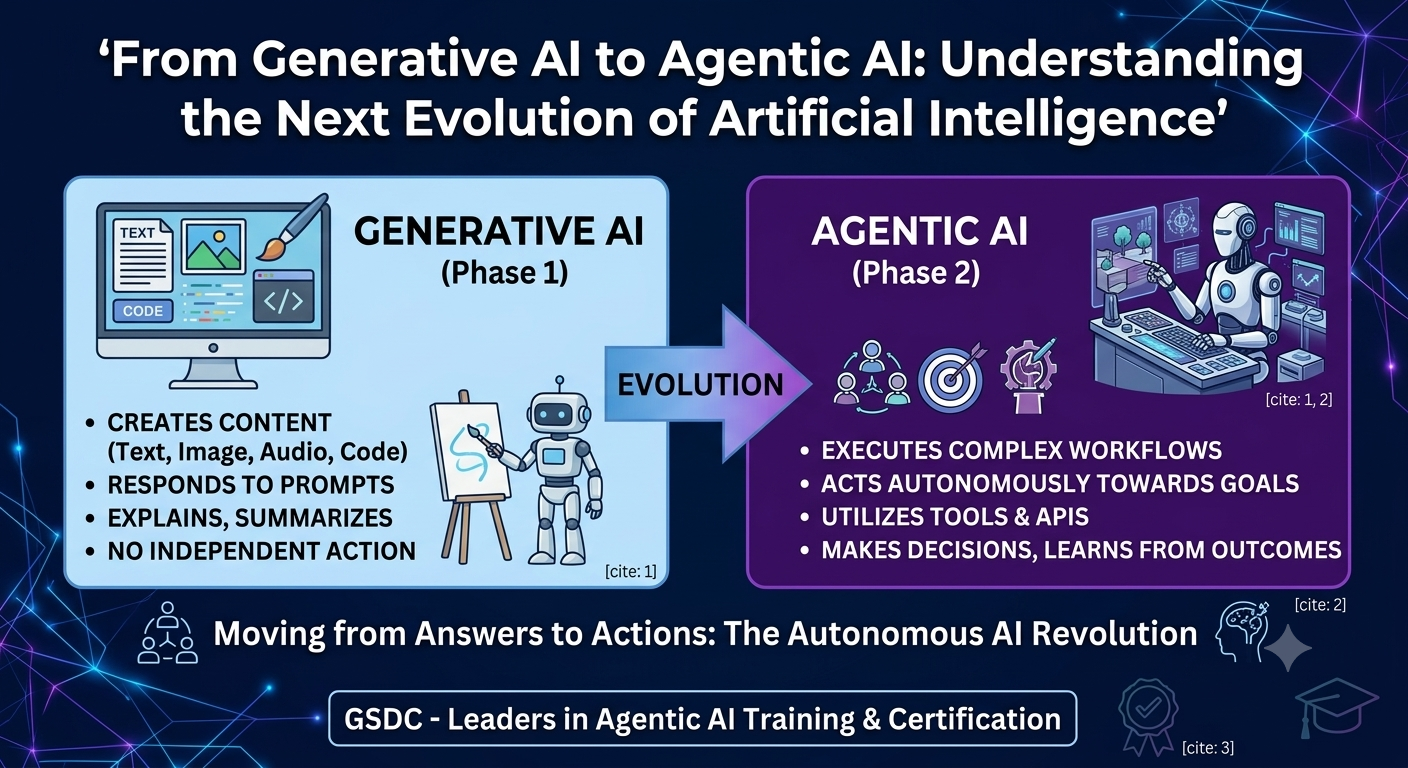
From Generative AI to Agentic AI: Understanding the Next Evolution of Artificial Intelligence
Artificial intelligence has rapidly evolved over the past decade. From rule-based automation to machine learning models and now large language models capable of generating human-like content, AI systems have continuously pushed the boundaries of innovation. However, we are now entering a new era, one defined by Agentic AI Technology.
Unlike generative AI, which primarily produces content based on prompts, agentic systems go further. They make decisions, set goals, execute multi-step actions, and adapt based on results. This shift represents one of the most important transformations in the history of artificial intelligence.
To understand where AI is heading, we must first examine where it has come from.
The Rise of Generative AI
Generative AI transformed industries by enabling machines to create text, images, code, and even video. Businesses began using AI for marketing content, customer service automation, product design, and software development support.
These systems are powerful, but they are fundamentally reactive. They wait for human prompts. They respond within defined boundaries. They generate outputs but do not independently act on them.
For example:
-
A generative model can draft a sales email.
-
It can summarize reports.
-
It can answer customer queries.
But it does not automatically identify customer churn risk, launch a retention campaign, schedule follow-ups, and optimize messaging over time. That level of autonomy requires something more advanced.
This is where the next evolution begins.
What Makes AI “Agentic”?
Agentic AI refers to systems designed to function as autonomous agents rather than passive tools. These systems are built around goals instead of prompts.
Instead of asking, “What should I generate?” agentic systems ask, “What is the objective, and how do I achieve it?”
The difference is structural:
|
Generative AI |
Agentic AI |
|
Prompt-driven |
Goal-driven |
|
Reactive |
Proactive |
|
Single-step output |
Multi-step execution |
|
Limited memory |
Persistent context |
|
No independent planning |
Strategic planning & decision-making |
This transformation moves AI from content creation to operational execution.
Core Capabilities of Agentic Systems
To truly understand this evolution, let’s break down the capabilities that define agentic AI systems.
1. Goal-Oriented Intelligence
Agentic systems operate with predefined objectives. For example, “Reduce IT downtime by 20%” or “Improve supply chain efficiency.”
2. Multi-Step Planning
They break complex objectives into smaller executable tasks and determine optimal sequencing.
3. Autonomous Decision-Making
Rather than following rigid scripts, agentic systems evaluate multiple options before selecting the most effective action.
4. Continuous Learning
They monitor results and refine strategies based on feedback loops.
5. Tool & API Integration
They interact with enterprise systems, cloud infrastructure, CRMs, analytics platforms, and more.
These capabilities collectively define the power of Agentic AI Technology, which is now being integrated into enterprise software, cybersecurity frameworks, and advanced automation systems.
Real-World Example: From Assistance to Execution
Consider customer support automation.
Traditional chatbot:
-
Answers questions.
-
Escalates to a human agent when necessary.
Agentic AI system:
-
Detects recurring complaint patterns.
-
Identifies potential churn signals.
-
Creates personalized outreach emails.
-
Schedules retention offers.
-
Tracks response metrics.
-
Adjusts communication strategies.
The difference is not incremental, it’s transformative.
Enterprise Transformation Through Autonomous AI
Organizations are beginning to embed autonomous AI agents into:
-
IT Operations (self-healing infrastructure)
-
Financial risk management
-
Healthcare diagnostics support
-
Smart manufacturing systems
-
Supply chain optimization
These systems do not simply assist teams—they operate alongside them.
At this stage of AI evolution, professionals who want to stay competitive are increasingly exploring structured learning paths such as an Agentic AI Course to understand system design, deployment strategies, and governance frameworks.
As adoption accelerates, technical expertise is becoming a strategic differentiator.
Why Agentic AI Is the Logical Next Step
The transition from generative to agentic AI mirrors earlier shifts in technology history.
-
From static websites to dynamic platforms
-
From manual operations to automation
-
From automation to intelligent orchestration
Generative AI addressed creativity and communication challenges. Agentic systems address execution and operational efficiency.
Businesses today face complex, dynamic environments where decisions must be made rapidly and at scale. Static automation cannot keep up. Agentic AI fills that gap by combining reasoning, planning, and execution in one integrated system.
Challenges in the Agentic AI Era
Despite its promise, agentic AI raises important concerns.
Governance & Accountability
If an AI agent autonomously executes a decision that leads to loss, who is responsible?
Transparency
Organizations must ensure explainability in autonomous decision processes.
Security Risks
Autonomous systems interacting with APIs and enterprise software increase potential attack surfaces.
Ethical Oversight
Bias mitigation and responsible AI frameworks must evolve alongside autonomy.
These concerns are not barriers, they are signals that governance must mature as technology advances.
The Role of Human Professionals
Contrary to popular fear, agentic AI does not eliminate human roles. Instead, it augments them.
-
Developers design architecture.
-
Strategists define objectives.
-
Analysts interpret insights.
-
Leaders govern AI behavior.
The demand for skilled professionals cap
able of building, managing, and auditing autonomous systems is rising rapidly. That is why structured credentials such as an Agentic AI Certification are becoming increasingly valuable in enterprise environments.
Organizations seek experts who understand not only AI models but also goal orchestration, system integration, and ethical governance.
The Future: Multi-Agent Ecosystems
The next phase of evolution involves multiple AI agents collaborating across digital ecosystems.
Imagine:
-
A cybersecurity agent detecting anomalies.
-
A compliance agent verifying regulatory adherence.
-
A financial agent adjusting budgets dynamically.
-
A DevOps agent resolving infrastructure bottlenecks.
Together, they form a coordinated AI workforce.
This future represents a structural transformation in how digital systems operate.
Conclusion: The Shift From Creation to Autonomy
Artificial intelligence is no longer limited to generating content or responding to prompts. It is becoming proactive, autonomous, and goal-driven.
The emergence of Agentic AI Technology marks the transition from assistance to execution. Businesses that understand this shift will gain operational efficiency, scalability, and strategic advantage.
As industries integrate autonomous agents into their workflows, professionals must adapt. Learning frameworks, architectural models, and governance practices are evolving rapidly.
Whether you are a developer, enterprise architect, strategist, or IT leader, understanding this evolution is no longer optional, it is essential.
The future of AI is not just intelligent.
It is autonomous.
It is goal-driven.
And it is agentic.

 English
 Arabic
 Français
 Español
 Português
 Deutsch
 Türkçe
 Dutch
Dutch
 Russian
 Romaian