


Database Management System Explained: Role & Types | UniAthena
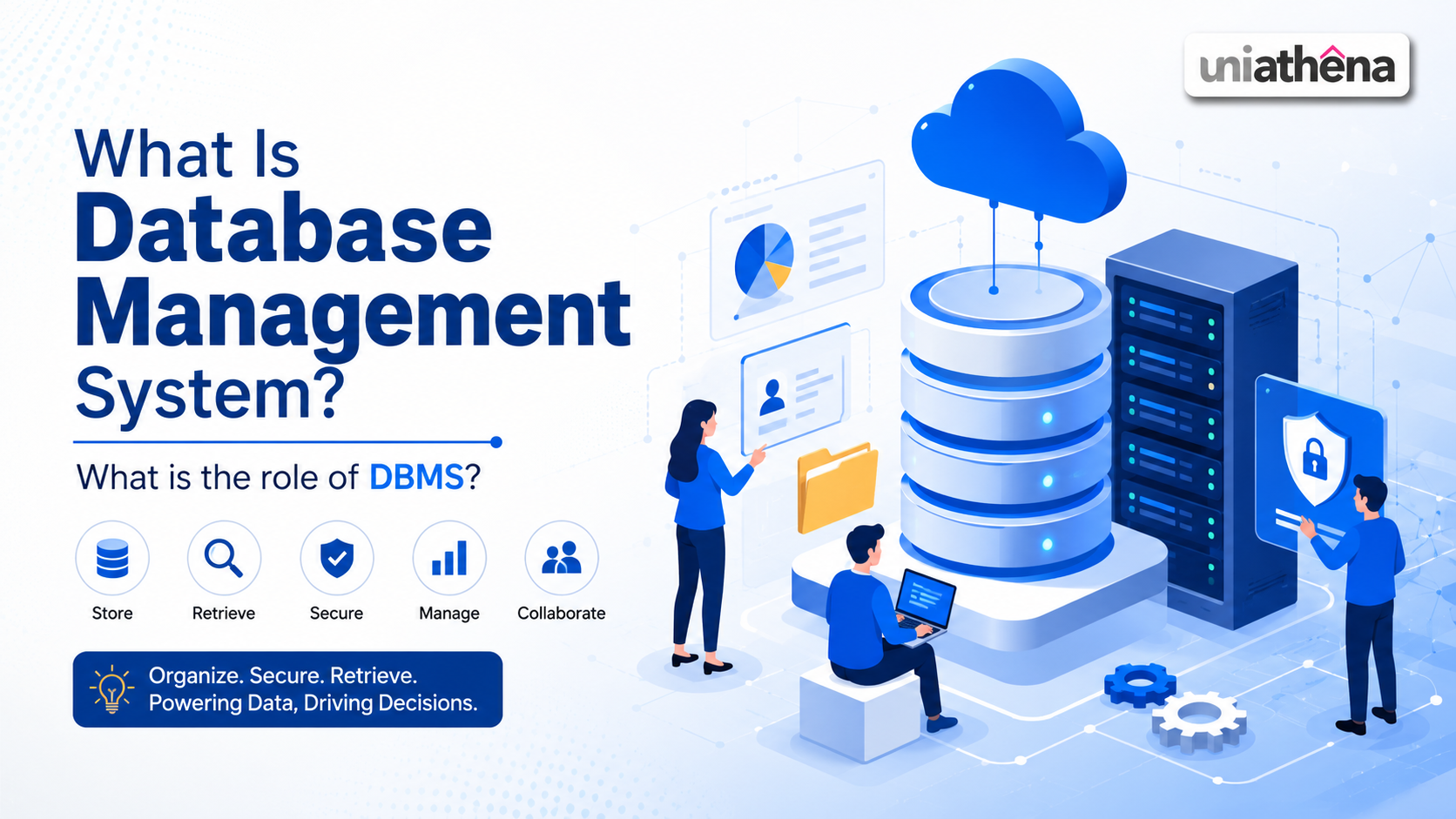
In today's digital world, businesses generate massive amounts of data every second. From online transactions to customer records, managing this information efficiently is essential for growth and informed decision-making. This is where a Database Management System becomes invaluable. It helps organizations store, organize, retrieve, and secure data while ensuring accuracy and easy accessibility.
What Is a Database Management System?
A Database Management System (DBMS) is software that allows users to create, manage, update, and retrieve data from databases. Instead of handling scattered files, users can access organized information quickly and securely through a centralized system.
If you're beginning your database journey, UniAthena offers Free Certificate Courses like Basics of SQL: Aggregate Functions & Joins, where learners explore SQL functions such as COUNT, SUM, AVG, MIN, MAX, and JOIN operations used in real-world databases.
Why Is a Database Management System Important?
A Database Management System simplifies data management by:
-
Organizing large volumes of data efficiently
-
Reducing duplication and errors
-
Enhancing data security
-
Supporting multiple users simultaneously
-
Enabling quick data retrieval
-
Providing backup and recovery features
These capabilities help businesses improve productivity and make faster, data-driven decisions.
Key Components of a Database Management System
Every Database Management System includes several essential components:
-
Database Engine: Stores and processes data efficiently.
-
Database Schema: Defines the database structure, including tables and relationships.
-
Query Processor: Executes SQL queries to retrieve or modify information.
-
Transaction Management: Maintains reliable database operations using ACID principles.
For learners who want comprehensive SQL knowledge, Diploma in SQL: Beginner to Advanced Levels covers database concepts, SQL constraints, joins, indexing, and stored procedures through practical learning.
Types of Database Management Systems
Different databases are designed for different business needs:
-
Relational DBMS (RDBMS): Uses tables and SQL. Popular examples include MySQL, PostgreSQL, Oracle Database, and Microsoft SQL Server.
-
NoSQL DBMS: Designed for structured and unstructured data. Examples include MongoDB and Cassandra.
-
Object-Oriented DBMS: Stores information as objects for object-oriented applications.
-
Hierarchical DBMS: Organizes data in a parent-child tree structure.
To strengthen practical database skills, Essentials of SQL Fundamentals & Practical Applications from UniAthena provides hands-on learning in database design, SQL querying, and database management.
Why Learning Database Management Skills Matters Today
According to industry reports, the demand for professionals with SQL and database management skills continues to grow across sectors such as IT, finance, healthcare, e-commerce, telecommunications, and artificial intelligence.
Learning database fundamentals can open opportunities in roles like:
-
Database Administrator
-
Data Analyst
-
Business Intelligence Analyst
-
SQL Developer
-
Software Engineer
-
Data Engineer
-
Backend Developer
Even professionals outside the IT industry increasingly use SQL to analyze business data and improve decision-making.
Benefits of a Database Management System
Using a Database Management System offers several advantages:
-
Improved collaboration through secure data sharing
-
Better protection of sensitive information
-
Increased operational efficiency
-
Faster reporting and decision-making
-
Reliable backup and disaster recovery
Database Management System in India
India's rapidly growing digital economy has significantly increased the demand for database professionals across industries such as IT, banking, healthcare, e-commerce, and education. Organizations rely on a Database Management System to manage growing data volumes, support cloud technologies, and drive digital transformation.
Professionals looking to build job-ready SQL skills can explore UniAthena's Free Certificate Courses, including Basics of SQL: Aggregate Functions & Joins, Diploma in SQL: Beginner to Advanced Levels, and Essentials of SQL Fundamentals & Practical Applications, which provide practical learning and globally recognized certifications.
Conclusion
A Database Management System is the backbone of modern data management, helping organizations securely store, organize, and retrieve information while improving efficiency and decision-making. As businesses continue to embrace digital transformation, database management skills are becoming increasingly valuable.
Whether you're a student or a working professional, UniAthena offers industry-relevant Free Certificate Courses that help you develop practical SQL and database management expertise to advance your career.

 English
 Arabic
 Español
 Português
 Deutsch
 Türkçe
 Dutch
Dutch
 Italiano
 Russian
 Romaian