As businesses expand across markets, the role of a global capability center operating model has changed significantly. What was once viewed primarily as an offshore support function has evolved into a strategic business unit that contributes to innovation, digital transformation, and operational excellence. Organizations that invest in the right operating model can unlock greater efficiency, improve collaboration, and create sustainable competitive advantages across global operations.
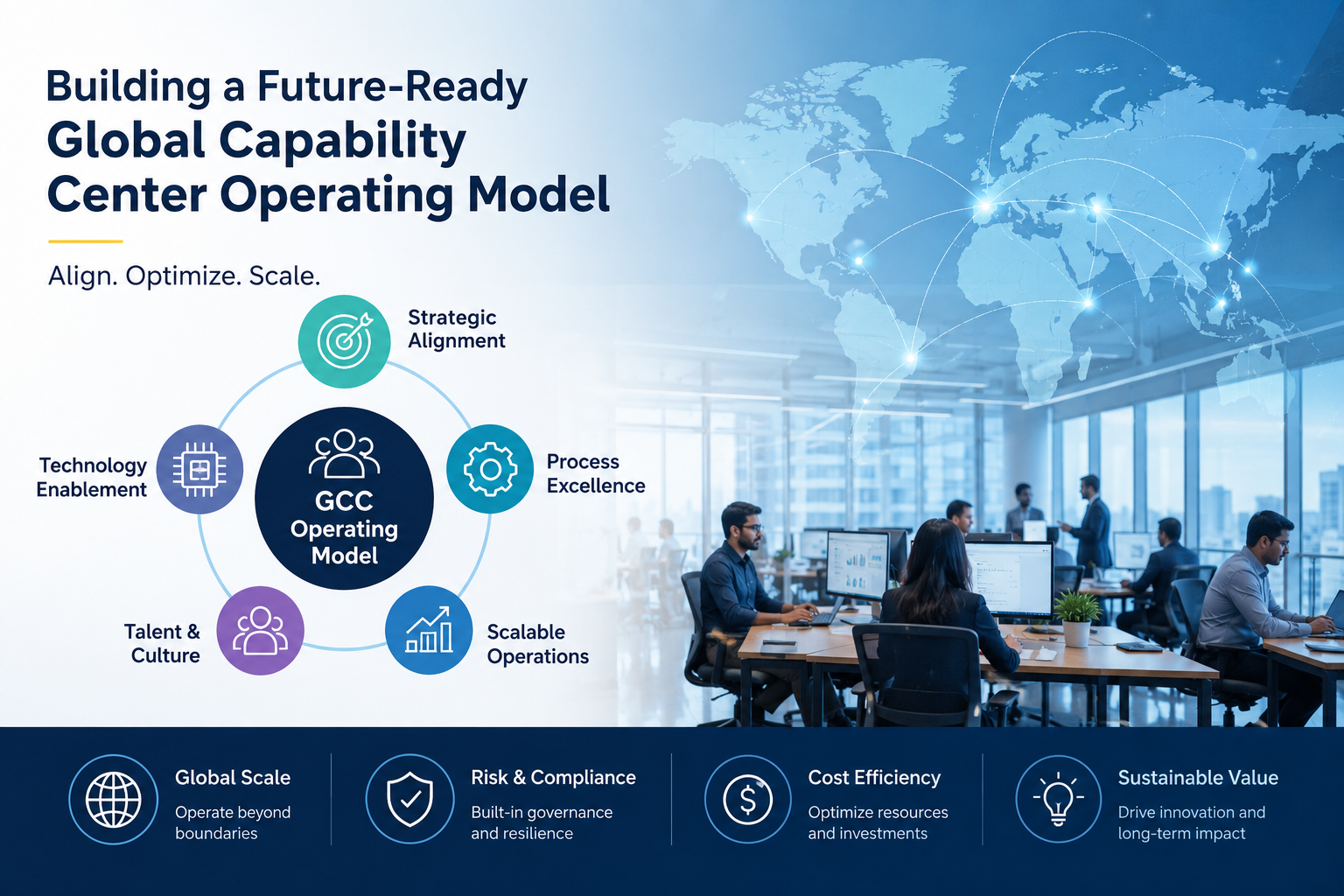
Whether an organization is establishing its first GCC or modernizing an existing one, success depends on creating an operating model that aligns people, processes, governance, and technology with long-term business goals.
Why the Global Capability Center Operating Model Matters
A global capability center operating model defines how a GCC is structured, managed, and integrated with the broader enterprise. It establishes decision-making frameworks, governance mechanisms, delivery standards, performance metrics, and communication channels that enable consistent execution.
Without a well-defined operating model, organizations often experience fragmented workflows, duplicated efforts, inconsistent governance, and slower decision-making. These challenges can reduce the strategic value a GCC is expected to deliver.
A mature operating model creates clarity across teams while enabling flexibility to adapt to changing market demands. It ensures that every function within the GCC contributes directly to enterprise objectives rather than operating independently.
Shifting from Cost Centers to Strategic Business Partners
The earliest Global Capability Centers primarily focused on lowering operational costs by relocating transactional work to lower-cost regions. While cost efficiency remains valuable, modern GCCs are expected to contribute much more.
Today's centers lead initiatives involving digital transformation, product engineering, artificial intelligence, finance, analytics, cybersecurity, procurement, and customer experience. They actively participate in innovation rather than simply executing predefined tasks.
This evolution requires leadership to rethink how GCCs are organized. Strategic planning, cross-functional collaboration, and stronger governance become essential for enabling higher-value work.
Organizations that embrace this shift often experience faster innovation cycles, improved customer experiences, and stronger alignment between global and regional teams.
Governance Creates Stability and Accountability
An effective operating model begins with clear governance. Every stakeholder should understand decision-making authority, reporting structures, ownership responsibilities, and escalation paths.
Strong governance reduces confusion while improving transparency across departments. It enables leadership teams to monitor progress, evaluate risks, and make informed business decisions.
Governance should also establish performance metrics that measure business outcomes instead of focusing solely on productivity or cost savings. Metrics related to innovation, customer satisfaction, operational quality, and business impact provide a more accurate picture of GCC performance.
Regular governance reviews also ensure that operating models continue evolving alongside changing business priorities.
Building Talent That Supports Long-Term Growth
Technology may enable transformation, but people ultimately determine whether a GCC succeeds.
Organizations must invest in recruiting professionals with technical expertise, leadership potential, and strong collaboration skills. Continuous learning programs help employees stay current with emerging technologies while preparing them for expanding responsibilities.
Leadership development is equally important. Future-ready GCCs require managers who can lead global teams, manage complex projects, and drive innovation across business functions.
A culture that encourages collaboration, experimentation, and continuous improvement creates an environment where employees contribute beyond their assigned responsibilities.
Technology as the Foundation of Modern GCCs
Digital technologies have become central to every successful GCC operating model.
Artificial intelligence, automation, cloud platforms, advanced analytics, and collaboration tools help organizations streamline operations while improving decision-making. Automation reduces repetitive work, allowing employees to focus on strategic initiatives that generate greater business value.
Real-time analytics provide leadership with better visibility into operational performance, enabling proactive improvements instead of reactive problem-solving.
Technology should not simply support operations. It should actively enhance agility, scalability, and enterprise-wide collaboration.
Choosing the Right GCC Outsourcing Strategy
Many organizations rely on GCC outsourcing to accelerate setup, reduce implementation risks, and access specialized expertise. Outsourcing partners can provide operational support during the initial stages while helping organizations establish governance frameworks, recruit talent, and deploy technology infrastructure.
However, outsourcing should be viewed as a strategic partnership rather than a transactional relationship.
The most successful organizations clearly define responsibilities between internal teams and external partners while maintaining strong governance and oversight. This balanced approach allows businesses to benefit from external expertise without compromising strategic control.
As business needs evolve, outsourcing strategies should also adapt to support new capabilities and changing priorities.
Selecting GCC Outsourcing Services That Scale
Choosing the right GCC outsourcing services requires evaluating far more than cost. Organizations should consider industry expertise, technology capabilities, scalability, governance maturity, and cultural alignment.
An experienced service provider helps accelerate operational maturity by implementing proven frameworks, standardized processes, and best practices developed across multiple GCC environments.
Scalable service models also allow organizations to expand operations without repeatedly redesigning internal structures. This flexibility becomes increasingly valuable as enterprises enter new markets or launch additional business functions within their GCC.
Long-term partnerships built on shared objectives often deliver stronger business outcomes than purely cost-driven engagements.
Integrating Risk Management into Daily Operations
Effective GCC risk management is essential for maintaining operational resilience in today's complex business environment.
Risk management extends beyond cybersecurity. Organizations must also address compliance, regulatory changes, operational disruptions, data privacy, vendor dependencies, and business continuity planning.
Rather than treating risk as a separate function, mature operating models integrate risk management into everyday decision-making processes. Regular assessments, clear governance policies, and continuous monitoring help identify potential issues before they impact business operations.
Building resilience allows organizations to maintain service quality even during periods of uncertainty or rapid change.
Aligning Procurement with Global Business Objectives
A successful global sourcing and procurement strategy complements the broader GCC operating model by strengthening supplier relationships, improving procurement efficiency, and reducing operational costs.
Strategic sourcing enables organizations to identify reliable suppliers, negotiate better contracts, and improve supply chain resilience. Procurement teams working within GCCs can also leverage analytics to optimize vendor performance and identify opportunities for continuous improvement.
When procurement strategies align with enterprise objectives, organizations gain greater visibility into spending while creating more consistent global purchasing practices.
The combination of strategic sourcing and effective governance supports sustainable long-term growth across multiple business functions.
Measuring Success Beyond Operational Efficiency
Traditional performance indicators such as labor cost reductions and productivity remain important, but modern GCCs require broader measures of success.
Organizations increasingly evaluate innovation output, digital transformation progress, customer experience improvements, employee engagement, operational quality, and business impact.
Regular performance reviews allow leadership teams to identify opportunities for optimization while ensuring the operating model continues supporting enterprise priorities.
Continuous improvement should become part of organizational culture rather than a periodic initiative.
Final Thoughts
A well-designed global capability center operating model provides the structure organizations need to transform Global Capability Centers into strategic business partners. By combining strong governance, skilled talent, modern technology, effective risk management, and scalable operating practices, enterprises can create GCCs that deliver lasting business value.
As organizations continue expanding globally, those that invest in resilient operating models will be better positioned to innovate faster, adapt to market changes, and achieve sustainable growth.
FAQs
1. What is a global capability center operating model?
It is the framework that defines how a Global Capability Center is structured, governed, managed, and aligned with enterprise goals to deliver consistent business value.
2. How does GCC outsourcing benefit organizations?
GCC outsourcing helps organizations accelerate setup, access specialized expertise, reduce operational complexity, and improve scalability while maintaining strategic focus.
3. Why are governance and risk management important in GCCs?
Strong governance and risk management improve accountability, ensure compliance, minimize operational disruptions, and support long-term business resilience.
4. What should businesses evaluate when selecting GCC outsourcing services?
Organizations should assess industry expertise, governance capabilities, technology infrastructure, scalability, security standards, and long-term partnership potential.
5. How does a global sourcing and procurement strategy support GCC success?
It improves supplier management, enhances procurement efficiency, reduces costs, strengthens supply chain resilience, and aligns purchasing decisions with broader business objectives.




 English
 Arabic
 Français
 Español
 Português
 Deutsch
 Türkçe
 Dutch
Dutch
 Italiano
 Russian