


What Technologies and Programming Languages Are Commonly Used in Custom Software Development?
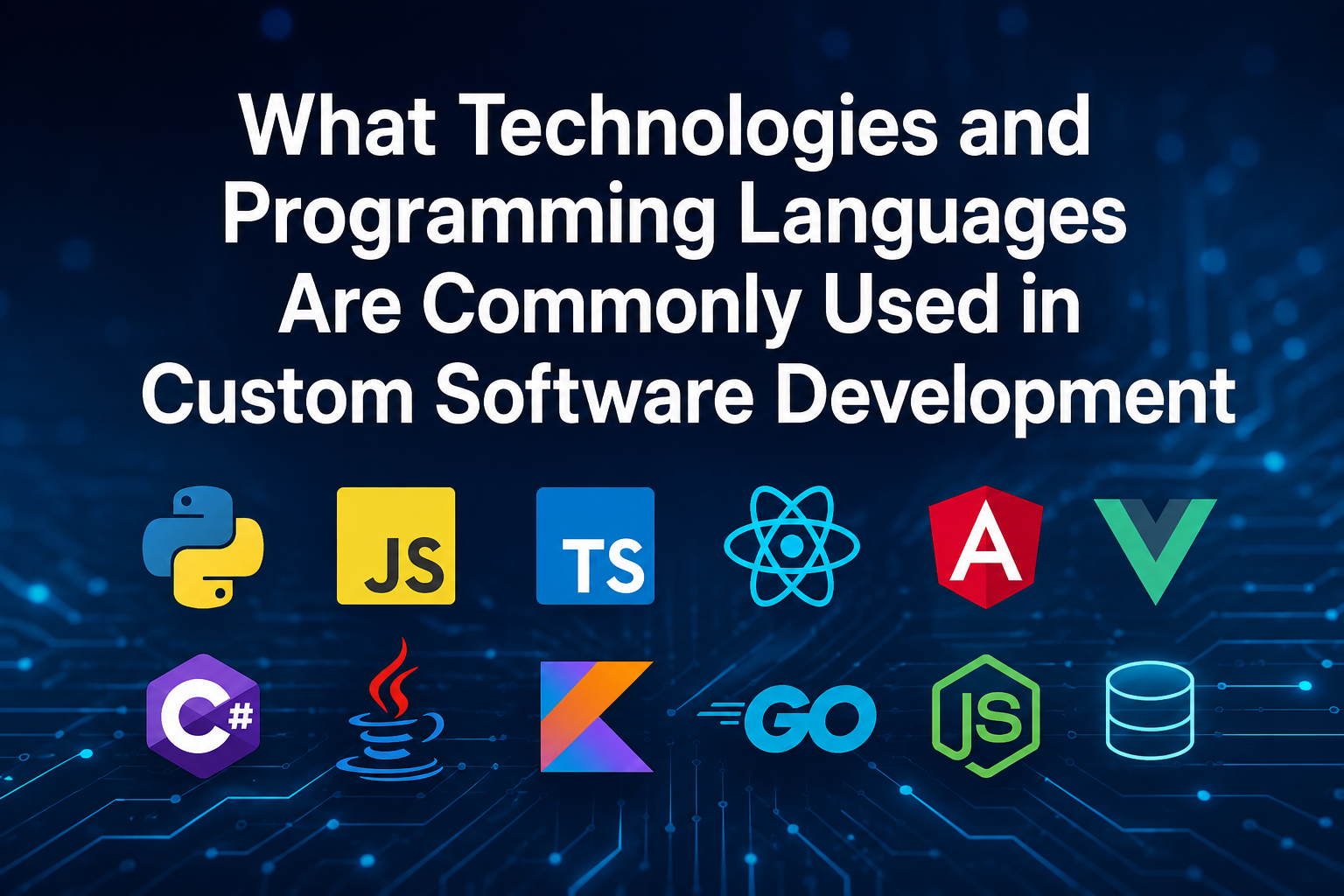
Custom software solutions are becoming increasingly popular among businesses. They offer just the right thing required to streamline the day-to-day operations of a specific business. The features and benefits of custom software depend a lot upon the tech stack used in its development.
However, the usage of the tech stack differs according to the custom software development service you choose. But there are some common technologies and programming languages that the development community uses for bespoke software development.
Commonly Used Technologies and Programming Languages in Custom Software Development [2023]
The process of developing custom software entails making programs that are specifically suited to fulfill company needs. There are different factors that play a role in the selection of technologies and programming languages. These factors include the complexity of the project, the need for scalability, and the demands for security. Plus, the level of competence of the development team is also an important factor.
In the creation of custom software, the following technologies and programming languages are frequently used:
1. Programming Languages:
· Java: Widely used for enterprise applications, web development, and Android app development, this flexible language has a sizable ecosystem.
· Python: The most simple and readable programming language. Commonly used for web development, data analysis, machine learning, and scripting.
· C# (.NET): Microsoft's language used for Windows applications, web development, and game development with Unity.
· JavaScript: The language of the web, used for frontend and backend development (Node.js).
· PHP: A popular language for web development, often used with frameworks like Laravel and WordPress.
· Ruby: Known for its elegant syntax, used with the Ruby on Rails framework for web development.
2. Web Development Frameworks:
· React: A JavaScript library for building dynamic user interfaces (frontend).
· Angular: A robust frontend framework maintained by Google.
· Vue.js: A progressive front-end framework for building user interfaces.
3. Backend Frameworks:
· Node.js: A JavaScript runtime used to build scalable server-side applications.
· Django: A Python framework for rapid backend development, known for its built-in admin interface and security features.
· Ruby on Rails: A powerful Ruby framework that emphasizes convention over configuration for backend development.
· ASP.NET Core: A cross-platform framework for building scalable and high-performance web applications with C#.
4. Database Management Systems:
· MySQL: An open-source technology for relational database management.
· PostgreSQL: A powerful and extensible open-source relational database system.
· MongoDB: A NoSQL database, suitable for handling large volumes of unstructured data.
· Microsoft SQL Server: A robust database management system used primarily with .NET applications.
5. Mobile App Development:
· Swift & Objective-C: Swift is Apple's modern programming language, and Objective-C is its predecessor, used for iOS app development.
· Kotlin & Java: Kotlin is the modern language preferred for Android app development, but Java is still widely used.
6. Cloud Platforms:
· Amazon Web Services (AWS): Offers a wide range of cloud services for scalable and cost-effective applications.
· Microsoft Azure: Provides cloud services for building, deploying, and managing applications.
· Google Cloud Platform (GCP): Offers cloud services and resources for various application needs.
7. DevOps and Deployment:
· Docker: Containerization platform for packaging applications and dependencies for easy deployment.
· Kubernetes: Container orchestration tool to manage and scale containerized applications.
· Continuous Integration and Continuous Deployment (CI/CD) tools: Such as Jenkins, GitLab CI/CD, and Travis CI, to automate the software delivery process.
The selection of the tech stack depends on both the custom software development service and the client. Let us discuss the importance of choosing the right tech stack for custom software development.
Why Is It Necessary to Choose the Right Technologies and Programming Languages for Custom Software Development?
For the development of custom software, picking the appropriate programming languages and technologies is essential. It is mainly because doing so directly affects the project's success and long-term viability.
The following is the list of things affected by the selection of the tech stack:
· Meeting Business Requirements: specific business needs, scalability requirements, and performance expectations.
· Efficiency and Productivity: good frameworks improve development speed and team productivity, resulting in faster time-to-market.
· Integration and Interoperability: suitable tech stack integrates seamlessly with existing systems and can communicate with other applications.
· Security and Reliability: perfectly selected technologies and languages help in building secure and reliable software, safeguarding sensitive data, and protecting against cyber threats.
· Scalability and Futureproofing: it is important to accommodate growing user bases and evolving business needs.
Choosing the wrong technologies may lead to subpar performance, security vulnerabilities, and increased maintenance costs. Companies for custom software development uk and all over the world emphasize the careful selection of programming languages and development frameworks. The process requires an understanding of the project's objectives, user requirements, and potential constraints to make informed decisions and build a successful and sustainable solution.

 Arabic
 Français
 Español
 Português
 Deutsch
 Türkçe
 Dutch
Dutch
 Italiano
 Russian
 Romaian