


Build Production-Ready Computer Vision Engineering Skills
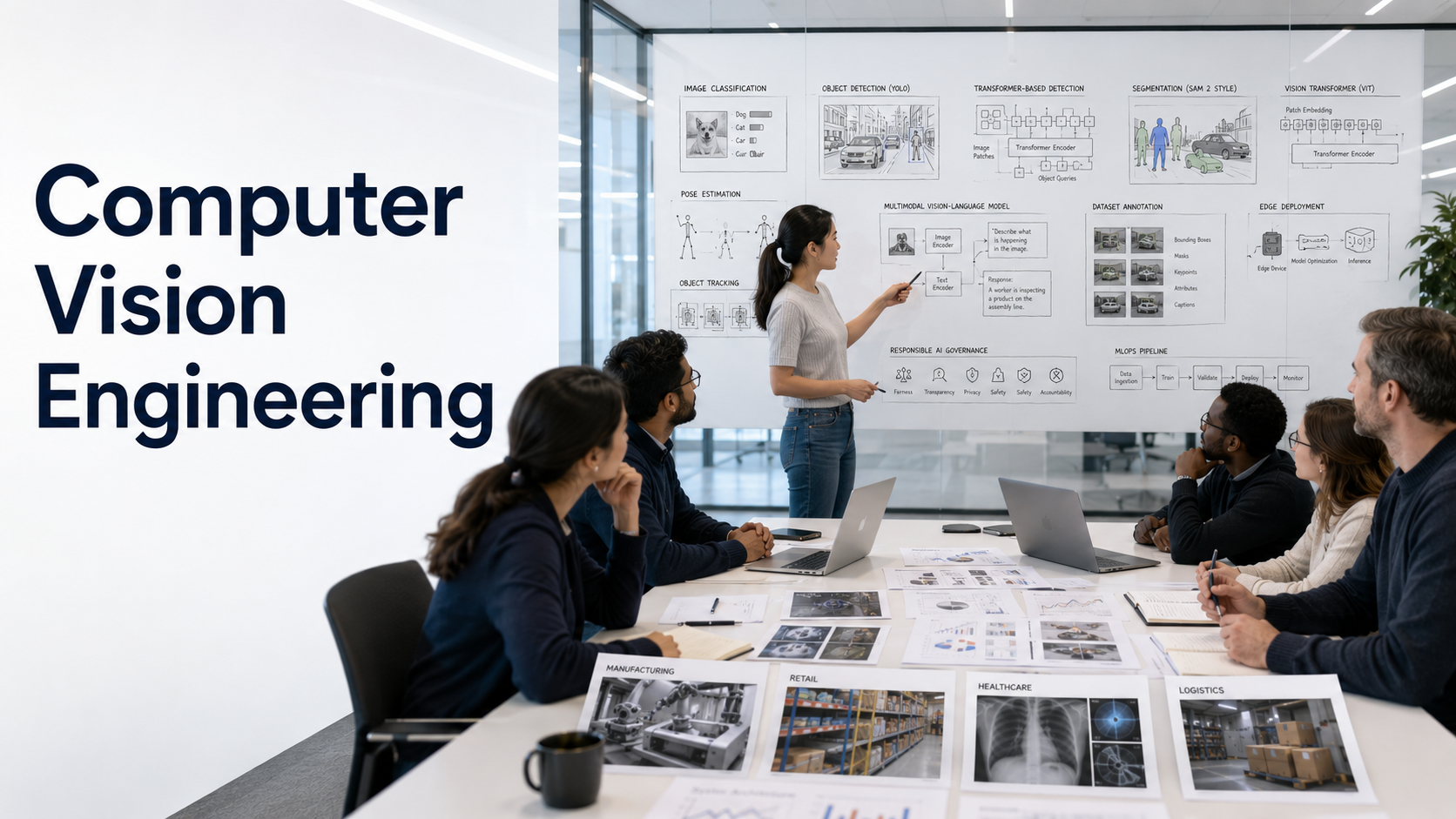
Images and video have become operational data. Manufacturers inspect components, retailers monitor shelves, healthcare teams analyse scans, and logistics operators track movement across facilities. However, converting visual information into dependable decisions requires more than training a model on a sample dataset. Organisations need engineers who can design, evaluate, deploy, monitor, and govern complete vision systems. A structured Computer Vision with AI Course provides the technical depth needed to move from experimentation to production.
Why Computer Vision Projects Struggle After the Demo
A proof of concept may detect objects successfully in controlled conditions but fail when lighting, camera angles, backgrounds, or data distributions change. Other projects encounter annotation inconsistency, slow inference, weak edge performance, or unclear privacy controls.
These problems highlight an important reality: successful computer vision training must cover the full engineering lifecycle. Teams need to understand image preparation, architecture selection, dataset quality, evaluation metrics, optimisation, deployment, drift monitoring, and responsible use. Choosing a popular model is easy; maintaining reliable performance in the real world is the difficult part.
Build Modern Vision Skills Across Architectures
NovelVista’s 36-hour blended programme combines instructor-led learning, GPU labs, and a production capstone. Its 13-module curriculum covers classical vision foundations, image classification, YOLO and DETR object detection, semantic and instance segmentation, SAM 2, vision-language models, tracking, annotation, edge deployment, MLOps, and responsible computer vision.
This breadth makes the programme relevant for ML engineers, computer vision engineers, robotics specialists, applied scientists, embedded developers, and senior software engineers who already understand Python and deep-learning fundamentals.
Learn Detection, Segmentation, and Multimodal Vision
A practical YOLO training course should teach professionals when speed-focused detectors are appropriate and when transformer-based detection may offer a stronger fit. Learners also need to compare classification, detection, segmentation, pose estimation, and tracking according to the business problem.
The curriculum includes YOLO-family models, DETR variants, SAM 2 training, Vision Transformers, CLIP, LLaVA, and other multimodal workflows. This helps teams select architectures based on accuracy, latency, compute availability, and operational constraints instead of following trends blindly.
Design for Edge and Cloud Deployment
Production systems must perform outside notebooks. A warehouse camera, mobile device, factory controller, or healthcare workstation may have strict limits on response time, memory, power, and connectivity.
NovelVista’s advanced computer vision course introduces ONNX, TensorRT, INT8 and FP16 quantisation, mobile and embedded deployment, model serving, and performance optimisation. Learners also work with MLflow, Weights & Biases, data drift, label drift, and retraining patterns to understand how vision models are maintained after launch.
Apply Responsible Computer Vision Practices
Visual AI can affect privacy, fairness, and regulatory exposure, especially in facial analysis, surveillance, security, and healthcare. Teams should document intended use, known limitations, dataset composition, evaluation results, and human oversight.
The course addresses bias audits, privacy obligations, model cards, system cards, and responsible deployment. Its production capstone requires learners to build and document an industry-focused vision system, giving organisations clearer evidence of practical capability.
Convert Vision Expertise into Business Capability
Effective corporate computer vision training connects technical learning with funded use cases such as defect detection, retail monitoring, medical imaging, document extraction, and security analytics. Teams should begin with a defined operational problem, establish a measurable baseline, validate annotation quality, and test performance under realistic conditions.
NovelVista’s Computer Vision with AI Course offers a customisable pathway for organisations seeking stronger capabilities across model development, multimodal AI, edge deployment, MLOps, and governance.
Request a customised syllabus or schedule a scoping discussion with NovelVista to build a production-focused computer vision programme aligned with your team’s technology stack and target use cases.

 English
 Arabic
 Français
 Português
 Deutsch
 Türkçe
 Dutch
Dutch
 Italiano
 Russian
 Romaian