


Study Permit vs Student Visa: The Complete Guide for Pakistani Students Studying Abroad
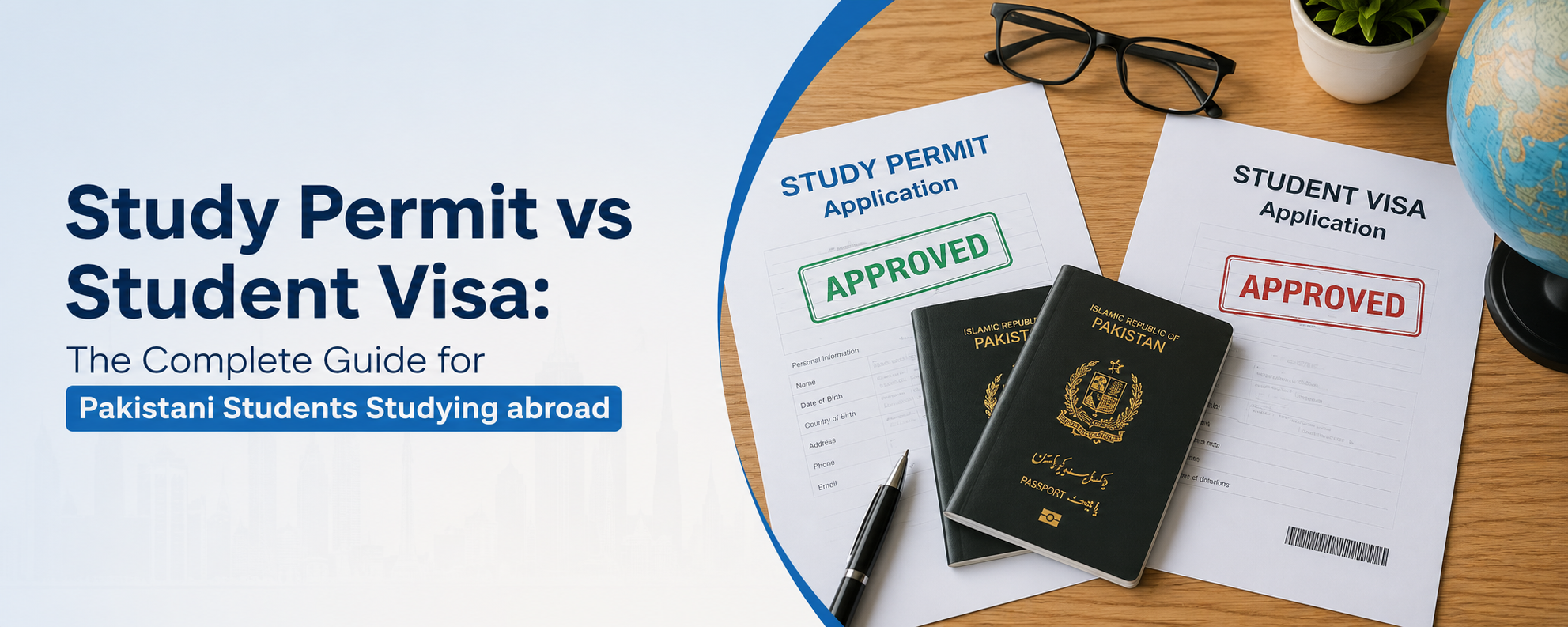
Every year, thousands of Pakistani students begin their study abroad journey with a university offer letter in hand and excitement in their eyes only to hit a wall of confusion at the very next step: Do I need a student visa or a study permit The two terms appear everywhere online, often used as if they mean the same thing. But depending on where you're headed, mixing them up can cost you weeks of processing delay, an incomplete application, or, in worse cases, a rejection you didn't see coming.
This guide gives you a clear, accurate breakdown of what a student visa is, what a study permit is, and exactly which one (or both) you need for Canada, the UK, the USA, and Australia so you walk into your application knowing precisely what to prepare.
Why This Confusion Costs Pakistani Students Time and Money
Study abroad consultants across Pakistan see the same pattern every intake season: a student gathers documents for a "visa," submits them, and later finds out the destination country actually required a completely different process or an additional document they never budgeted time or money for. Immigration systems don't forgive guesswork. A single wrong assumption about which document governs your entry versus your right to stay can push your intake back by an entire semester.
Understanding study permit vs student visa terminology isn't just an academic exercise it directly affects your application timeline, your bank statement planning, your visa interview preparation, and even how many hours you're legally allowed to work once you arrive.
What Is a Student Visa?
A student visa is fundamentally an entry document. It is issued by the embassy or consulate of your destination country, usually stamped or attached to your passport, and it grants you permission to travel into that country for the specific purpose of studying.
A student visa typically confirms the following:
-
That you have been accepted by a recognized institution
-
That you meet the financial requirements set by that country
-
The approved duration you're permitted to stay for your course
In many countries, the USA, the UK, and Australia among them the student visa does double duty: it lets you enter the country and legally authorizes your study period, all through a single document.
What Exactly Is a Study Permit?
A study permit works differently. Rather than being issued abroad by an embassy, it's granted by the immigration authority inside your destination country, and it governs your legal right to stay and study, not your entry.
A study permit usually specifies the following:
-
Which Designated Learning Institution (DLI) you're authorized to attend
-
How many hours per week you can work during your semester
-
The total duration you're permitted to remain in the country as a student
-
Conditions around renewal if your program runs longer than initially approved
Canada is the country where this distinction matters most for Pakistani students. Immigration, Refugees and Citizenship Canada (IRCC) issues your study permit based on your Letter of Acceptance (LOA), and this is a completely separate process from getting permission to enter the country.
Study Permit vs Student Visa: Side-by-Side Comparison
|
Factor |
Student Visa |
Study Permit |
|
Core purpose |
Grants entry into the country |
Grants legal permission to stay and study |
|
Issuing authority |
Embassy/consulate in Pakistan |
Immigration authority inside destination country |
|
Where it's used |
USA, UK, Australia, most European countries |
Canada (as a separate document) |
|
Work rights |
Often built directly into the visa |
Defined by permit conditions (weekly hour limits) |
|
Validity |
Usually fixed for course duration |
May require renewal/extension |
|
Application order |
Applied for after university offer |
Applied for after Letter of Acceptance (Canada) |
The simplest way to remember it: a visa gets you in, a permit lets you stay. Some countries combine both functions into one document. Canada keeps them deliberately separate.
How This Works in Canada: Study Permit, TRV, and eTA Explained
For Pakistani students applying to study in Canada, the process almost always involves two layers, not one:
-
Study Permit – Applied for through IRCC, based on your Letter of Acceptance from a Designated Learning Institution, proof of funds, and (for most applicants using the Student Direct Stream) a Guaranteed Investment Certificate (GIC).
-
Temporary Resident Visa (TRV) or eTA – Since Pakistan is a visa-required country, IRCC automatically issues a TRV alongside your approved study permit. This is what physically lets you board your flight and cross the Canadian border.
Without the study permit, holding a TRV alone does not authorize you to attend classes. And without the TRV, an approved study permit doesn't get you onto the plane. Pakistani students need both approved together but function for entirely different purposes.
What About the UK, USA, and Australia?
Not every destination splits the process this way. Here's how the terminology plays out for other top study destinations from Pakistan:
Study in UK: A single student visa, tied to your Confirmation of Acceptance for Studies (CAS) from a licensed sponsor institution. No separate permit is required.
Study in USA: The F-1 student visa, paired with your I-20 form and SEVIS fee payment. One visa covers both your entry and your study authorization.
Study in Australia: The student visa (subclass 500) functions as a single document covering entry and your entire study period.
Study in Europe: Many European countries follow a Canada-style model. You enter on a student visa, then apply for a residence permit locally once you arrive to legally remain for the length of your program.
5 Mistakes Pakistani Students Make With Visa and Permit Applications
-
Assuming every country uses one universal process. Students applying to Canada sometimes prepare documents as if it works like the UK or USA system, missing the study permit application entirely.
-
Overlooking work-hour conditions attached to the permit. Canada's study permit specifies exact part-time work limits different from what a UK or Australian visa allows, and getting this wrong can affect your status.
-
Missing renewal deadlines. Unlike a one-time student visa, a study permit may need extension if your program duration changes or runs longer than planned.
-
Applying for documents in the wrong order. In Canada, your study permit application must be based on an approved Letter of Acceptance applying prematurely or in the wrong sequenc. Applyingunnecessary delays.
-
Underestimating financial proof requirements. Whether it's a GIC for Canada or a maintenance fund requirement for the UK, financial documentation differs by destination and by document type a generic bank statement approach rarely works across all countries.
How to Know Which Document You Need
Before you start gathering paperwork, confirm three things: your destination country's specific system (single visa vs. visa-plus-permit), the exact issuing authority for each document, and the correct order of application. This single step prevents the majority of avoidable delays Pakistani students face each intake cycle.
Why Pakistani Students Trust Edwise Education for Visa Guidance
Since 2009, Edwise Education has guided thousands of Pakistani students through study visa and study permit applications for Canada, the UK, the USA, Australia, and Europe. Our counselors stay current with each country's evolving immigration requirements, from Canada's Student Direct Stream updates to the UK's CAS-based process, so you're never relying on outdated or generalized information. We match your profile to the correct document pathway from day one, reducing the risk of costly application errors.
Final Thoughts
The difference between a study permit and a student visa isn't just terminology; it's the foundation of a correctly filed, on-time application. Get it right, and your study abroad journey moves forward smoothly. Get it wrong, and you risk delays that can push your intake back by months.
Book a free consultation with Edwise Education and get destination-specific guidance tailored to your chosen country before you apply.
Frequently Asked Questions
Is a study permit the same as a student visa?
Not always. A student visa grants entry into a country, while a study permit grants legal permission to stay and study there. Canada requires both as separate documents; most other destinations combine them into one.
Does Canada require both a visa and a study permit?
Yes. Pakistani students need a study permit to legally stay and study in Canada, plus a temporary resident visa or eTA to enter the country. Both are typically issued together by IRCC.
Which countries only require a student visa, not a separate permit?
The USA, UK, and Australia each issue a single student visa that covers both entry and full study authorization, so no separate permit is required.
Can I work while on a study permit?
Yes, but the number of hours you're allowed to work depends on the specific conditions listed on your study permit or visa. Always verify current rules before you plan your schedule.
What happens if my study permit expires before my course finishes?
You must apply for an extension through the destination country's immigration authority before the expiry date to avoid falling out of legal student status.
Do I need a study permit for the UK or the USA?
No. The UK and USA each use a single student visa system, so a separate study permit isn't part of their process.

 English
 Arabic
 Français
 Español
 Português
 Deutsch
 Dutch
Dutch
 Italiano
 Russian
 Romaian