


Essential Skills Every Site Reliability Engineer Should Have
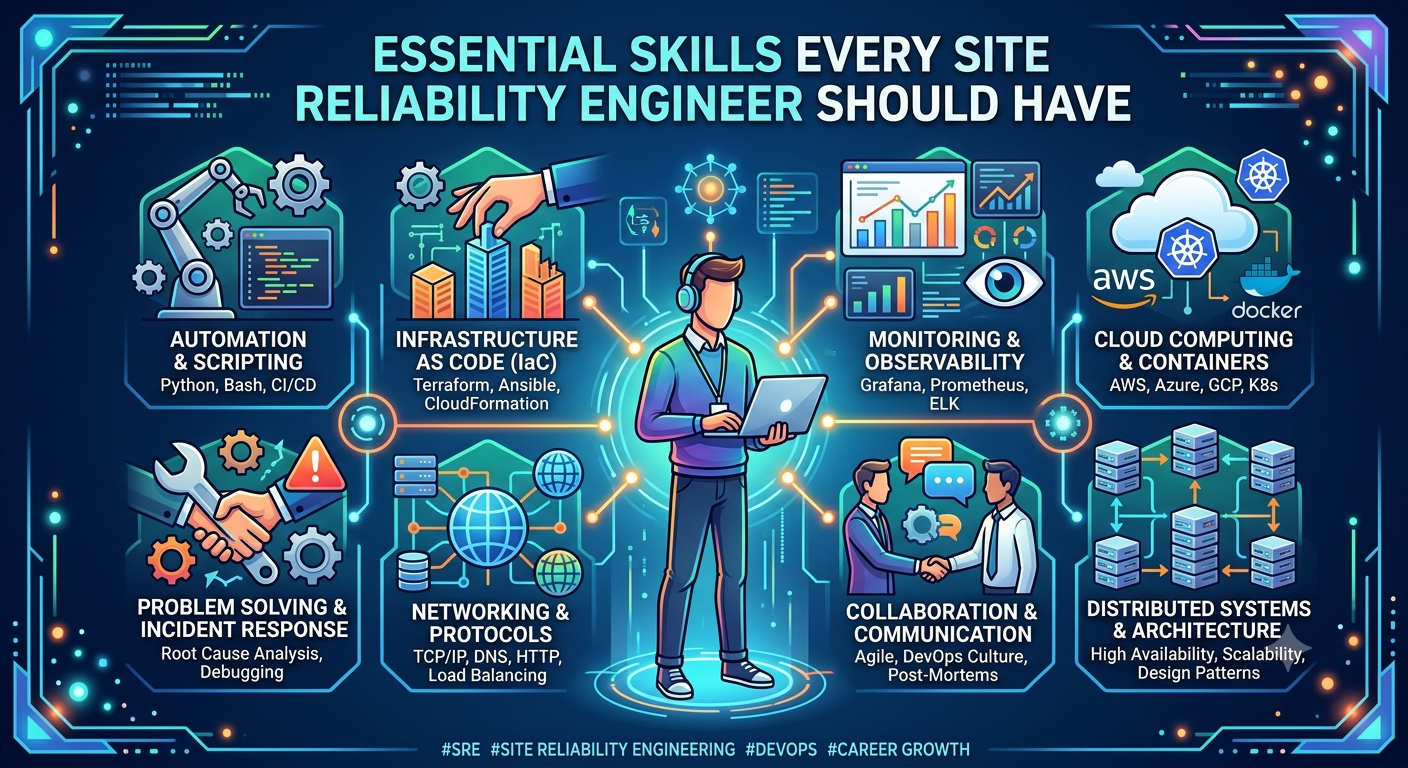
As organizations continue to rely on cloud-native applications and always-on digital services, the demand for skilled Site Reliability Engineers (SREs) is growing rapidly. SREs bridge the gap between software development and IT operations by ensuring systems remain reliable, scalable, and efficient. If you're planning to pursue an SRE Certification or enroll in an SRE Course, understanding the core skills required for the role is the first step toward a successful career.
1. Strong Linux and System Administration Skills
Linux is the foundation of most production environments. A Site Reliability Engineer should be comfortable managing servers, configuring services, troubleshooting system issues, and optimizing performance. Knowledge of shell scripting also helps automate repetitive administrative tasks.
2. Programming and Automation
Automation is at the heart of Site Reliability Engineering. SREs should know at least one programming language such as Python, Go, or Java. Writing scripts to automate deployments, monitoring, backups, and incident responses reduces manual effort and minimizes human error.
Most SRE Training programs include automation concepts because they are essential for improving operational efficiency.
3. Cloud Computing Knowledge
Modern applications run on cloud platforms like AWS, Microsoft Azure, and Google Cloud Platform. SREs must understand cloud services, networking, storage, security, and scaling strategies. Familiarity with Infrastructure as Code (IaC) tools like Terraform is also highly valuable.
4. Monitoring and Observability
A reliable system requires continuous monitoring. SREs should know how to use tools such as Prometheus, Grafana, ELK Stack, or Datadog to track system health and identify issues before they affect users.
Understanding metrics, logs, and traces helps engineers quickly diagnose problems and improve application performance.
5. Incident Management and Problem Solving
Unexpected failures are inevitable. A skilled Site Reliability Engineer must remain calm under pressure, identify root causes, and restore services quickly. Knowledge of incident response processes, post-incident reviews, and Root Cause Analysis (RCA) is essential.
An SRE Course often includes real-world scenarios to build these critical troubleshooting skills.
6. CI/CD and DevOps Practices
Continuous Integration and Continuous Deployment (CI/CD) enable faster and more reliable software releases. SREs should understand tools like Jenkins, GitHub Actions, GitLab CI/CD, or Azure DevOps to support automated deployment pipelines.
This knowledge helps improve software delivery while maintaining system stability.
7. Containerization and Kubernetes
Containers have become the standard for deploying modern applications. SREs should understand Docker and Kubernetes to manage containerized workloads, automate scaling, and ensure high availability across distributed environments.
These skills are now commonly included in advanced SRE Training programs.
8. Communication and Collaboration
Technical expertise alone isn't enough. SREs work closely with developers, security teams, and business stakeholders. Strong communication, documentation, and collaboration skills help teams resolve incidents faster and continuously improve system reliability.
Conclusion
A successful Site Reliability Engineer combines technical knowledge with analytical thinking and effective collaboration. Skills in Linux, automation, cloud platforms, monitoring, CI/CD, Kubernetes, and incident management form the foundation of the profession. Earning an SRE Certification validates these capabilities, while a structured SRE Course and hands-on SRE Training provide the practical experience needed to succeed in today's fast-paced IT environments. As businesses continue to prioritize reliability and scalability, mastering these essential skills can open the door to rewarding career opportunities in Site Reliability Engineering.

 English
 Arabic
 Français
 Español
 Português
 Deutsch
 Türkçe
 Italiano
 Russian
 Romaian