


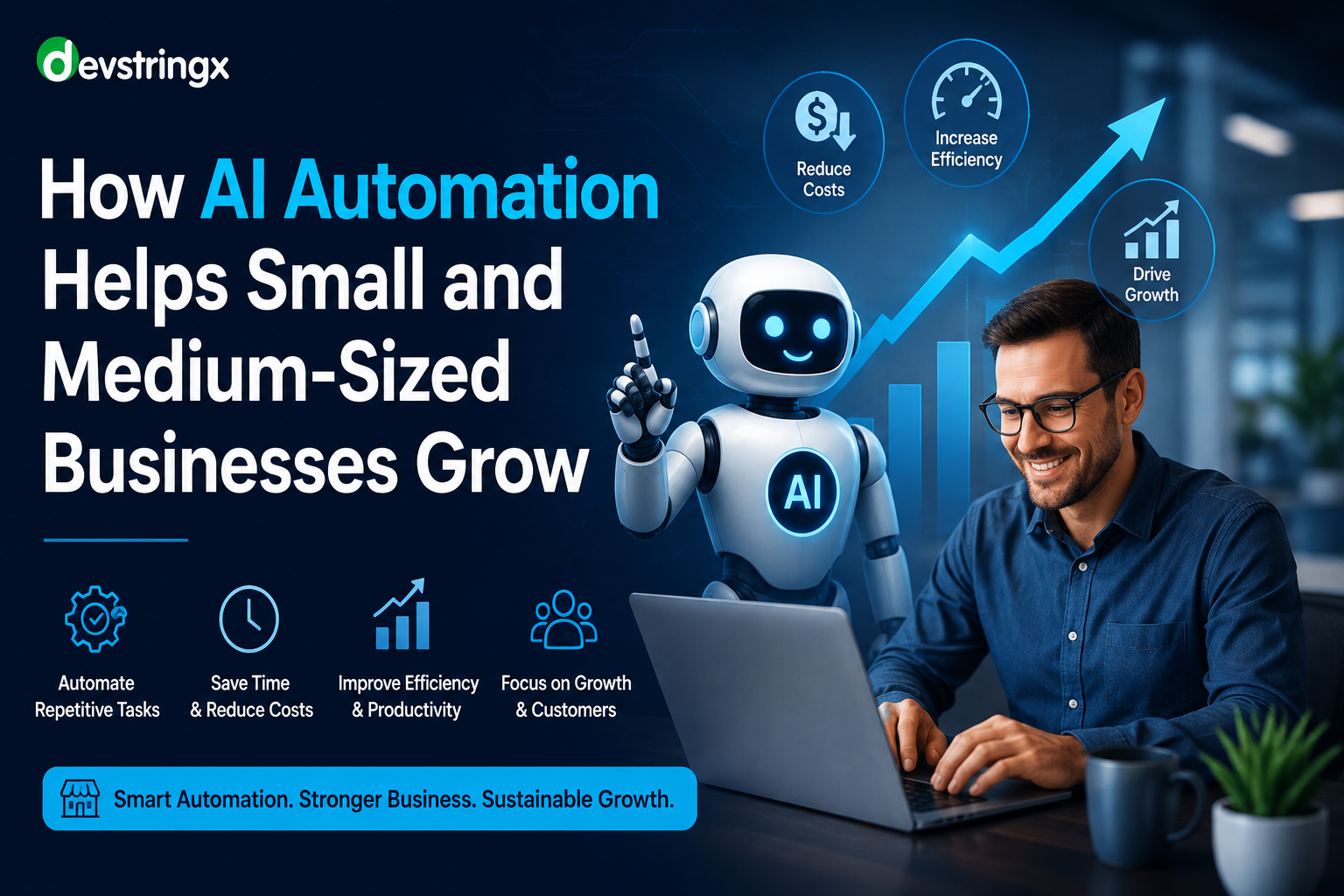
How AI Automation Helps Small and Medium-Sized Businesses Grow
Introduction
Small and medium-sized businesses (SMBs) play an important role in the global economy. However, growing a business in a competitive market can be challenging. Limited resources, rising operational costs, increasing customer expectations, and growing competition often make it difficult for SMBs to scale efficiently.
This is where AI automation can make a significant difference.
Artificial intelligence and automation are no longer technologies limited to large enterprises. Today, small and medium-sized businesses can use AI-powered tools and automated workflows to reduce repetitive work, improve productivity, deliver better customer experiences, and make smarter decisions.
Instead of spending valuable employee time on repetitive manual tasks, businesses can automate routine processes and allow teams to focus on more strategic activities.
From customer service and marketing to sales, finance, HR, and operations, AI automation can support businesses across multiple functions.
In this article, we explore how AI automation helps small and medium-sized businesses grow and why adopting the right automation strategy can create long-term business value.
What Is AI Automation?
AI automation combines artificial intelligence with automated workflows to perform tasks that traditionally require human effort.
Traditional automation typically follows predefined rules.
For example:
If a customer submits a form → Send an email.
AI automation can make the process more intelligent.
For example:
Customer submits a message → AI understands the customer's intent → Analyses the request → Generates a relevant response → Updates the CRM → Escalates complex issues to a human.
This combination of AI and automation allows businesses to automate more complex processes while maintaining appropriate human oversight.
1. AI Automation Reduces Repetitive Manual Work
One of the biggest benefits of AI automation for SMBs is reducing repetitive tasks.
Employees often spend significant amounts of time on activities such as:
- Data entry
- Email management
- Document processing
- Appointment scheduling
- Report generation
- Customer follow-ups
- Invoice processing
- Lead qualification
While these tasks may be necessary, they do not always require human creativity or strategic thinking.
AI automation can handle many routine activities, allowing employees to spend more time on tasks that directly contribute to business growth.
For example, an automated workflow can collect information from a customer form, update the CRM, assign the lead to the right salesperson, and send a follow-up email.
This saves time and creates a more efficient workflow.
2. AI Helps Small Businesses Increase Productivity
Small businesses often operate with limited teams.
An employee may be responsible for multiple functions, making productivity extremely important.
AI automation can help employees complete tasks faster by assisting with:
- Information retrieval
- Content generation
- Data analysis
- Customer communication
- Document processing
- Workflow management
Instead of manually completing every step, employees can use AI tools to automate repetitive parts of their work.
This allows small teams to accomplish more without increasing their workload at the same rate.
The result can be greater productivity and more efficient use of existing resources.
3. AI Automation Helps Reduce Operational Costs
Cost management is critical for SMBs.
Hiring additional employees for every increase in workload may not always be financially sustainable.
AI automation can help reduce certain operational costs by streamlining repetitive workflows and improving resource utilization.
For example, businesses can automate:
- Customer inquiries
- Invoice processing
- Data entry
- Scheduling
- Marketing workflows
- Internal reporting
Automation does not eliminate every operational cost, but it can help businesses use their resources more efficiently.
The key is to identify processes where automation can generate measurable value.
4. AI Automation Improves Customer Service
Customers expect fast and convenient support.
However, small businesses may not have the resources to maintain large customer service teams.
AI automation can help SMBs provide better customer support through:
- AI chatbots
- Automated FAQs
- Intelligent ticket routing
- Automated follow-ups
- Customer data analysis
- AI-powered support assistants
For example, an AI chatbot can answer common questions at any time, while complex issues can be automatically transferred to human support staff.
This approach allows businesses to provide faster responses without removing human support from important customer interactions.
5. AI Helps Businesses Generate and Qualify Leads
Finding potential customers is essential for growth.
However, sales teams often spend significant time identifying and qualifying leads.
AI automation can help businesses:
- Collect lead information
- Score leads
- Identify potential customers
- Analyse customer behaviour
- Update CRM records
- Send automated follow-ups
For example, an AI system can analyse information submitted through a website and identify leads that are more likely to become customers.
The sales team can then prioritize high-value opportunities.
This can improve sales efficiency and help teams focus their time where it matters most.
6. AI Automation Supports Marketing Growth
Marketing can be challenging for SMBs with limited budgets and small teams.
AI automation can help streamline marketing activities such as:
- Email campaigns
- Customer segmentation
- Content creation
- Lead nurturing
- Social media workflows
- Campaign analysis
AI can help analyse customer behaviour and identify patterns.
Automation can then deliver targeted communication based on customer actions.
For example:
Customer downloads an ebook → AI identifies their interests → Customer is added to a relevant segment → Automated email sequence begins.
This can help SMBs create more personalized marketing experiences without manually managing every interaction.
7. AI Automation Helps Businesses Scale
One of the biggest challenges for growing businesses is managing increased demand.
As the number of customers increases, businesses often need to process more:
- Orders
- Leads
- Customer requests
- Documents
- Transactions
If every process depends on manual work, operational complexity can increase quickly.
AI automation can help businesses handle higher workloads without increasing manual effort at the same rate.
For example, an automated customer support workflow can process a larger number of routine inquiries while human employees handle complex cases.
This scalability can help SMBs grow more efficiently.
8. AI Helps Reduce Human Errors
Manual processes can result in mistakes.
Errors in data entry, document processing, or financial workflows can lead to:
- Delays
- Rework
- Customer dissatisfaction
- Financial losses
AI-powered automation can standardize repetitive workflows and reduce certain types of manual errors.
For example, automated data extraction can transfer information from documents into business systems without requiring employees to manually enter every field.
However, businesses should maintain appropriate quality checks and human oversight for important processes.
9. AI Automation Improves Decision-Making
Small businesses generate valuable data through their daily activities.
This data may include:
- Customer interactions
- Sales performance
- Website activity
- Marketing results
- Operational information
- Financial data
AI can help analyse large amounts of information and identify patterns.
Businesses can use AI-powered insights to better understand:
- Which products perform well
- Which customers are most valuable
- Where operational bottlenecks exist
- Which marketing campaigns generate results
- Where customer churn may occur
Better insights can help business owners make more informed decisions.
10. AI Automation Improves Employee Experience
Automation is not only about reducing costs.
It can also improve the employee experience.
Employees may become frustrated when they spend a large portion of their day performing repetitive tasks.
AI automation can reduce administrative workloads and allow employees to focus on:
- Creative work
- Customer relationships
- Strategic planning
- Problem-solving
- Innovation
This can help create a more productive and engaging work environment.
The best automation strategies focus on supporting employees rather than simply replacing human work.
11. AI Automation Helps Businesses Compete With Larger Companies
Large enterprises often have greater resources, larger teams, and bigger technology budgets.
AI automation can help SMBs compete more effectively by improving operational efficiency.
A small team using the right AI tools can potentially:
- Respond to customers faster
- Process leads more efficiently
- Automate marketing activities
- Analyse data more quickly
- Reduce administrative work
This can help smaller businesses operate more efficiently without requiring enterprise-level resources.
12. AI Automation Enables Personalized Customer Experiences
Customers increasingly expect personalized experiences.
AI can analyse customer data and help businesses understand individual preferences.
Businesses can use AI automation to personalize:
- Marketing messages
- Product recommendations
- Customer support
- Email communication
- Offers and promotions
For example, an online business can analyse customer behaviour and automatically recommend products based on previous interactions.
Personalization can help businesses build stronger customer relationships and improve engagement.
13. AI Automation Helps Improve Business Operations
Businesses often have processes that involve multiple departments and systems.
For example:
Lead Generation → Sales → CRM → Proposal → Contract → Invoice → Payment
Without automation, employees may need to manually move information between systems.
AI automation can connect these processes and trigger actions automatically.
This can help reduce bottlenecks and improve workflow visibility.
A well-designed automation strategy can help SMBs create smoother operations across departments.
14. AI Automation Supports Remote and Distributed Teams
Many SMBs now work with remote or hybrid teams.
AI automation can help employees access information and complete workflows regardless of location.
Automated systems can:
- Route tasks
- Send notifications
- Update records
- Generate reports
- Manage approvals
This can improve collaboration and reduce dependency on manual communication.
AI-powered assistants can also help employees find information quickly without searching through multiple systems.
15. AI Automation Helps Improve ROI
Businesses should evaluate AI automation based on measurable outcomes.
Useful metrics include:
- Time saved
- Cost reduction
- Productivity improvements
- Error reduction
- Customer satisfaction
- Lead conversion
- Revenue growth
For example, if a business spends 100 employee hours per month on a repetitive process and automation reduces this to 20 hours, the business can measure the value of the saved time.
A simple ROI calculation can be:
ROI = (Total Benefits - Total Investment) ÷ Total Investment × 100
Tracking ROI helps businesses identify which automation projects are delivering the most value.
16. AI Automation Supports Better Business Continuity
Businesses need processes that can continue operating even when employees are unavailable.
Automated workflows can help maintain consistency by ensuring that important tasks are triggered automatically.
For example:
- Customer follow-ups can be scheduled automatically.
- Reports can be generated regularly.
- Leads can be routed automatically.
- Notifications can be triggered based on predefined conditions.
This reduces dependency on individual employees for routine processes.
17. AI Automation Can Help SMBs Access Enterprise-Level Capabilities
In the past, advanced AI technologies were often associated with large enterprises.
Today, cloud platforms, AI APIs, SaaS solutions, and automation tools make advanced capabilities more accessible.
Small businesses can use AI for:
- Customer service
- Marketing
- Sales
- Analytics
- Operations
- Document processing
This allows SMBs to adopt advanced technologies without necessarily building everything from scratch.
Common AI Automation Use Cases for SMBs
Small and medium-sized businesses can start with practical use cases such as:
Customer Support
Automate common questions and support workflows.
Lead Management
Automatically capture, score, and route leads.
Marketing
Automate email campaigns, segmentation, and customer engagement.
Document Processing
Extract and organize information from invoices, forms, and documents.
Finance
Automate repetitive financial workflows and reporting.
HR
Streamline employee onboarding and administrative tasks.
Sales
Automate CRM updates, follow-ups, and sales assistance.
Operations
Connect systems and automate repetitive business processes.
How SMBs Can Start With AI Automation
Businesses do not need to automate everything at once.
A practical approach is to follow these steps.
Step 1: Identify Repetitive Processes
Find tasks that consume significant employee time.
Step 2: Measure Current Performance
Understand the existing cost, time, and error rates.
Step 3: Prioritize High-Value Opportunities
Choose processes where automation can provide measurable benefits.
Step 4: Start With a Pilot
Test automation on a focused use case.
Step 5: Measure Results
Track productivity, costs, time savings, and other KPIs.
Step 6: Improve and Scale
Once the pilot succeeds, expand automation to other business processes.
Working with an experienced AI Automation Agency in USA can help SMBs identify suitable use cases, choose appropriate technologies, and develop scalable solutions.
How to Choose the Right AI Automation Partner
The success of an AI automation project often depends on choosing the right technology partner.
Businesses should evaluate:
- AI and automation expertise
- Industry experience
- Portfolio and case studies
- Integration capabilities
- Data security
- Scalability
- Pricing transparency
- Communication
- Post-launch support
The right partner should focus on solving business problems rather than simply implementing the latest technology.
Conclusion
AI automation can provide significant opportunities for small and medium-sized businesses.
By automating repetitive work, improving customer service, supporting marketing and sales, reducing operational inefficiencies, and enabling better decision-making, AI can help SMBs operate more effectively and scale with greater confidence.
The key is to start strategically.
Businesses should identify processes that create the most friction, select high-value automation opportunities, define measurable goals, and continuously evaluate results.
For SMBs that lack internal AI expertise, partnering with an experienced AI Automation Agency in USA can provide access to specialized knowledge and technology without requiring the organization to build a large internal AI team.
AI automation is not about automating everything. It is about finding the right processes to automate so that people can focus on the work that creates the greatest value.
For small and medium-sized businesses, the right AI automation strategy can become a powerful tool for improving efficiency, serving customers better, and building a foundation for sustainable growth.
Frequently Asked Questions
1. How does AI automation help small businesses?
AI automation helps small businesses reduce repetitive work, improve productivity, streamline operations, enhance customer service, and manage growing workloads more efficiently.
2. Is AI automation affordable for small and medium-sized businesses?
Yes. SMBs can start with smaller automation projects and scale gradually. Cloud-based AI tools and specialized automation services can make advanced technology more accessible.
3. What business processes should SMBs automate first?
Businesses should consider repetitive, time-consuming, and measurable processes such as customer support, lead management, document processing, data entry, marketing workflows, and reporting.
4. Can AI automation help small businesses compete with larger companies?
Yes. AI automation can help SMBs improve efficiency, respond faster to customers, streamline operations, and deliver personalized experiences, helping them compete more effectively.
5. Do small businesses need an in-house AI team?
Not necessarily. SMBs can work with an experienced AI automation agency to access specialized expertise without hiring a complete internal AI team.
6. How long does it take to implement AI automation?
The timeline depends on the complexity of the process, integrations, data requirements, and solution scope. Starting with a focused pilot can help businesses achieve results faster.
7. How can SMBs measure the ROI of AI automation?
SMBs can measure ROI by tracking time saved, cost reductions, productivity improvements, error reduction, customer satisfaction, lead conversion, and revenue impact.
8. What is the first step toward AI automation?
The first step is to identify a specific business problem or repetitive process that can potentially benefit from automation. Businesses should then define measurable goals and evaluate suitable solutions.

 English
 Arabic
 Français
 Español
 Deutsch
 Türkçe
 Dutch
Dutch
 Italiano
 Russian
 Romaian