


How Riyadh Businesses Can Transform Their Ideas into Successful Mobile Applications
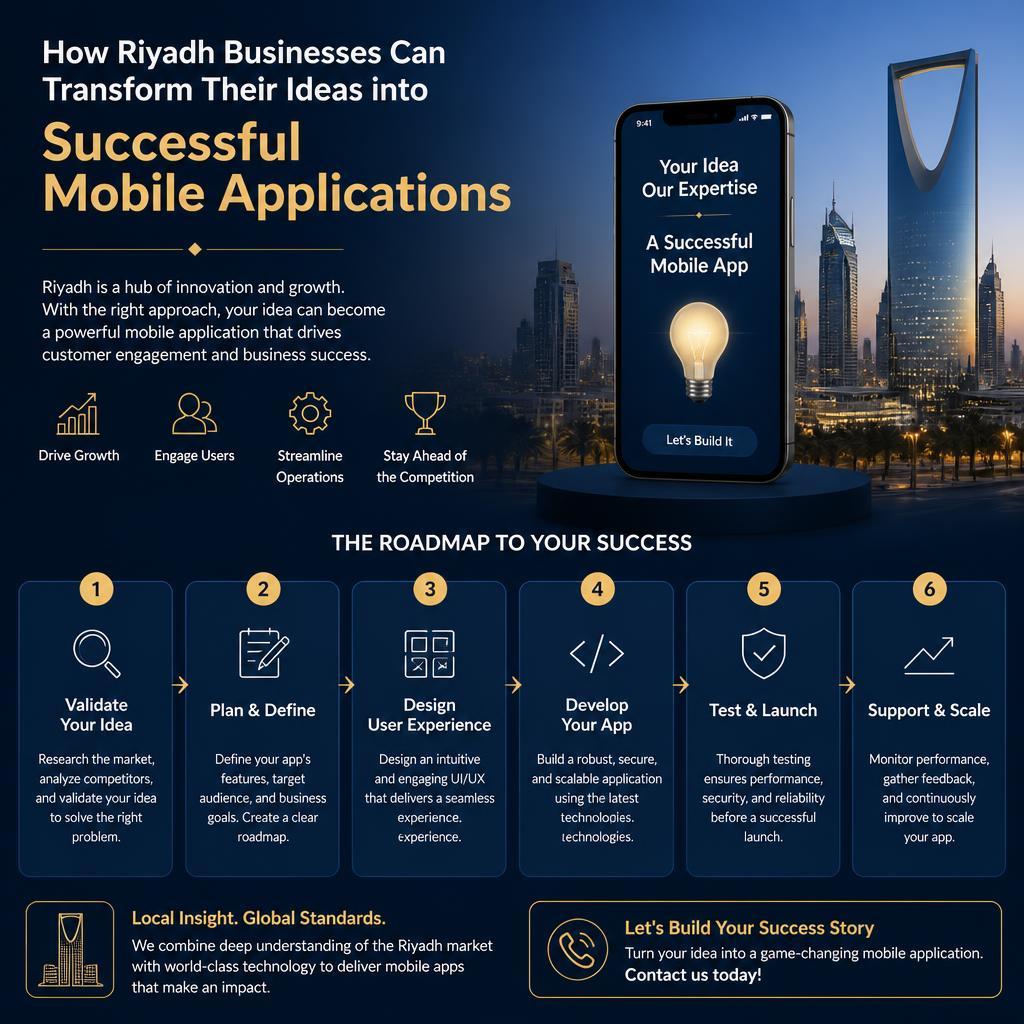
A great mobile application rarely begins with a line of code. It starts with a business idea, a customer problem, and a clear understanding of what digital experience can make that problem easier to solve.
For businesses operating in Riyadh, mobile applications can create new ways to interact with customers, streamline internal processes, simplify transactions, and deliver services more efficiently. From emerging startups to established enterprises, companies can turn a simple concept into a practical digital product when they approach development strategically.
However, having an interesting app idea is only the beginning. Turning that idea into a successful product requires market research, thoughtful planning, user-focused design, suitable technology, rigorous testing, and continuous improvement.
This guide explains how businesses can move from an initial concept to a reliable and valuable mobile application.
Why Are Mobile Applications Important for Riyadh Businesses?
Customer expectations are changing rapidly. People increasingly expect businesses to provide convenient digital experiences instead of making them depend entirely on traditional communication channels.
A well-designed application can help a company:
- Improve customer accessibility
- Simplify purchasing and booking processes
- Provide faster customer support
- Strengthen customer engagement
- Automate repetitive activities
- Collect useful business insights
- Create additional revenue opportunities
- Build stronger digital relationships
For a company serving customers in Riyadh, an application can also become an important channel for delivering services in a competitive local market.
The key is to develop an app because it solves a genuine business or customer problem—not simply because competitors already have one.
1. Turn the Initial Idea into a Clear Business Concept
Many app projects begin with a broad statement such as, "We want to create an app for our business."
That is not enough to guide development.
Start by converting the idea into a specific concept.
Ask:
- Who will use the application?
- What problem does it solve?
- Why would customers download it?
- What makes the solution different?
- How will the business benefit?
- What action should users complete inside the app?
For example, instead of saying, "We need a delivery application," a business could define its concept as:
"Customers can order products, select delivery preferences, monitor order progress, and receive real-time notifications through one convenient platform."
This level of clarity gives the development team a practical foundation.
2. Research the Riyadh Market Before Investing
A promising idea still needs market validation.
Before beginning mobile app development in Riyadh, businesses should investigate existing solutions and identify gaps that competitors have not addressed effectively.
Research should examine:
Competitors
Look at similar applications and understand their strengths and weaknesses.
Customer Complaints
Reviews can reveal recurring problems such as complicated checkout processes, slow support, confusing navigation, or unreliable notifications.
Market Demand
Determine whether customers actually need the proposed solution.
Pricing Models
Study whether competitors use subscriptions, commissions, one-time payments, advertising, or other revenue approaches.
Customer Expectations
Identify what users consider essential when choosing between competing applications.
This research can transform an untested idea into a stronger business proposition.
3. Identify Your Ideal App Users
An application designed for everyone often ends up being useful to no one in particular.
Businesses should define their primary users before deciding what the product should contain.
A target audience profile might include:
- Individuals looking for convenient services
- Parents searching for family-oriented solutions
- Retail customers who prefer digital shopping
- Professionals managing business activities
- Delivery customers tracking orders
- Organizations requiring internal workflow tools
Understanding users influences everything from interface design to feature selection.
For businesses targeting Riyadh, customer expectations should be considered within the local market rather than copying an application designed for another region.
4. Build a Strong Value Proposition
Users need a reason to install an application.
Your value proposition should explain the benefit clearly and quickly.
For instance:
"Book your preferred service in minutes without making phone calls."
or
"Track every delivery from dispatch to doorstep through one mobile platform."
A strong value proposition answers one important question:
Why should someone use this application instead of an alternative?
If that answer is unclear, adding more features will not necessarily make the product more successful.
5. Decide Which Features Actually Matter
Feature planning is one of the most important stages of custom mobile app development in Riyadh.
Businesses often become enthusiastic about adding every possible function. This can increase development costs and make the application difficult to use.
Instead, separate features into three groups.
Core Functions
These directly support the main purpose of the app.
Examples include:
- Account creation
- Product or service browsing
- Search
- Booking
- Checkout
- Order management
- Notifications
Supporting Functions
These improve convenience without defining the product.
Examples might include:
- Wishlist
- Ratings
- Saved preferences
- Promotional offers
- Referral systems
Future Enhancements
These can be introduced after the application gains traction.
Examples include:
- Advanced personalization
- AI-powered recommendations
- Loyalty programs
- Predictive analytics
- Additional automation
This approach allows the initial release to remain focused.
6. Create the User Experience Before Building the Product
A successful application should feel straightforward from the first interaction.
Before development begins, designers should map the important journeys users will take.
Consider a service application:
Open App → Select Service → Choose Date → Confirm Details → Make Payment → Receive Confirmation
Every stage should be logical.
Businesses should also consider what happens when something goes wrong.
What happens if:
- Payment fails?
- Internet connectivity disappears?
- A selected service becomes unavailable?
- A customer enters incorrect information?
- A booking needs to be cancelled?
Planning these situations creates a more reliable user experience.
7. Choose Technology Based on the Business Requirement
Technology should support the business objective rather than dictate it.
Depending on the project, businesses may consider native Android and iOS development or cross-platform technologies.
The appropriate approach depends on:
- Application complexity
- Target devices
- Performance requirements
- Development resources
- Integration requirements
- Long-term maintenance
- Scalability expectations
For example, a straightforward business application may benefit from a cross-platform approach, while a product requiring highly specialized device capabilities may need platform-specific development.
A knowledgeable mobile app development company in Riyadh can evaluate the requirements before recommending an appropriate technical architecture.
8. Plan Integrations Early
Modern applications rarely operate independently.
A business application may need to communicate with several external systems, including:
- Payment gateways
- CRM platforms
- ERP systems
- Inventory software
- Maps
- SMS providers
- Email services
- Accounting platforms
- Delivery systems
- Analytics tools
Integration requirements should be identified during planning rather than after development has already started.
This prevents technical surprises and makes it easier to estimate development effort.
9. Give Security the Attention It Deserves
An application can lose customer trust quickly if sensitive information is not handled properly.
Businesses should incorporate security into the architecture from the beginning.
Important considerations include:
- Secure login systems
- Strong authentication
- Data encryption
- Protected APIs
- Controlled user permissions
- Secure payment processing
- Regular security testing
- Monitoring for suspicious activity
Businesses should also collect only information that is genuinely necessary.
A simpler data model can often make an application easier to manage and protect.
10. Develop a Prototype Before Full Development
A clickable prototype can help businesses visualize the product before committing to full development.
A prototype can demonstrate:
- Navigation
- Screen layouts
- User journeys
- Key interactions
- Content hierarchy
- Major application functions
Stakeholders can review the prototype and identify problems early.
Changing a screen during the design stage is generally easier than rebuilding a completed feature after development.
This stage is especially useful when several departments or decision-makers are involved in the project.
11. Develop in Controlled Stages
Instead of treating development as one enormous project, divide it into manageable phases.
A practical workflow can include:
Discovery
Define objectives, users, features, and technical requirements.
Design
Create wireframes, prototypes, and the final interface.
Development
Build the application, backend systems, APIs, and integrations.
Testing
Identify functional, usability, security, and performance issues.
Deployment
Prepare the application for release and publish it through the appropriate stores.
Improvement
Use customer feedback and analytics to guide future updates.
This staged approach makes progress easier to measure and gives businesses more opportunities to adjust their strategy.
12. Test With Real Users
Internal testing is important, but real users can reveal problems that development teams may overlook.
A small group of representative customers can test the application before its wider release.
Ask them to perform realistic tasks such as:
- Create an account
- Search for a product
- Complete a booking
- Make a payment
- Change an order
- Contact support
Observe where they hesitate or become confused.
Their feedback can help improve the application before launch.
For a product targeting Riyadh customers, testing with representative local users can also provide valuable insight into whether the application feels intuitive for its intended audience.
13. Prepare a Launch and Marketing Strategy
Even an excellent application can struggle if nobody knows it exists.
Before launch, businesses should prepare a strategy for attracting their intended audience.
Potential channels include:
- Search marketing
- Social media
- Content marketing
- Email campaigns
- Existing customer databases
- Partnerships
- Referral programs
- Promotional offers
Businesses should also optimize their application store presence with clear descriptions, relevant screenshots, appropriate keywords, and compelling messaging.
The launch should be treated as the beginning of customer acquisition—not the conclusion of the project.
14. Measure What Happens After Launch
Once the application is live, businesses should pay attention to actual user behavior.
Useful metrics can include:
- Downloads
- Active users
- Retention rate
- Conversion rate
- Session frequency
- Feature adoption
- Customer feedback
- Uninstall rate
- Failed transactions
These measurements help answer an important question:
Is the application actually producing the expected business outcome?
If customers consistently abandon a particular process, the company can investigate and improve it.
This creates a continuous cycle of development rather than a one-time software project.
15. Work With the Right Development Partner
Choosing the right development team can significantly affect the quality, timeline, and scalability of the final product.
When evaluating a mobile app development company in Riyadh, businesses should consider more than price.
Look for:
- Relevant development experience
- Strong UI/UX capabilities
- Transparent communication
- Appropriate technology expertise
- Testing practices
- Security awareness
- Post-launch support
- Understanding of business objectives
The ideal partner should be able to discuss both technical requirements and commercial goals.
Five Programmers helps businesses turn application concepts into practical digital solutions by combining development expertise with a focus on usability and business requirements.
A development partnership should continue beyond the first release because applications require updates, maintenance, optimization, and new capabilities as the business grows.
Common Mistakes Riyadh Businesses Should Avoid
Several mistakes can weaken an otherwise promising application.
Building Without Market Research
An application should address a validated opportunity rather than an assumption.
Adding Too Many Features
Complexity can increase costs and make the user journey harder to understand.
Ignoring User Feedback
Customers often identify usability problems faster than internal teams.
Choosing Technology Only Because It Is Popular
A technology should fit the project's requirements.
Underestimating Maintenance
Operating systems, security requirements, integrations, and customer expectations change over time.
Focusing Only on Downloads
A large number of installations means little if users do not return or complete valuable actions.
Frequently Asked Questions
How can a business validate a mobile app idea before development?
Businesses can conduct customer interviews, competitor research, surveys, prototype testing, and small-scale market experiments. These methods can reveal whether the proposed solution addresses a genuine demand.
What is the first step in creating a business application?
The first step is defining the problem the application will solve and identifying the users who experience that problem. This creates a foundation for feature planning and product design.
Should businesses launch every planned feature at once?
Not necessarily. Launching with the most important functions can make the product easier to test, improve, and manage. Additional capabilities can be introduced based on customer feedback and business priorities.
How can a mobile application become more successful after launch?
Businesses should continuously study user behavior, collect feedback, fix usability problems, improve performance, and introduce features that provide measurable value. Regular optimization can help the application remain useful as customer expectations evolve.
Turn Your App Idea Into a Digital Reality
A successful application is the result of more than an attractive interface or advanced technology. It requires a clear business purpose, meaningful customer value, thoughtful planning, appropriate development practices, and continuous improvement.
For businesses in Riyadh, the opportunity is to transform ideas into digital experiences that make everyday interactions simpler, faster, and more convenient.
Whether you are a startup developing your first product or an established organization modernizing an existing service, the right development strategy can turn an initial concept into a scalable mobile solution.
Five Programmers can help you move from the first idea to design, development, testing, and ongoing improvement with a solution tailored to your business objectives.
Ready to transform your concept into a powerful digital product?
Contact Us or Get a Free Quote Today and take the first step toward building a successful mobile application in Riyadh.

 English
 Arabic
 Français
 Español
 Português
 Deutsch
 Türkçe
 Dutch
Dutch
 Italiano
 Russian