


AI Implementation Services: How Businesses Can Successfully Adopt AI
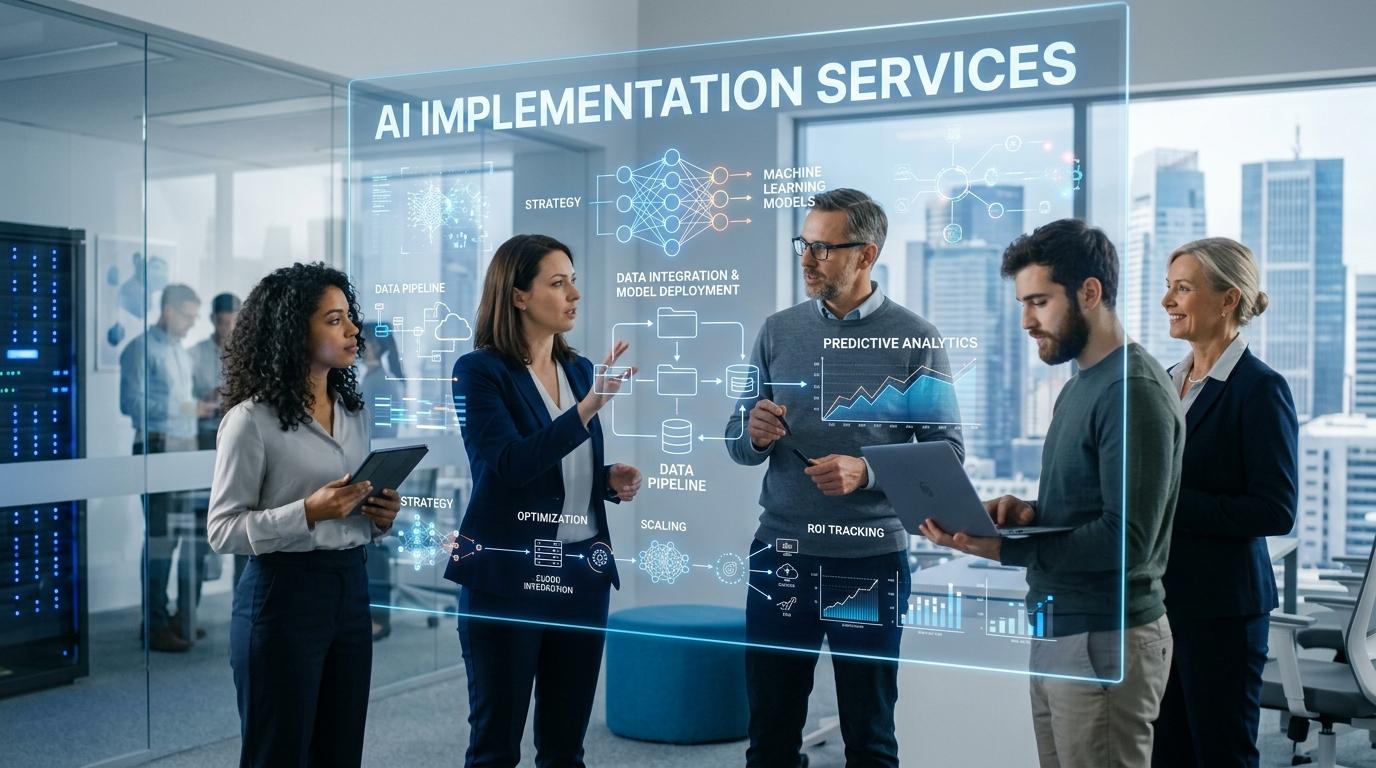
Artificial intelligence is rapidly becoming part of everyday business operations. Companies are using AI to automate repetitive tasks, analyze information, improve customer experiences, support employees, and make faster business decisions.
However, adopting AI is not as simple as purchasing an AI tool and connecting it to a company's existing systems. Businesses need to determine where AI can create measurable value, prepare their data and infrastructure, integrate AI with existing workflows, and train employees to use new technologies effectively.
This is where AI implementation services can play an important role.
AI implementation services help organizations move from experimenting with artificial intelligence to deploying practical AI solutions that work within real business environments.
What Are AI Implementation Services?
AI implementation services involve the planning, development, integration, deployment, and optimization of artificial intelligence solutions for a business.
Rather than treating AI as a standalone technology, implementation focuses on connecting AI with existing business processes and systems.
Depending on the organization's needs, implementation may involve:
-
AI strategy and consulting
-
Business process analysis
-
AI model integration
-
Generative AI implementation
-
Machine learning solutions
-
AI automation
-
Chatbot development
-
Data integration
-
Workflow automation
-
API integrations
-
AI-powered analytics
-
Employee enablement
-
AI monitoring and optimization
The objective is to make AI useful within the organization's existing operational environment.
Why AI Adoption Requires More Than Software
Many businesses start their AI journey by testing publicly available AI tools. These experiments can demonstrate the potential of artificial intelligence, but enterprise implementation requires a more structured approach.
A business may need to answer questions such as:
-
Which processes should be automated?
-
What data will the AI system use?
-
How will AI connect with existing software?
-
Who will manage the system?
-
How will outputs be evaluated?
-
What security controls are required?
-
How will employees use the new system?
-
How will the company measure ROI?
Without answers to these questions, an AI project can become an expensive technology experiment rather than a useful business solution.
Start With an AI Strategy
Successful AI implementation starts with identifying business problems.
Instead of asking, "Where can we use AI?" organizations should ask, "Which business challenges could AI solve?"
For example, a company may have a customer service team spending hours answering repetitive questions. An AI chatbot or AI-powered support assistant could potentially reduce that workload.
Another organization may spend significant time processing documents. Intelligent document processing could help extract and organize information automatically.
A sales organization may want to improve lead qualification, while a finance department may need faster analysis of large datasets.
The right AI strategy connects technology with measurable business objectives.
Identify High-Value AI Use Cases
Not every business process is suitable for AI implementation.
A strong implementation strategy prioritizes use cases based on factors such as business value, complexity, available data, risk, and potential return on investment.
Common AI use cases include:
Customer Service Automation
AI assistants can answer frequently asked questions, provide support information, and route more complex requests to human representatives.
Marketing Automation
AI can assist with content creation, customer segmentation, campaign analysis, personalization, and marketing workflows.
Sales Support
AI tools can help analyze leads, summarize customer interactions, identify opportunities, and support sales teams with relevant information.
Document Processing
AI can extract information from invoices, contracts, forms, reports, and other documents.
Business Intelligence
AI-powered analytics can help organizations identify patterns and generate insights from large volumes of business data.
Workflow Automation
Organizations can connect AI with existing applications to automate repetitive processes across departments.
Integrating AI With Existing Systems
One of the most important parts of AI implementation is integration.
Businesses rarely operate with a single software system. They may use CRM platforms, ERP systems, customer support software, databases, cloud applications, communication tools, and internal business applications.
An AI solution becomes significantly more useful when it can work with these existing systems.
For example, an AI sales assistant could connect with a CRM to retrieve customer information and summarize previous interactions. An AI support system could connect with a knowledge base to provide relevant answers.
This type of integration turns AI from an isolated tool into part of the organization's workflow.
Data Is at the Center of AI Implementation
AI systems depend heavily on data.
Poor-quality, incomplete, outdated, or inconsistent data can negatively affect AI performance.
Before implementing an AI solution, organizations should evaluate:
-
Data quality
-
Data availability
-
Data structure
-
Data access
-
Data security
-
Data governance
-
Data privacy
Businesses may need to clean, organize, transform, or consolidate their data before an AI system can use it effectively.
AI Implementation and Automation
AI implementation becomes particularly valuable when combined with business automation.
Traditional automation typically follows predefined rules. AI can introduce greater flexibility by allowing systems to interpret information, generate responses, classify content, summarize documents, and make recommendations.
For example:
Customer inquiry → AI understands request → Relevant information retrieved → Response generated → CRM updated → Human agent notified if necessary
This workflow can reduce manual effort while keeping employees involved when human judgment is required.
Employee Adoption Matters
Technology alone does not guarantee successful AI adoption.
Employees need to understand how AI fits into their daily responsibilities.
Organizations should provide appropriate training and establish clear guidelines for using AI systems. Employees should understand what the technology can do, where it may make mistakes, and when human review is required.
Successful implementation therefore involves both technology and people.
Security and Responsible AI
Businesses also need to consider security and responsible AI practices.
Depending on the application, AI systems may process confidential business information, customer data, financial information, or internal documents.
Implementation should therefore consider:
-
Access controls
-
Data protection
-
User permissions
-
Secure integrations
-
Monitoring
-
Human oversight
-
AI output validation
-
Compliance requirements
These considerations become increasingly important as AI moves deeper into business operations.
Measuring AI Implementation ROI
AI implementation should produce measurable business outcomes.
Depending on the use case, organizations can measure:
-
Time saved
-
Operating costs reduced
-
Customer response times
-
Support resolution rates
-
Lead conversion
-
Employee productivity
-
Revenue generated
-
Error reduction
-
Customer satisfaction
For example, if an AI automation system saves a customer service department hundreds of employee hours each month, the organization can compare those savings with implementation and operating costs.
This creates a clearer picture of AI's business value.
Why Businesses Work With AI Implementation Specialists
Building an AI solution internally can require expertise across artificial intelligence, software engineering, data management, cloud infrastructure, cybersecurity, automation, and business operations.
An experienced AI implementation partner can bring these capabilities together.
Instead of simply recommending an AI tool, an implementation partner can help an organization move through the complete process:
Strategy → Use-Case Identification → AI Solution Design → Integration → Deployment → Employee Adoption → Monitoring → Optimization
This structured approach can reduce implementation challenges and help businesses focus on outcomes rather than technology alone.
The Future of Business AI Is Implementation
AI experimentation is already widespread, but the next stage is practical implementation.
Organizations that successfully integrate AI into everyday operations can potentially improve efficiency, accelerate decision-making, and deliver better customer experiences.
The competitive advantage will not necessarily come from simply having access to AI.
It will come from knowing where, when, and how to implement it effectively.
Final Thoughts
AI implementation services provide businesses with a structured path from AI experimentation to real-world deployment.
From strategy and data preparation to system integration, automation, employee adoption, and performance monitoring, every stage matters.
Businesses should begin with measurable problems, prioritize high-value use cases, and implement AI in a way that complements existing workflows.
With the right strategy and implementation approach, artificial intelligence can become more than an experimental technology. It can become an integrated business capability that supports productivity, automation, customer experience, and long-term growth.

 Arabic
 Français
 Español
 Português
 Deutsch
 Türkçe
 Dutch
Dutch
 Italiano
 Russian
 Romaian