


Data Governance for Analytics Strengthens Trusted Business Intelligence
Introduction
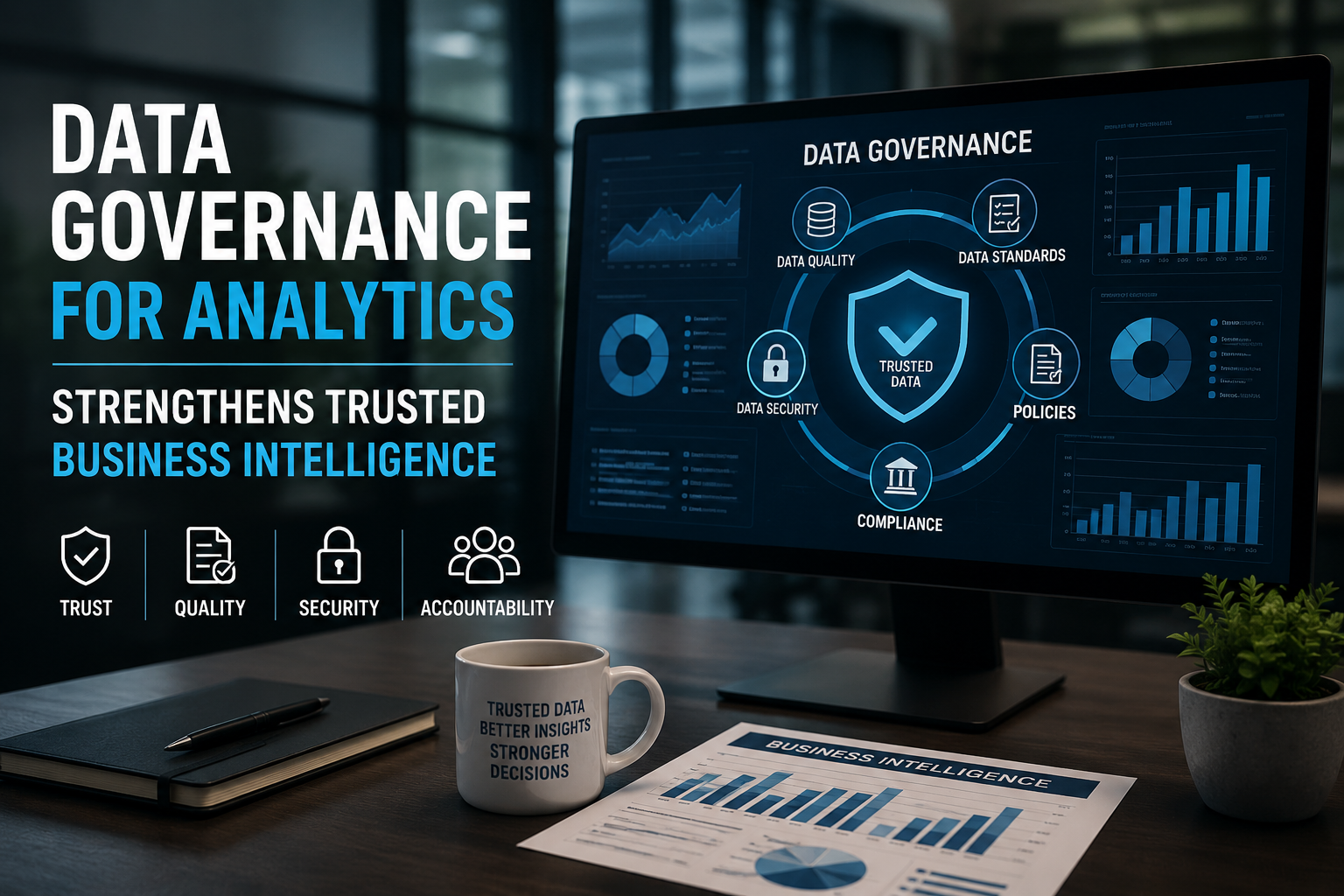
Organizations collect information from customer interactions, financial transactions, connected devices, applications, and digital platforms every day. While this growing volume of information creates valuable opportunities, it also introduces challenges related to quality, consistency, privacy, and compliance. Businesses cannot generate reliable insights unless their data is accurate, well-managed, and secure. This is where data governance for analytics becomes an essential business strategy rather than just a technical initiative.
Effective data governance for analytics establishes clear policies, ownership, standards, and processes that improve the reliability of analytical data. When teams trust the information they use, they make faster and more confident decisions that support business growth. Organizations also reduce operational risks, eliminate duplicate records, and improve collaboration across departments.
Modern enterprises increasingly rely on artificial intelligence, predictive analytics, and business intelligence platforms. These technologies perform best when supported by governed, high-quality datasets. Without proper governance, inaccurate or inconsistent information can produce misleading reports, poor forecasts, and ineffective business strategies.
Why Data Governance for Analytics Matters
Reliable analytics depends on trustworthy information. Companies often store data across multiple cloud services, business applications, warehouses, and legacy systems. When every department manages information differently, reporting becomes inconsistent and difficult to verify.
Implementing data governance for analytics creates standardized practices that improve data quality across the organization. Governance establishes common definitions, validation rules, ownership responsibilities, and security policies that ensure analytical data remains consistent from source to dashboard.
A governed analytics environment enables executives, analysts, and operational teams to work with confidence because everyone relies on the same trusted information.
Building Trust in Business Intelligence
Business intelligence platforms transform raw information into dashboards and reports that guide strategic decisions. However, even the most advanced analytics tools cannot compensate for poor-quality data.
Organizations that prioritize data governance for analytics establish data stewardship, documentation, metadata management, and quality monitoring processes. These practices help identify inconsistencies before they affect reports or predictive models.
When employees trust business intelligence reports, organizations spend less time validating numbers and more time acting on meaningful insights. This improved confidence supports better planning, budgeting, customer engagement, and operational efficiency.
Improving Data Quality Across Enterprise Systems
High-quality data is the foundation of successful analytics. Duplicate records, incomplete values, outdated information, and inconsistent formatting reduce reporting accuracy and slow decision-making.
A strong data governance for analytics framework introduces standardized quality controls throughout the data lifecycle. Validation rules, automated monitoring, and continuous auditing improve the reliability of information before it reaches analytics platforms.
Organizations also benefit from consistent data definitions that eliminate confusion between departments. Sales, finance, operations, and marketing teams work from the same trusted information, reducing reporting conflicts and improving collaboration.
Supporting Artificial Intelligence and Advanced Analytics
Artificial intelligence depends on accurate and well-prepared datasets. Machine learning models trained on inconsistent or biased information often generate unreliable predictions and poor business outcomes.
Organizations investing in AI initiatives increasingly recognize that data governance for analytics is a critical success factor. Governance ensures datasets remain complete, consistent, traceable, and compliant throughout model development and deployment.
Well-governed information improves feature engineering, model accuracy, explainability, and regulatory compliance. As AI adoption grows across industries, governance becomes even more valuable for maintaining trustworthy analytical systems.
Strengthening Security and Regulatory Compliance
Data privacy regulations continue evolving worldwide, making responsible information management increasingly important. Organizations must understand where sensitive information resides, who can access it, and how it is used.
An effective data governance for analytics strategy introduces clear access controls, classification standards, retention policies, and audit trails. These governance practices protect confidential information while supporting legitimate analytical requirements.
Compliance becomes easier when organizations maintain documented governance processes that demonstrate accountability, transparency, and responsible data handling.
Enhancing Collaboration Across Business Teams
Data often exists in separate business units with different naming conventions, quality standards, and reporting methods. These inconsistencies create communication barriers and reduce analytical efficiency.
Implementing data governance for analytics encourages collaboration by establishing shared business terminology, standardized metrics, and clearly assigned ownership responsibilities. Analysts, engineers, executives, and operational teams gain access to consistent information that supports organization-wide decision-making.
Cross-functional collaboration becomes more effective because everyone understands the meaning, source, and quality of the information being analyzed.
Best Practices for Successful Data Governance
Successful governance initiatives require more than technology alone. Organizations should establish governance policies that align with business objectives while encouraging accountability across departments.
Leadership commitment plays an essential role in sustaining governance programs. Executive sponsorship encourages consistent adoption and provides the resources needed for continuous improvement.
Organizations should also maintain comprehensive metadata, monitor data quality regularly, document governance policies, and review analytical processes as business requirements evolve. Continuous improvement ensures data governance for analytics remains effective as data volumes and technologies continue expanding.
Training employees is equally important. When teams understand governance standards and recognize the value of trusted information, compliance improves naturally throughout the organization.
Future Trends Shaping Data Governance
Modern analytics environments continue evolving rapidly as cloud computing, artificial intelligence, and automation become increasingly integrated into business operations.
Future governance platforms will rely more heavily on automation to monitor data quality, detect anomalies, classify sensitive information, and enforce governance policies in real time. Intelligent governance capabilities will reduce manual effort while improving consistency across enterprise environments.
Organizations adopting modern governance frameworks today will be better prepared for future analytical innovation and digital transformation initiatives.
Conclusion
Reliable analytics begins with trusted information. Organizations that invest in data governance for analytics create stronger data quality, improve regulatory compliance, support artificial intelligence initiatives, and enable confident business decision-making. Governance transforms information into a dependable business asset that delivers long-term strategic value.
As enterprises continue expanding their analytical capabilities, governance will remain one of the most important foundations for sustainable growth. Businesses that prioritize data governance for analytics today position themselves for more accurate reporting, smarter innovation, improved operational efficiency, and greater confidence in every decision driven by data.

 English
 Arabic
 Français
 Português
 Deutsch
 Türkçe
 Dutch
Dutch
 Italiano
 Russian
 Romaian