Public leadership and management play an important role in building strong, safe, and developed communities. Good leadership is not only about holding a position or making decisions. It is about understanding people's needs, using resources responsibly, solving local problems, and creating opportunities for everyone.
A community becomes stronger when leaders listen to residents and work with them to find practical solutions. Effective management helps turn these ideas into real actions through proper planning, teamwork, and accountability.
What Is Public Leadership?
Public leadership means guiding people and working for the common good. A public leader may work with government departments, community groups, volunteers, or local residents to address issues that affect everyday life.
A responsible public leader should:
- Listen carefully to people's concerns
- Understand local problems
- Communicate clearly with the community
- Make decisions responsibly
- Encourage public participation
- Work fairly and transparently
- Focus on long-term development
Leadership is most effective when people feel that their concerns are being heard and their participation matters.
What Is Public Management?
Public management is the process of planning and organizing resources to achieve community goals. It includes managing people, time, money, projects, and public services.
For example, if a village needs better drinking-water facilities, leadership can identify the problem and build support for a solution. Management then helps determine what resources are required, who should be involved, what steps need to be taken, and how progress should be monitored.
This combination of leadership and management helps transform ideas into measurable results.
How Can Public Leadership Build Better Communities?
Strong public leadership can contribute to community development in several ways.
1. Understanding Local Needs
Every community has different priorities. Some areas may need better roads and sanitation, while others may focus on education, healthcare, employment, or water facilities.
Good leaders spend time understanding these local needs instead of assuming that the same solution will work everywhere.
2. Encouraging Community Participation
Development becomes more meaningful when residents are involved in the process. Public leaders can encourage people to share suggestions, participate in local initiatives, and work together on common concerns.
Community participation can also create a stronger sense of responsibility among residents.
3. Improving Public Services
Effective management can help improve the delivery of essential services. Proper planning and monitoring can make it easier to identify gaps and use available resources efficiently.
Important areas may include:
- Drinking water
- Healthcare
- Education
- Sanitation
- Roads and transportation
- Public safety
- Employment opportunities
- Support for vulnerable groups
The Role of Accountability and Transparency
Trust is one of the most important parts of public leadership. People are more likely to support community initiatives when they understand how decisions are made and how resources are being used.
Accountable leadership involves:
- Explaining important decisions
- Following established rules and procedures
- Listening to feedback
- Monitoring projects
- Accepting responsibility for mistakes
- Reporting progress honestly
Transparency does not mean that every decision will satisfy everyone. Instead, it helps create a culture where people can understand the reasoning behind public actions.
Leadership and Youth Development
Young people are an important part of every community. Public leadership can support youth by encouraging education, skill development, sports, entrepreneurship, employment, and civic participation.
A community benefits when young people have opportunities to learn and contribute. Leaders can help connect young people with suitable programs, organizations, training opportunities, and community initiatives.
A Local Perspective: Abhishek Chaudhary
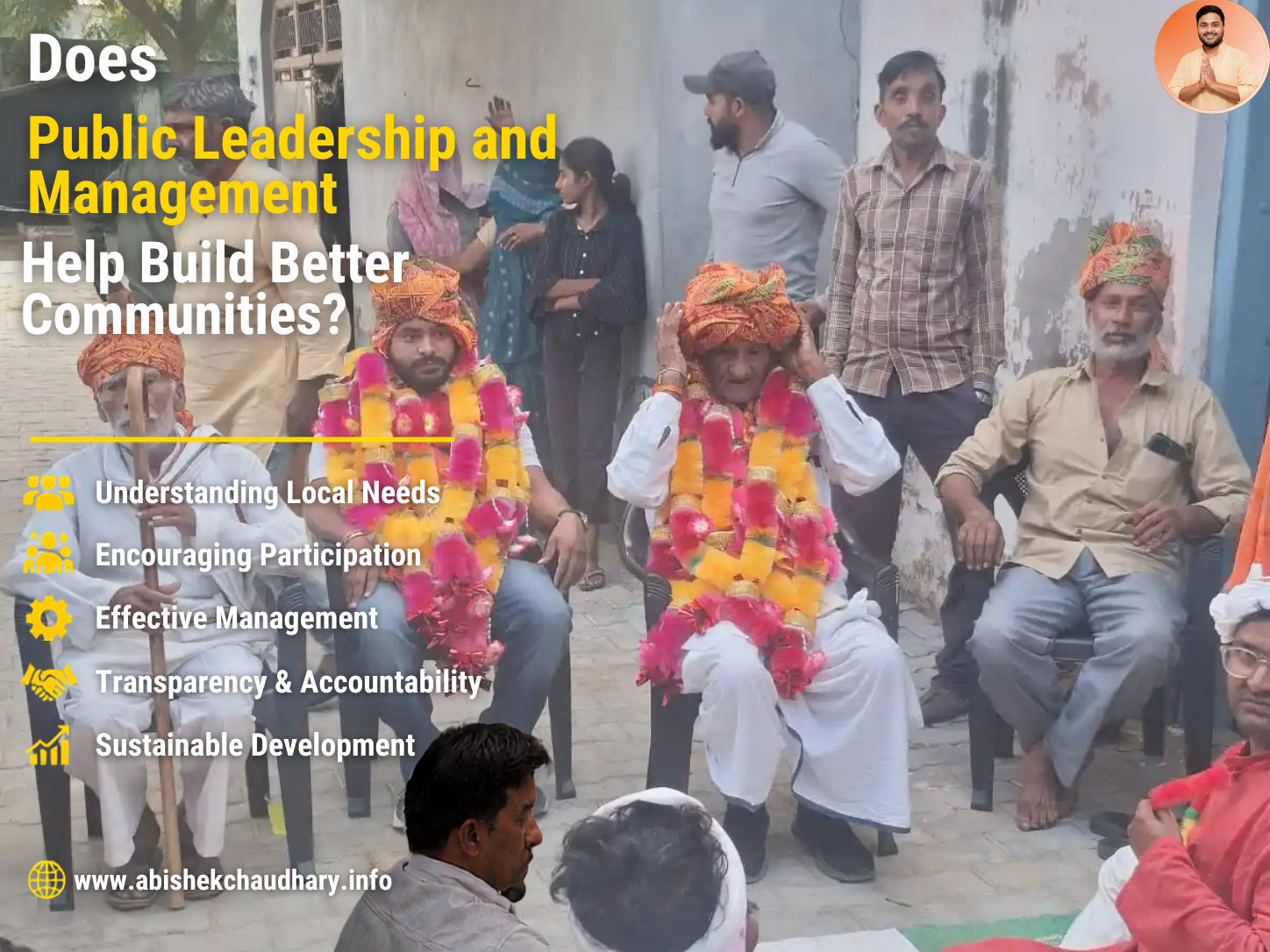
The discussion around community-focused leadership can also be viewed through local public-service work. Abhishek Chaudhary Public Leader Mathura is associated with community-oriented activities and an interest in local development and public welfare.
The broader lesson from such local leadership is that meaningful community development often starts with understanding everyday challenges faced by residents. Whether the issue involves basic facilities, youth participation, healthcare, education, or social welfare, consistent engagement with people can help identify practical priorities.
Abhishek Chaudhary can be discussed in this context as an example of how local public leadership connects community concerns with development-oriented efforts. However, evaluating any public leader should be based on verifiable work, transparency, public feedback, and measurable outcomes rather than titles alone.
Why Leadership and Management Must Work Together
Leadership without proper management can result in good ideas that never become successful projects. Similarly, management without effective leadership can become focused only on procedures without understanding people's real needs.
Together, they can provide:
- Vision: A clear direction for development
- Planning: Practical steps to achieve goals
- Teamwork: Cooperation between residents and organizations
- Resource management: Better use of available resources
- Accountability: Regular monitoring of progress
- Sustainability: Solutions designed for long-term benefit
Challenges in Public Leadership
Building a better community is not always easy. Leaders may face limited resources, different public opinions, administrative delays, and competing priorities.
Good leadership does not mean avoiding these challenges. It means addressing them with patience, communication, evidence-based planning, and responsible decision-making.
Leaders should also remain open to criticism. Constructive feedback can reveal problems that may otherwise be overlooked.
Conclusion
Yes, public leadership and management can help build better communities when they are based on responsibility, participation, transparency, and practical action. Effective leaders understand people's concerns, while effective managers help organize the resources and processes needed to address those concerns.
The strongest communities are not built by one person alone. They develop through cooperation between residents, leaders, local institutions, volunteers, and other stakeholders. When leadership creates a clear vision and management turns that vision into organized action, communities have a stronger foundation for sustainable development and public welfare.




 English
 Arabic
 Français
 Español
 Deutsch
 Türkçe
 Dutch
Dutch
 Italiano
 Russian
 Romaian