


ISO 42001 Scope Explained: What Does It Cover?
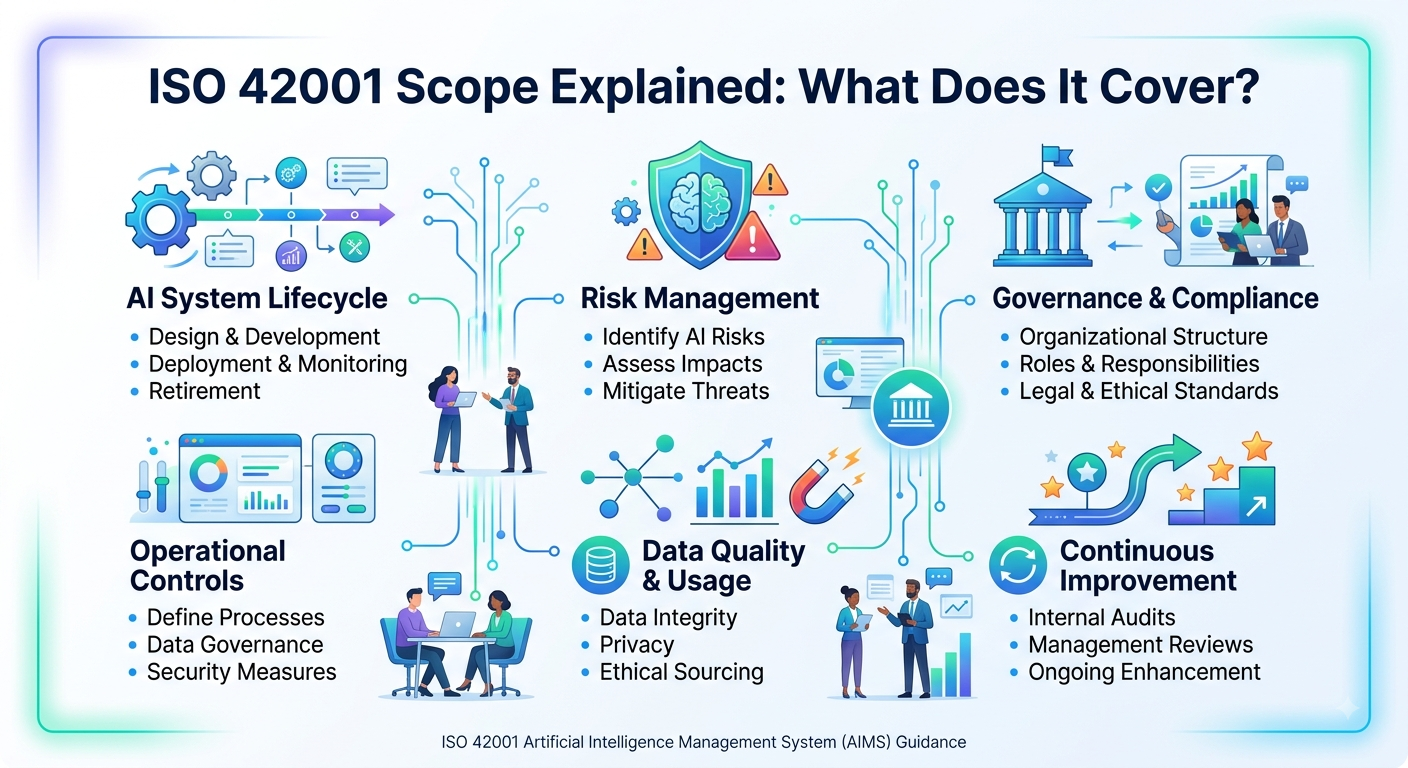
As artificial intelligence becomes part of everyday business operations, organizations need a structured approach to manage AI responsibly. ISO 42001, the international standard for Artificial Intelligence Management Systems (AIMS), provides a framework for establishing, implementing, maintaining, and continually improving AI governance practices.
But what exactly does ISO 42001 cover? Understanding its scope can help organizations determine whether the standard applies to their AI systems, processes, and business activities.
What Is the Scope of ISO 42001?
The scope of ISO 42001 defines the boundaries of an organization's Artificial Intelligence Management System. It determines which AI-related activities, processes, departments, technologies, and locations are included within the management system.
Organizations can define their scope based on factors such as:
-
AI systems developed or used by the organization
-
AI-related products and services
-
Business processes involving AI
-
Departments responsible for AI development or deployment
-
Internal and external AI service providers
-
Applicable legal, regulatory, and contractual requirements
The scope should be clearly documented so that stakeholders understand which AI activities are governed by the AIMS.
What Does ISO 42001 Cover?
ISO 42001 addresses the organizational and management aspects of AI rather than prescribing how a specific AI technology must be built. Its scope includes areas such as:
AI governance: Establishing policies, responsibilities, and accountability for managing AI-related risks and opportunities.
Risk management: Identifying and addressing risks associated with AI systems, including potential impacts on individuals, organizations, and society.
AI lifecycle management: Applying appropriate controls throughout the lifecycle of AI systems, from planning and development to deployment, monitoring, and improvement.
Data and information management: Establishing processes for managing information and data used in AI-related activities.
Transparency and accountability: Supporting responsible AI practices through appropriate documentation, oversight, and decision-making processes.
These areas form part of the broader ISO 42001 Requirements, which organizations use to establish an effective AI management system.
Why Is Defining the Scope Important?
A clearly defined scope prevents organizations from creating an AIMS that is either unnecessarily broad or too limited. It helps identify relevant AI activities, assign responsibilities, determine applicable controls, and prepare for audits.
For organizations pursuing ISO 42001 Certification, defining the scope is also an important part of demonstrating that their AI management system is properly established and maintained.
How Can Organizations Prepare?
Organizations can begin by identifying where and how AI is used, understanding relevant stakeholders and regulations, assessing AI-related risks, and documenting the boundaries of their management system.
Professional ISO 42001 Training can also help teams understand the standard, its requirements, risk-based approach, and practical implementation process.
Ultimately, ISO 42001 provides organizations with a structured foundation for governing AI responsibly. A well-defined scope ensures that the management system focuses on the AI activities and processes that matter most to the organization.

 English
 Arabic
 Français
 Español
 Português
 Deutsch
 Dutch
Dutch
 Italiano
 Russian
 Romaian