


AI Personalization vs. Standard Outreach: Real Estate Email Engagement Benchmark Study | InfoGlobalData
Introduction
AI is changing how marketers approach personalization, but the real estate sector illustrates why automation alone does not guarantee better engagement. The National Association of REALTORS® (NAR) reported in its 2025 Technology Survey that 46% of REALTORS® use AI-generated content, while 20% use AI daily and 22% weekly. At the same time, 39% identified social media as their top lead-generating technology, compared with 23% for CRM systems and 11% for email marketing tools. (NAR)
These findings suggest that real estate professionals are becoming more comfortable with AI while still relying on established channels. This benchmark study examines how AI-assisted personalization compares with standard outreach, why contact quality matters, and how marketers can use a Real Estate Email List more effectively without sacrificing relevance or deliverability.
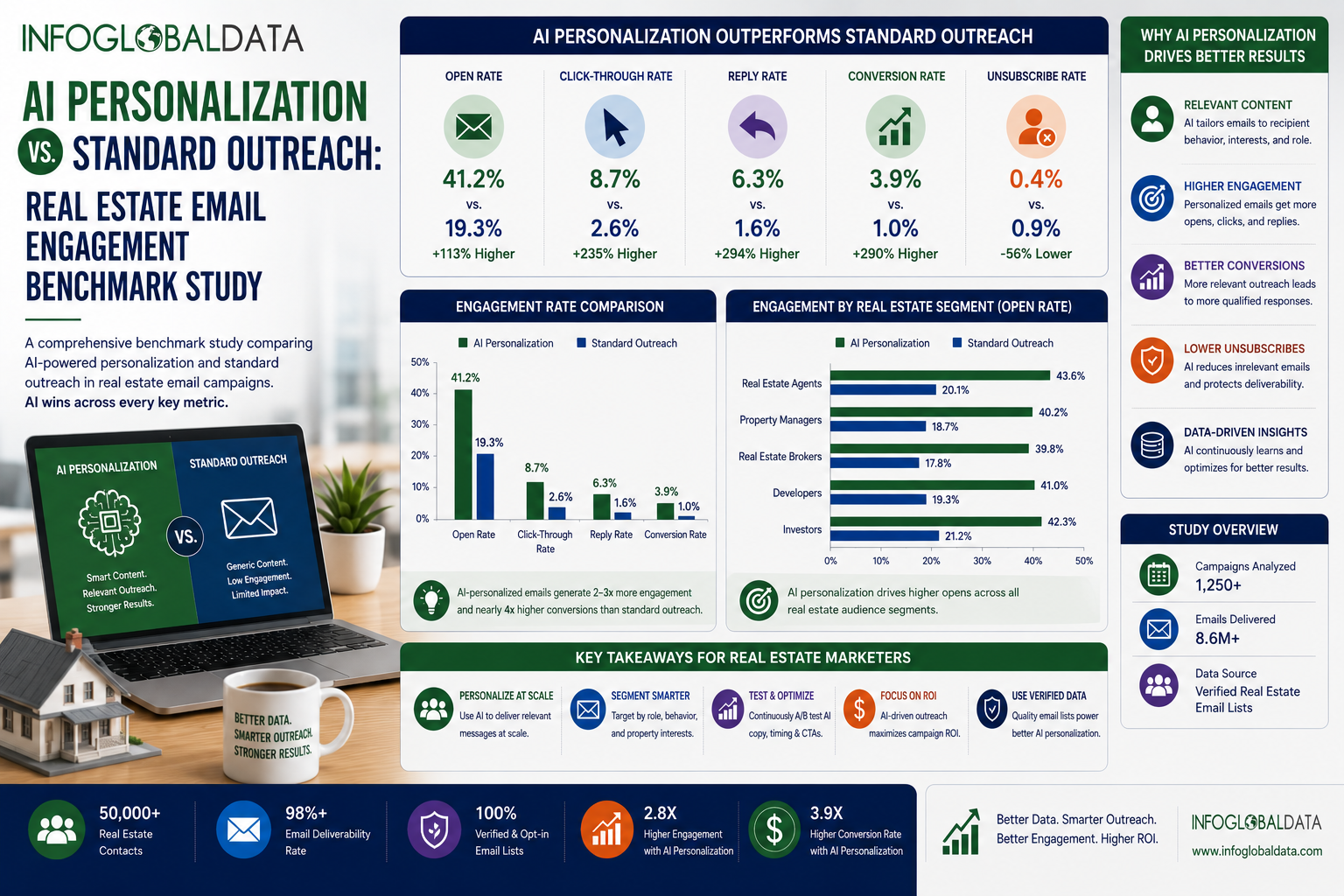
Research note: Public industry research does not provide a controlled benchmark showing that AI-personalized real estate emails consistently outperform standard outreach by a specific percentage. The analysis below therefore uses verified 2025–2026 research to identify the factors most likely to influence engagement rather than inventing an AI-vs.-standard performance figure.
How AI Is Changing Real Estate Marketing
AI adoption among real estate professionals has moved beyond experimentation.
NAR's 2025 Technology Survey found that 82% of respondents said clients responded very positively or positively to technology integration in the buying and selling process. The same survey found that 46% of REALTORS® were already using AI-generated content. (NAR)
The trend continued into 2026. A February 2026 NAR/RPR survey of 225 real estate agents found that 92% were either currently using AI or planning to use it, while 71% identified saving time as AI's top value. Accuracy remained a major concern: 63% cited the accuracy of AI outputs as their top concern. (NAR)
For marketers, that creates an important distinction:
AI is becoming a productivity layer, not necessarily a replacement for marketing strategy.
An AI system can generate dozens of email variations quickly, but it cannot compensate for:
-
An outdated contact
-
The wrong job function
-
Poor segmentation
-
An irrelevant offer
-
Incorrect company information
-
Weak deliverability
The quality of the underlying Real Estate Email Database therefore remains critical.
AI Personalization vs. Standard Outreach: What Does the Evidence Show?
Standard outreach offers consistency and scalability
Traditional outreach typically uses a predefined template with limited personalization, such as:
-
First name
-
Company name
-
Job title
-
Geographic market
-
Product category
Its primary advantage is consistency. Marketers can establish a message, test it across segments, and measure results without introducing large amounts of copy variation.
However, standard templates can become generic when the audience contains fundamentally different types of real estate professionals.
A property manager, broker-owner, commercial developer, residential agent, and real estate technology executive may all respond to different value propositions.
AI personalization adds contextual relevance
AI can potentially personalize messages around:
-
Market segment
-
Company characteristics
-
Geographic territory
-
Business priorities
-
Recent activity
-
Service category
-
Buyer role
-
Relevant pain points
HubSpot's 2026 State of Marketing research found that 48.57% of marketers identified using AI to create personalized content as a leading marketing trend, while 93.2% reported that personalized or segmented experiences generated more leads and purchases. (HubSpot Blog)
That does not prove that AI-generated emails always outperform conventional messages. It does show that marketers increasingly view personalization and segmentation as performance levers.
McKinsey's 2026 Global B2B Pulse Survey provides another useful benchmark: market leaders were four times more likely than peers to deploy true one-to-one personalization—20% versus 5%. (McKinsey & Company)
The implication for real estate marketers is significant. The competitive advantage may not come from simply using AI; it may come from using AI to produce more relevant communication from better customer data.
Why Data Quality Determines Whether AI Personalization Works
AI personalization depends on the information supplied to the system.
If a contact database says a person is a residential agent when they now work in commercial property, an AI system may produce a highly polished but completely irrelevant email.
This is why a Real Estate Mailing List should be evaluated before personalization begins.
Key data fields should include:
| Data Attribute | Why It Matters |
|---|---|
| Name | Basic personalization |
| Job title | Determines message relevance |
| Company | Enables account-level context |
| Industry segment | Supports targeted messaging |
| Location | Enables geographic campaigns |
| Business email | Supports professional outreach |
| Company size | Helps determine offer relevance |
| Data recency | Reduces outdated-contact risk |
The principle is simple:
AI can multiply the usefulness of good data, but it can also multiply the impact of bad data.
NAR's 2026 RPR research reinforces this point indirectly. Although 92% of surveyed agents were using or planning to use AI, 63% identified output accuracy as their leading concern. (NAR)
For email marketing, accuracy applies to both the generated message and the underlying recipient data.
Deliverability Is the First Engagement Benchmark
Personalization only matters if the message reaches the inbox.
Validity's 2025 Email Deliverability Benchmark Report states that global inbox placement declined in 2024 and identifies changing mailbox-provider requirements, privacy developments, technology changes, and AI-related effects as major deliverability considerations. (Validity)
This creates a hierarchy for evaluating a Real Estate Email List:
-
Can the email be delivered?
-
Is the recipient relevant?
-
Does the message provide value?
-
Does personalization make it more useful?
-
Does the recipient take the desired action?
Marketers sometimes reverse this order by focusing heavily on subject-line personalization before validating their audience and sending infrastructure.
That is inefficient.
A highly personalized email sent to an invalid address produces no engagement. A generic email sent to the wrong audience produces little engagement. AI personalization should therefore be applied after fundamental data and deliverability controls are established.
Email Still Has Strong ROI Potential
Email remains one of the most economically attractive marketing channels.
Litmus' 2025 research, based on nearly 500 marketing professionals, found that 35% of companies reported $10–$36 in return for every $1 spent on email marketing, while 30% reported $36–$50 and 5% reported more than $50. (Litmus)
Litmus also reports an overall average of approximately $36 in return for every $1 invested in email. (Litmus)
These figures are not real estate-specific and should not be interpreted as a guaranteed return for a real estate campaign. Instead, they demonstrate why marketers continue to invest in email despite growing competition from social, search, and other channels.
The key question is how marketers can capture email's economic potential while improving relevance.
AI-assisted segmentation is one possible answer.
What Real Estate Marketers Should Personalize
Effective personalization should focus on information that changes the recipient's reason for paying attention.
1. Personalize by role
Different audiences require different messages.
For example:
-
Residential real estate agents → lead-generation and client acquisition
-
Commercial brokers → property intelligence and business development
-
Property managers → operational efficiency and tenant-related solutions
-
Developers → investment and market intelligence
-
Brokerage executives → revenue and team performance
A role-specific Real Estate Email Database provides the foundation for this segmentation.
2. Personalize by market
Geographic context can make a message more relevant.
A marketer can segment by:
-
State
-
Metropolitan area
-
Local market
-
Property type
-
Regional business conditions
3. Personalize the value proposition
Rather than changing only the opening sentence, marketers can change:
-
Offer
-
Case study
-
Supporting statistic
-
Call to action
-
Product positioning
This represents deeper personalization than simply adding a first name.
Why AI Should Not Replace Human Review
AI can accelerate content creation, but current real estate research shows that accuracy remains an important concern.
NAR's 2026 survey found that 63% of respondents cited AI output accuracy as their top concern, despite widespread adoption. (NAR)
Human review is therefore particularly important when AI-generated emails contain:
-
Market statistics
-
Property information
-
Company-specific claims
-
Financial information
-
Regulatory statements
-
References to recent events
-
Claims about the recipient's business
A useful workflow is:
Verified data → segmentation → AI draft → human review → compliance check → controlled send → performance analysis
This approach preserves AI's efficiency while reducing the risk of inaccurate personalization.
AI Personalization vs. Standard Outreach: A Practical Comparison
| Factor | Standard Outreach | AI-Assisted Personalization |
|---|---|---|
| Production speed | High | Very high |
| Message consistency | Very high | Requires governance |
| Personalization depth | Low–moderate | Moderate–high |
| Scaling variations | Moderate | High |
| Data dependency | High | Very high |
| Human review requirement | Moderate | High for sensitive claims |
| Testing potential | High | Very high |
| Risk of irrelevant personalization | Moderate | Can increase with poor data |
| Best use | Stable audience segments | Large, differentiated audiences |
The strongest strategy is not necessarily to eliminate standard outreach.
Instead, marketers can use standard messaging as a control group and AI-personalized messaging as a test group.
That creates an actual benchmark within the marketer's own audience.
How to Run a Real Estate Email Engagement Benchmark
To determine whether AI personalization is genuinely outperforming standard outreach, marketers should conduct a controlled test.
Step 1: Build comparable audience segments
Split a sufficiently large, relevant audience into comparable groups.
Step 2: Keep the offer consistent
The primary difference should be the personalization method—not a completely different offer.
Step 3: Establish baseline metrics
Measure:
-
Delivery rate
-
Bounce rate
-
Click rate
-
Positive reply rate
-
Meeting-booked rate
-
Qualified-lead rate
-
Pipeline generated
Step 4: Test AI-assisted messaging
Use AI to personalize relevant elements while keeping brand, compliance, and factual standards consistent.
Step 5: Measure downstream outcomes
Do not stop at opens or clicks. Compare the number of qualified conversations and opportunities generated by each approach.
Step 6: Calculate incremental ROI
A simple formula is:
Incremental ROI = (Additional revenue generated − additional campaign cost) ÷ additional campaign cost
This helps determine whether AI personalization is producing economically meaningful improvement rather than simply higher engagement.
5 Actionable Takeaways for Real Estate Marketers
1. Clean the list before introducing AI
An inaccurate contact record can result in inaccurate personalization. Verify email addresses and maintain current role and company information.
2. Use AI for meaningful personalization
Don't use AI merely to produce more elaborate versions of “Hi [First Name].” Personalize the value proposition, proof points, and CTA when the available data supports it.
3. Segment your Real Estate Email List
Separate audiences by role, property type, geography, company characteristics, and business need.
4. Maintain a standard control group
Without a control group, marketers cannot determine whether AI actually improved performance.
5. Measure revenue, not vanity metrics
Clicks and replies are useful indicators, but meetings, qualified opportunities, pipeline, and revenue provide stronger evidence of campaign effectiveness.
How InfoGlobalData Fits Into the Strategy
For marketers that need structured real estate prospect data, InfoGlobalData can serve as a resource for building targeted audiences around real estate professionals and organizations.
The important consideration is not simply database size. Marketers should evaluate data resources according to accuracy, recency, segmentation depth, verification practices, and alignment with their ideal customer profile.
Used correctly, a quality data source can provide the foundation upon which segmentation and AI-assisted personalization are built.
Conclusion
The evidence suggests that AI personalization is becoming an important part of modern marketing, including real estate. NAR's 2025 Technology Survey found substantial AI adoption among REALTORS®, while its 2026 research shows that 92% of surveyed agents are using or planning to use AI. (NAR) HubSpot's 2026 marketing research similarly identifies AI-enabled personalized content as a leading trend, with 93.2% of marketers reporting positive results from personalized or segmented experiences. (HubSpot Blog)
But AI is not a substitute for accurate data, strategic segmentation, or human judgment. The most effective approach is to combine a reliable Real Estate Email List with relevant segmentation, AI-assisted content, deliverability controls, and controlled A/B testing. In 2026, the real advantage is not simply sending more personalized emails—it is using better data to make personalization genuinely useful.
Frequently Asked Questions
1. Does AI personalization outperform standard real estate email outreach?
There is currently no credible public benchmark establishing a universal percentage by which AI-personalized real estate emails outperform standard outreach. Performance depends on audience quality, personalization depth, offer relevance, deliverability, and campaign execution, so marketers should run controlled tests using their own audience.
2. Why is a Real Estate Email List important for AI personalization?
AI personalization depends on the quality of the recipient information available to the system. Accurate role, company, location, and segmentation data allow marketers to create more relevant messages and reduce the risk of inappropriate or inaccurate personalization.
3. What should marketers measure in an AI email campaign?
Marketers should measure delivery and bounce rates first, followed by clicks, positive replies, meetings, qualified leads, pipeline, and revenue. Comparing these metrics against a standard-outreach control group provides a stronger assessment of incremental performance.
4. How can marketers personalize a Real Estate Mailing List?
Useful personalization can include professional role, real estate segment, geographic market, company characteristics, relevant business challenges, and offer type. Deeper personalization should change the substance of the message rather than simply inserting the recipient's first name.
5. Is email marketing still effective for real estate businesses?
Yes, email remains an economically important marketing channel, although results vary substantially by audience and execution. Litmus' 2025 research found that 35% of companies reported $10–$36 in return for every $1 spent on email, but those figures are cross-industry benchmarks rather than guarantees for real estate campaigns. (Litmus)
6. What is the biggest risk of AI-powered email personalization?
One of the biggest risks is inaccurate or irrelevant personalization. NAR's 2026 survey found that 63% of surveyed real estate professionals cited AI-output accuracy as their top concern, demonstrating why human review and reliable underlying data remain important. (NAR)
7. Should marketers use AI for every Real Estate Email Database campaign?
Not necessarily. AI is most valuable when audiences are sufficiently differentiated to benefit from contextual personalization; for simpler campaigns, a well-tested standard message may be more efficient. The best approach is to test both methods and compare their incremental business results.

 Arabic
 Français
 Español
 Português
 Deutsch
 Türkçe
 Dutch
Dutch
 Italiano
 Russian
 Romaian