


How SRE Teams Handle Production Incidents
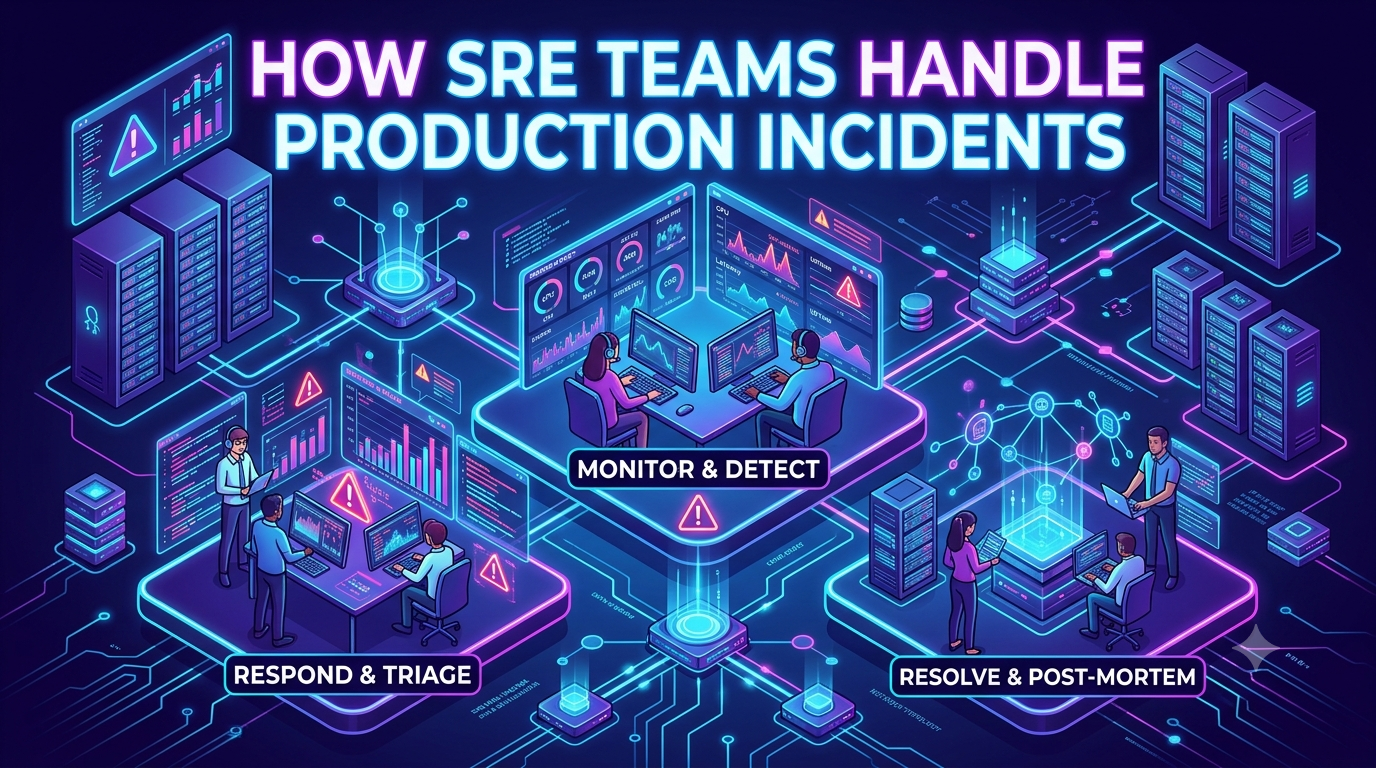
Production incidents are an unavoidable part of running modern software systems. A service may become unavailable, response times may increase, or a deployment may introduce unexpected errors. Site Reliability Engineering (SRE) teams use structured processes to detect, manage, and prevent these incidents while keeping the impact on users as low as possible.
1. Detecting the Incident
The first step is identifying that something has gone wrong. SRE teams rely on monitoring, alerts, logs, dashboards, and Service Level Indicators (SLIs) to detect unusual system behavior. Well-designed alerts help engineers identify genuine problems without overwhelming them with unnecessary notifications.
2. Assessing the Impact
Once an incident is detected, the team determines its severity and scope. They ask questions such as: How many users are affected? Which services are impacted? Is there a risk of data loss? This assessment helps the team prioritize the response and involve the right people.
3. Responding Quickly
During an incident, the primary goal is restoring service, rather than immediately finding the perfect root cause. SRE teams may roll back a deployment, redirect traffic, restart unhealthy services, or temporarily disable a problematic feature.
Clear communication is also important. An incident commander may coordinate the response while other engineers investigate the technical issue. This separation of responsibilities helps prevent confusion and duplicated efforts.
4. Finding the Root Cause
After the immediate problem is controlled, engineers investigate why it happened. They analyze logs, metrics, traces, recent changes, and system behavior. The goal is not to blame an individual but to understand the underlying technical and process-related causes.
5. Learning From Incidents
A major part of SRE is learning from failures. Teams conduct blameless post-incident reviews to document what happened, what worked, and what could be improved. They may create action items such as improving monitoring, automating recovery, updating documentation, or changing deployment practices.
Building SRE Skills
Understanding incident management is an important part of becoming an SRE professional. An SRE Course can help learners understand monitoring, incident response, automation, reliability principles, and system availability. Practical SRE Training can further develop these skills through real-world scenarios and hands-on exercises.
For professionals looking to validate their knowledge, SRE Certification can demonstrate familiarity with core SRE concepts and practices.
Ultimately, effective incident management is not just about fixing problems quickly. It is about building systems and processes that become more reliable after every incident. By combining automation, monitoring, communication, and continuous learning, SRE teams help organizations deliver dependable services to their users.

 Arabic
 Français
 Español
 Português
 Deutsch
 Türkçe
 Dutch
Dutch
 Italiano
 Russian
 Romaian