


Intent Data Timing Study: Can Real-Time Signals Increase Hotel Lead Conversion? | InfoGlobalData
Introduction
For hotel technology vendors, hospitality suppliers, travel-service providers, and other B2B marketers, timing can be as important as targeting. A prospect may be a perfect fit for an offer but still be unreceptive if contacted before a relevant business need emerges. Current B2B research shows why intent signals are attracting attention: 6sense's 2025 Buyer Experience Report found that buyers contacted sellers at about 61% of the way through their buying journey, down from roughly 69% in prior years. Yet buyers continued to establish preferences before speaking with sales. (6sense)
For marketers using a Hotel Email List, the implication is significant. Static contact information identifies who might buy; intent data can provide clues about when an account may be more receptive. This article examines what current research says about timing, intent signals, hospitality demand, personalization, and the practical limits of real-time prospecting.
Why Timing Matters More in B2B Hotel Sales
The traditional outbound model treats every qualified prospect as equally ready for contact. Intent-led marketing challenges that assumption.
A hotel company may fit a vendor's ideal customer profile but have no immediate need for a new revenue-management platform, payment solution, CRM, procurement service, cybersecurity product, or marketing technology.
Another hotel may have just:
-
Announced an expansion
-
Opened a new property
-
Changed senior leadership
-
Increased hiring
-
Adopted new technology
-
Entered a new market
-
Launched a renovation
-
Experienced a change in occupancy or RevPAR
-
Published content around a relevant business problem
The second account may represent a much stronger near-term opportunity.
Gartner's 2025 guidance on intent data specifically recommends combining multiple intent signals rather than relying on a single indicator. The analyst firm argues that organizations need to triangulate signals to identify meaningful buying activity more precisely. (Gartner)
That is an important distinction: intent data is most useful when it adds timing and context to existing account and contact data.
What the Latest B2B Buyer Research Says About Timing
6sense's 2025 Buyer Experience Report provides some of the strongest recent evidence that buying behavior is changing.
The study analyzed nearly 4,000 B2B buyers across North America, APAC, and EMEA. Average buying-cycle length declined from 11.3 months in 2024 to 10.1 months in 2025, while the point at which buyers first contacted sellers moved from approximately 69% to 61% of the journey. (6sense)
That represents roughly six to seven weeks of earlier seller engagement.
However, earlier engagement does not mean buyers have surrendered control.
6sense found that:
-
79% of buyer-seller engagements were initiated by buyers.
-
94% of buying groups ranked their preferred vendors before engaging sellers.
-
Approximately 77% purchased from the vendor they spoke with first.
-
The preferred vendor before seller engagement continued to win roughly four out of five deals. (6sense)
The lesson for hotel-focused sales teams is nuanced.
Being early matters, but simply being early is not enough.
A sales team needs to identify an account while its requirements are forming and provide information that helps influence the shortlist.
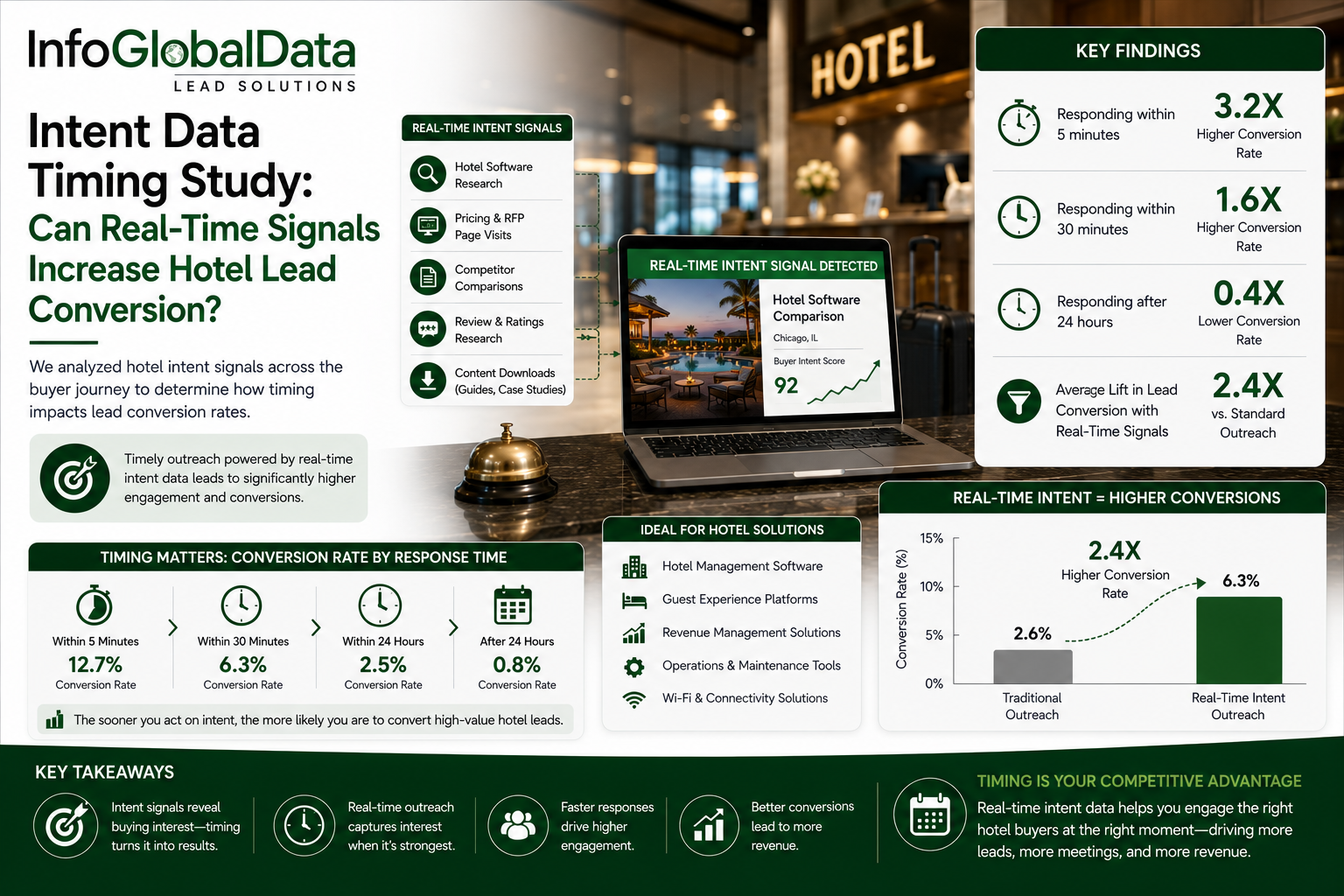
Can Real-Time Intent Signals Improve Hotel Lead Conversion?
There is a strong strategic case, but current evidence does not justify claiming that real-time intent automatically increases hotel lead-conversion rates by a specific percentage.
The reason is that intent data varies considerably by provider and signal type.
Potential signals include:
Behavioral signals
-
Searches for relevant solutions
-
Visits to product pages
-
Downloads
-
Content engagement
-
Repeat website visits
Company signals
-
New hotel openings
-
Expansion announcements
-
Acquisitions
-
Funding
-
Leadership changes
-
Hiring activity
Technology signals
-
New software installations
-
Technology replacements
-
Platform migrations
-
Digital transformation initiatives
Market signals
-
Occupancy changes
-
RevPAR trends
-
New development activity
-
Tourism growth
-
Regional investment
Gartner's 2025 research recommends combining multiple intent signals because a single behavioral indicator can provide an incomplete picture. (Gartner)
For example, a hotel executive reading an article about revenue-management software does not necessarily mean the company is preparing to purchase such software.
But if that same company is also hiring revenue-management staff, opening properties, researching technology vendors, and visiting relevant product pages, the combined signal becomes more meaningful.
Hospitality's Current Environment Creates More Signals to Monitor
The hotel industry itself is undergoing substantial change, giving B2B marketers more potential signals to incorporate into account prioritization.
Horwath HTL's 2025 India Hotel Market Review reported that India's hotel market achieved 64% occupancy, ₹8,624 ADR, and ₹5,522 RevPAR in 2025. RevPAR increased 10.8%, while demand grew approximately 9.1%. The report also identified a branded hotel pipeline of approximately 144,000 rooms. (Horwath HTL)
These market dynamics create commercial triggers.
For example, a rapidly expanding hotel group may have emerging requirements around:
-
Distribution
-
Staffing
-
Guest communications
-
Revenue management
-
Payment technology
-
CRM
-
Procurement
-
Digital marketing
-
Cybersecurity
-
Property-management systems
A marketer that detects the expansion signal can potentially prioritize the account before it becomes saturated with competitors.
Why a Hotel Email List Still Matters
Intent data does not replace contact data.
A real-time signal may tell a marketer that Hotel Group A appears to be researching a particular solution. But sales still needs to identify the people who can influence or approve the purchase.
This is where a Hotel Email List becomes strategically useful.
The database can provide the underlying account and contact structure needed to act on intent signals.
Useful attributes may include:
-
Hotel or hospitality company
-
Property count
-
Corporate headquarters
-
Geography
-
Job title
-
Seniority
-
Department
-
Business email
-
Company size
-
Hotel segment
-
Ownership or management structure
The strongest workflow is therefore:
Contact data + account data + intent signals + timing + relevant messaging.
Intent without identity creates an incomplete opportunity.
Identity without timing can create inefficient prospecting.
Data Quality Determines Whether Intent Becomes Action
Real-time signals are only useful when they connect to accurate account and contact records.
Validity's 2025 State of CRM Data Management study found that 37% of CRM users reported losing revenue because of poor data quality, while 76% said less than half of their organization's CRM data was accurate and complete. (Forrester)
This matters because hotel organizations frequently experience organizational change.
Contacts can:
-
Change hotels
-
Move into new roles
-
Leave organizations
-
Change responsibilities
-
Become decision-makers
-
Lose purchasing authority
A marketer might detect strong intent from a company but send the resulting outreach to someone who left six months ago.
The signal was good.
The execution was not.
For that reason, an Hotel Email Database should be continuously validated and enriched rather than treated as a permanent record of organizational reality.
Personalization Makes Timing More Valuable
Timing alone does not create relevance.
Suppose a hotel group is showing intent around guest-experience technology. Sending a generic sales pitch immediately may still produce little response.
A better approach is to combine the signal with business context.
For example:
"We noticed your group is expanding its property portfolio. We work with hotel operators looking to standardize guest communications across multiple locations."
This message connects:
Signal → business event → likely challenge → relevant solution.
That is much more powerful than:
"We provide hospitality technology. Would you like a demo?"
The importance of personalization is supported by broader marketing research. HubSpot's 2025 State of Marketing research found that 94% of surveyed marketers said personalized customer experiences impact their company's sales, while only 65% reported having high-quality data about their target audience. (HubSpot Blog)
The gap illustrates the challenge: marketers understand personalization's value, but data limitations make it difficult to execute consistently.
Hospitality Research Shows Why Personalization Matters
The hotel industry provides particularly strong evidence for the value of contextual communication.
Adyen's 2025 hospitality research surveyed more than 8,100 businesses and 40,000 consumers across 27 countries. It found that 72% of travelers using AI travel agents did so to receive personalized information quickly, while 33% expected travel companies to invest more in personalized promotions and discounts. (Adyen)
Although this research focuses on consumers rather than B2B buyers, it highlights a broader expectation affecting the hospitality ecosystem: people increasingly expect relevant information without unnecessary delay.
For B2B marketers selling into hotels, that expectation reinforces the value of context-aware communication.
A prospect should not have to explain why a vendor's message is relevant.
Hotel Email Campaigns Also Benefit From Segmentation
Intent data becomes considerably more useful when marketers can segment the audience before activating a campaign.
Revinate's 2025 Hospitality Benchmark Report analyzed hotel marketing data collected throughout 2025. Its findings indicate that applying tighter audience filters can materially improve email engagement; in both EMEA and APAC, reducing segments below 5,000 recipients produced approximately a 10% gain in open rate. (Revinate)
This is not a direct measure of B2B cold-email conversion, but it provides an important lesson:
Smaller, more relevant audiences can outperform larger undifferentiated audiences.
For B2B hotel prospecting, segmentation might separate:
-
Hotel chains
-
Independent hotels
-
Resorts
-
Boutique properties
-
Management companies
-
Hospitality technology companies
-
Luxury properties
-
Budget and midscale hotels
-
Newly opened properties
-
Expanding hotel groups
Intent signals can then determine which segments should receive attention first.
A Practical Real-Time Intent Workflow for Hotel Sales
A useful intent-driven workflow can be organized into seven stages.
1. Build the target universe
Start with a qualified Hotel Mailing List aligned with the ideal customer profile.
2. Enrich accounts
Add company size, property count, geography, segment, technology information, and relevant business attributes.
3. Monitor signals
Track behavioral, organizational, technological, and market signals.
4. Score accounts
Assign greater priority when multiple independent signals point toward the same business need.
5. Identify decision-makers
Map relevant executives, managers, technology leaders, revenue leaders, marketing professionals, or procurement contacts.
6. Activate outreach
Send a message based on the prospect's likely business context rather than merely referencing the intent event.
7. Measure outcomes
Track engagement through qualified meetings and opportunities rather than clicks alone.
This creates a closed-loop process where campaign results can improve future prioritization.
What Should Count as a High-Intent Hotel Account?
Not every signal deserves immediate sales attention.
A useful scoring model could distinguish between:
| Signal | Potential Intent Strength |
|---|---|
| One content visit | Low |
| Repeated visits | Moderate |
| Product-page activity | Moderate–High |
| Relevant hiring | Moderate |
| New property announcement | High |
| Technology replacement | High |
| Multiple signals simultaneously | Very High |
| Direct inquiry/demo request | Extremely High |
The exact scoring system should be calibrated using a company's own historical conversion data.
Gartner's recommendation to combine multiple intent signals is particularly relevant here: signal convergence is generally more informative than isolated activity. (Gartner)
Why Real-Time Does Not Mean Instant Outreach
One of the biggest misconceptions about intent data is that every signal should trigger an immediate sales email.
That can create poor experiences.
A prospect researching a topic at 2 a.m. does not necessarily want a sales representative contacting them at 2:05 a.m.
Instead, real-time signals should influence priority and timing, while the outreach itself should remain appropriate to the prospect's context.
6sense's 2025 research demonstrates why this matters. Buyers are still doing substantial independent research and usually establish vendor preferences before speaking to sales. (6sense)
Therefore, the objective should be:
Contact the right account earlier with something useful—not simply contact it faster.
How Should Marketers Measure Intent-Led Hotel Prospecting?
A credible test should compare intent-informed outreach with a suitable control group.
Control group
Prospects are selected primarily from firmographic and contact criteria.
Intent group
Prospects meet the same criteria but additionally demonstrate defined intent signals.
Then compare:
-
Delivery rate
-
Reply rate
-
Positive reply rate
-
Meeting rate
-
Qualified opportunity rate
-
Pipeline created
-
Opportunity conversion
-
Cost per qualified opportunity
-
Sales-cycle length
The most important metric for the article's central question is qualified opportunity conversion, not open rate.
For example:
Qualified opportunity rate = Qualified opportunities ÷ contacted qualified accounts
This allows teams to test whether intent actually improves commercial outcomes.
5 Practical Takeaways for Hotel B2B Marketers
1. Use intent to prioritize, not blindly automate
Real-time signals should determine which accounts deserve attention first. They should not automatically trigger identical messages.
2. Combine multiple signals
A single page visit is weak evidence. Several independent signals pointing toward the same business problem provide stronger grounds for action.
3. Keep contact data current
A useful intent signal paired with an outdated contact can still produce a failed campaign.
4. Personalize around the business event
Do not simply tell prospects that you know they visited a page. Translate the underlying signal into a relevant business conversation.
5. Test against a control group
If marketers want to claim that intent data improves conversion, they need a controlled comparison rather than anecdotal success stories.
How InfoGlobalData Can Support Intent-Led Hotel Outreach
Intent data works best when marketers can quickly connect an account signal to the appropriate business contacts.
InfoGlobalData can provide a contact-data foundation for marketers building targeted hospitality campaigns, including segmentation around companies and professional roles. A Hotel Email List can therefore serve as the contact layer that allows intent-informed account prioritization to become actionable outreach.
The important distinction is that the database should not be treated as the intent signal itself.
Instead:
Database = who to reach.
Intent = when to prioritize them.
Research = why the message may matter.
Personalization = what to say.
Measurement = whether it worked.
That combination creates a more defensible approach to B2B hotel prospecting than relying on contact volume alone.
Frequently Asked Questions
What is intent data in hotel sales?
Intent data consists of behavioral, organizational, technological, or other signals suggesting that a company may be researching a relevant business problem or solution. Examples include repeated website activity, technology research, hiring activity, expansion announcements, and other buying-related signals.
Can real-time intent data increase hotel lead conversion?
It can potentially improve account prioritization and timing, but current research does not establish a universal conversion uplift for hotel B2B campaigns. The best way to determine impact is to compare intent-informed outreach against a properly designed control group.
How does a Hotel Email List work with intent data?
A Hotel Email List provides the contact and account foundation, while intent data helps determine which accounts deserve attention at a particular time. Combining the two allows marketers to move from broad prospecting toward more targeted, timely outreach.
What should an Hotel Email Database contain?
A useful database can include business email addresses, company information, job titles, seniority, location, hotel segment, and other firmographic fields relevant to the campaign. Accuracy and freshness are particularly important because hotel organizations and personnel can change frequently.
What are the strongest hotel intent signals?
No single signal is universally strongest. Multiple signals—such as relevant research activity combined with expansion, hiring, technology changes, or direct engagement—can provide stronger evidence than an isolated website visit.
How quickly should sales respond to an intent signal?
The appropriate response depends on the strength and context of the signal. High-intent actions such as a direct inquiry generally warrant faster follow-up, while weaker research signals should be used for prioritization and nurturing rather than immediate aggressive outreach.
Does personalization improve hotel email engagement?
Evidence from hospitality email marketing supports the value of segmentation and relevance. Revinate's 2025 benchmark found that tighter segmentation in EMEA and APAC could produce roughly a 10% improvement in open rate, although this is not a direct benchmark for cold B2B email. (Revinate)
What is the difference between a Hotel Mailing List and a Hotel Email List?
The terms are often used interchangeably. A Hotel Mailing List may describe a broader collection of hotel contacts used for marketing, while a Hotel Email List generally emphasizes contacts intended for email communication.
What is the best metric for evaluating intent data?
For B2B sales, qualified opportunity conversion is more meaningful than raw engagement. Marketers should compare positive replies, qualified meetings, opportunities, pipeline, and revenue between intent-informed and control audiences.
Conclusion
Real-time intent signals have genuine potential to improve hotel prospecting, but the evidence supports a precision-first approach rather than a volume-first approach. 6sense's 2025 research shows that B2B buying cycles are shortening and seller engagement is occurring earlier, yet buyers still establish vendor preferences before contacting sales. (6sense)
For hotel-focused marketers, this creates an opportunity to combine a well-maintained Hotel Email List with account-level intent, current contact information, segmentation, and contextual messaging. Hospitality research also shows that personalization and connected data are becoming increasingly important as customer expectations evolve. (Adyen)
The key question is therefore not whether marketers can identify prospects in real time. It is whether they can identify the right signal, interpret it correctly, reach the right person, and offer something genuinely relevant. That is where intent data can move from an interesting technology layer to a measurable sales advantage.

 English
 Arabic
 Français
 Español
 Português
 Deutsch
 Türkçe
 Dutch
Dutch
 Russian
 Romaian