


How Webflow Enterprise Development Improves Website Performance
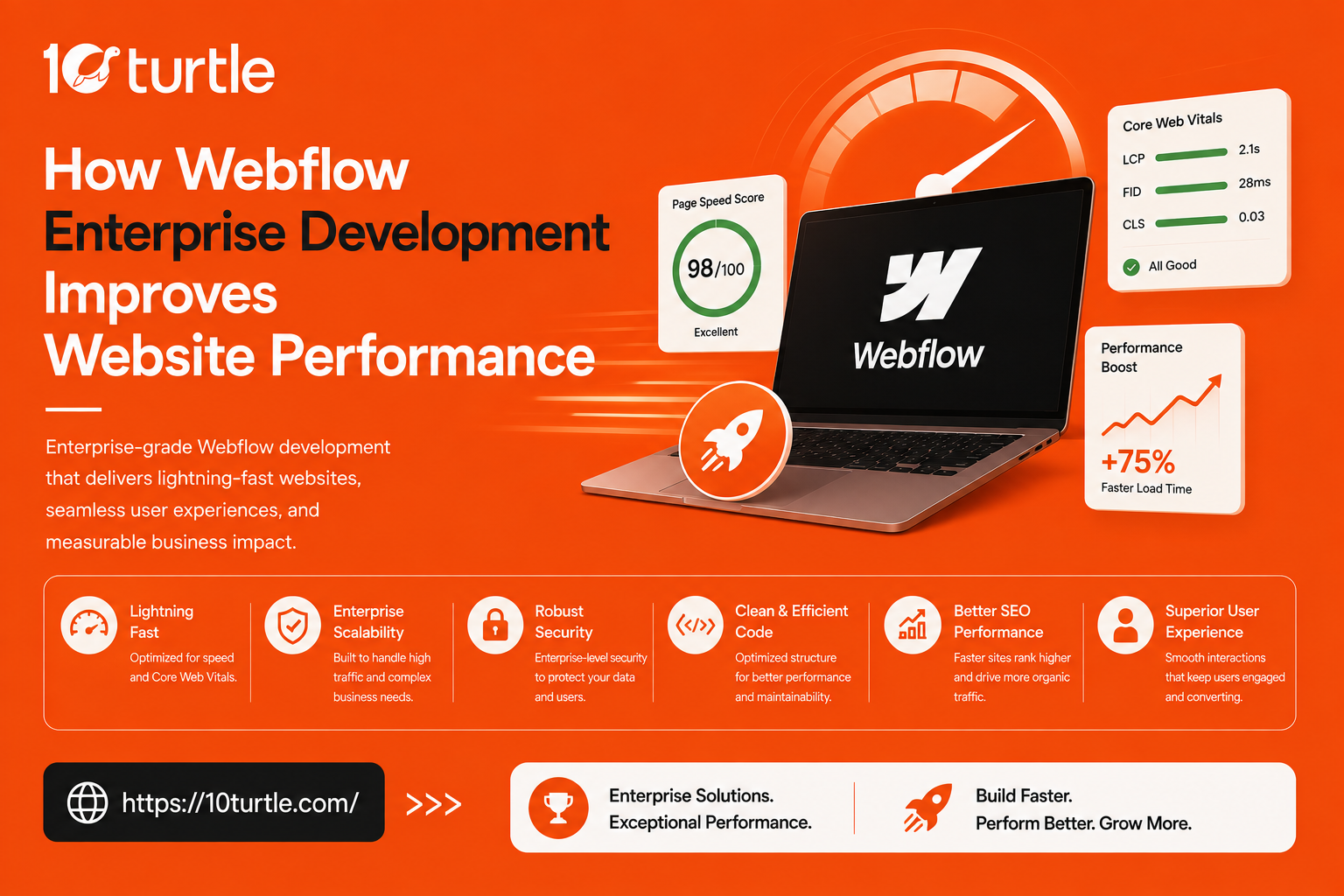
Website speed is no longer a "nice to have" for enterprise organizations in the USA, it's a revenue metric. A one-second delay in page load can quietly bleed conversions, tank search rankings, and frustrate visitors who expect instant results. This is exactly why more mid-market and enterprise companies across the United States are turning to webflow enterprise solutions to rebuild slow, bloated websites into fast, scalable digital assets.
Unlike traditional CMS platforms that rely on heavy plugins and third-party scripts, Webflow's enterprise tier is built with performance architecture baked in from the ground up. In this guide, we'll break down exactly how enterprise webflow development improves site speed, what USA businesses should know before migrating, and why performance optimization has become a non-negotiable part of digital strategy in 2026.
Why Website Performance Matters More Than Ever for US Enterprises
Google's ranking algorithm continues to weigh core web vitals heavily — metrics like Largest Contentful Paint, Interaction to Next Paint, and Cumulative Layout Shift directly influence where a site lands in search results. For enterprise brands competing in crowded US markets (SaaS, healthcare, finance, retail), even a marginal drop in website loading speed can mean losing visibility to a faster competitor.
Beyond SEO, there's a direct business case. Studies from Google and Deloitte have repeatedly shown that faster sites see measurably higher conversion rates and lower bounce rates. For enterprise teams managing dozens or hundreds of landing pages, the cumulative impact of poor website page speed compounds fast — across paid campaigns, organic traffic, and brand trust.
How Webflow Enterprise Development Improves Website Performance
1. Cloud-Native Hosting Built for Scale
Webflow's enterprise hosting runs on a global CDN (powered by AWS and Fastly), meaning assets are served from servers closest to the visitor. This dramatically reduces latency for US-based traffic across time zones — from New York to Los Angeles — without requiring manual server configuration.
2. Clean, Semantic Code Output
One of the biggest advantages of webflow development services over legacy platforms is code cleanliness. Webflow generates lean HTML and CSS without the plugin bloat common in WordPress builds, which directly supports faster website performance optimization and easier long-term maintenance for development teams.
3. Built-In Image and Asset Optimization
Enterprise Webflow sites automatically compress and serve images in modern formats (like WebP), lazy-load below-the-fold content, and minify code — all of which contribute to stronger core web vitals scores without needing a dozen third-party plugins stacked on top of each other.
4. Enterprise-Grade Security Without the Speed Trade-Off
Many CMS platforms sacrifice speed for security layers (firewalls, SSL management, bot protection). Webflow enterprise bakes SOC 2 Type 2 compliance, SSO, and advanced permissions directly into the platform architecture, so US enterprises get both enterprise website development standards and performance in the same package — a combination that's historically been hard to achieve on WordPress or Drupal at scale.
5. Simplified Workflow for Distributed Teams
For US-based enterprises with marketing, design, and dev teams working across multiple locations, Webflow's visual builder combined with reusable components and staging environments means faster publishing cycles without compromising webflow site speed. Content teams can ship pages independently while developers manage custom code in the background.
What's New for USA Businesses in 2026
A newer consideration for US enterprise teams: Google's continued rollout of AI Overviews and stricter Interaction to Next Paint (INP) thresholds has made improve website performance work less optional and more foundational to search visibility. Enterprise IT and marketing leaders evaluating a CMS migration should specifically ask vendors how they handle INP — since this metric, more than older speed measures, tends to expose weaknesses in JavaScript-heavy platforms.
Additionally, with more US enterprises operating multi-brand or multi-region site architectures, Webflow's localization and workspace-sharing features (allowing separate teams to manage subdomains or brand sites under one enterprise account) have become a practical differentiator for companies scaling across states or into international markets from a US headquarters.
Webflow vs. Traditional CMS Platforms
When comparing webflow vs wordpress for enterprise use cases, the performance gap becomes clear in real-world testing: WordPress sites typically require additional caching plugins, CDN integrations, and image optimization tools bolted on after the fact — each one a potential point of failure or slowdown. Webflow's webflow cms architecture handles most of this natively, reducing the technical debt enterprise dev teams have to manage over time.
That doesn't mean Webflow is the right fit for every use case — highly custom backend logic or complex e-commerce functionality may still favor other platforms. But for content-heavy, marketing-driven enterprise sites, the performance and maintenance advantages are substantial.
Getting Started with Webflow Enterprise Development
For US organizations considering a migration, the process typically starts with a technical audit of the existing site's Core Web Vitals baseline, followed by a phased rebuild — starting with highest-traffic pages first. Partnering with an experienced enterprise webflow agency ensures the migration accounts for SEO redirects, structured data, and analytics continuity, so performance gains don't come at the cost of lost rankings during the transition.
Frequently Asked Questions
1. What makes Webflow enterprise different from the standard Webflow plan? Webflow enterprise adds advanced security (SSO, SOC 2 compliance), dedicated support, custom workspace permissions, and higher scalability limits — designed specifically for large organizations managing multiple sites or teams.
2. How much faster is a Webflow enterprise site compared to WordPress? Results vary by implementation, but Webflow's native CDN hosting and clean code output generally produce faster Core Web Vitals scores out of the box, without needing the caching and optimization plugins WordPress sites typically require.
3. Does migrating to Webflow enterprise affect SEO rankings? If handled correctly — with proper 301 redirects, preserved URL structures, and metadata migration — an enterprise webflow development project should maintain or improve rankings over time, particularly due to Core Web Vitals gains.
4. Is Webflow enterprise suitable for e-commerce businesses? Webflow supports e-commerce, but highly complex catalog or inventory systems may need custom integrations or a hybrid approach. It's best suited for content-and-conversion-focused enterprise sites.
5. How long does an enterprise Webflow migration typically take? Timelines depend on site size and complexity, but most enterprise migrations run anywhere from 6 to 16 weeks, including audit, design, development, QA, and phased launch.
 Deutsch
 English
 Arabic
 Français
 Español
 Português
 Türkçe
 Dutch
Dutch
 Italiano
 Russian
 Romaian