


How to Build a Strong Local Search Presence for Your Business
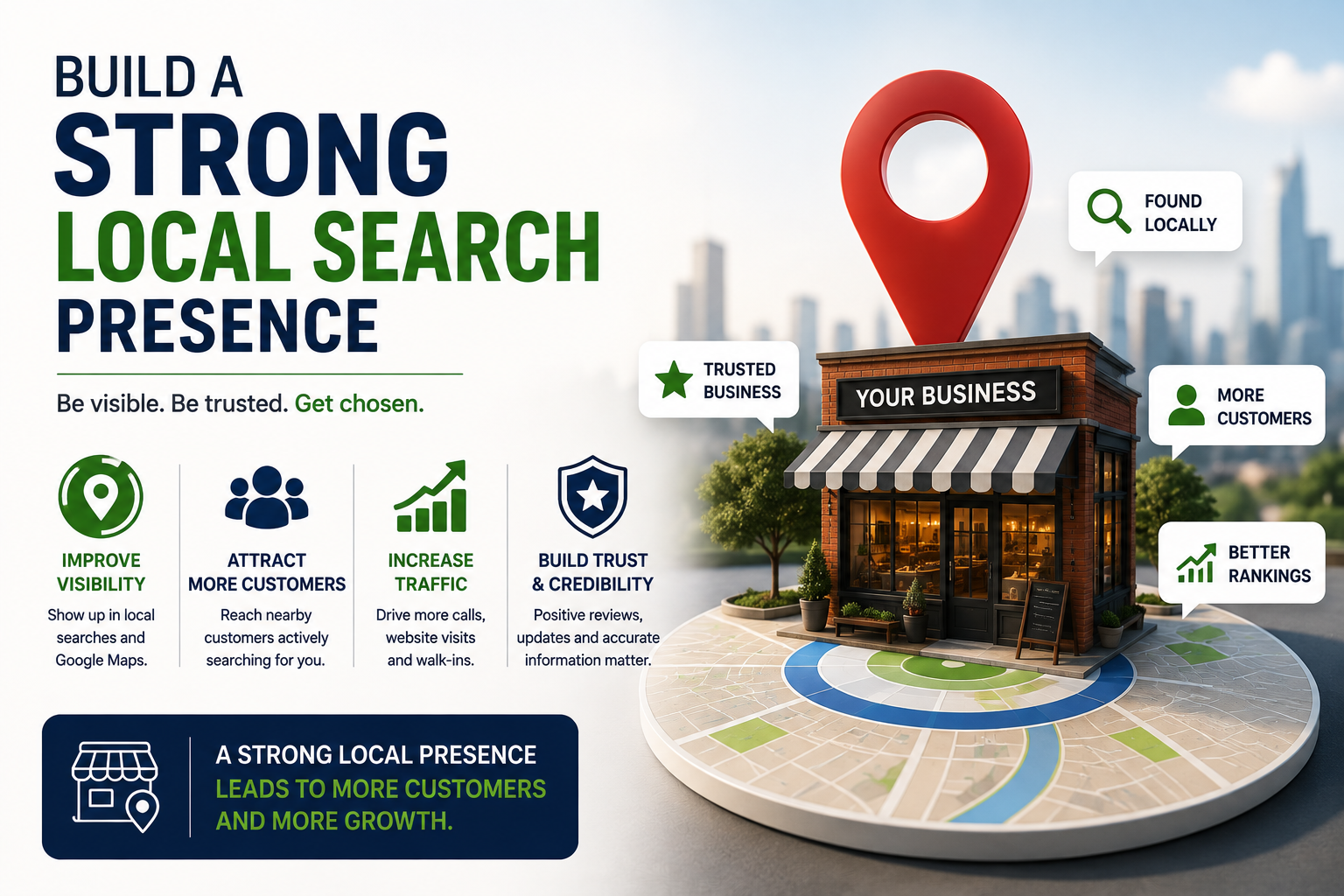
When customers need a nearby product or service, they often turn to Google. They may search for a clinic, restaurant, salon, repair service, retail store, or professional in their area. At this point, businesses that are easy to find and provide useful information have a better opportunity to earn the customer's attention.
But a strong local search presence is not created by optimizing one page or adding a few location keywords. It comes from several connected areas: your Google Business Profile, website, services, reviews, local reputation, and overall customer experience.
The goal is simple: make it easy for nearby customers to find your business, understand what you offer, trust you, and take action.
Start With a Clear Picture of Your Local Market
Before changing your website or Google Business Profile, understand who you actually want to reach.
Ask three basic questions:
Which services matter most to the business?
Which locations can we genuinely serve?
What do customers search for when they need those services?
This prevents you from trying to rank for every possible service and location.
For example, a business serving only a specific part of a city does not necessarily need hundreds of visitors from distant areas. It needs visibility among people who can realistically become customers.
Local SEO should prioritize relevant local visibility, not traffic for its own sake.
Build an Accurate Google Business Profile
Your Google Business Profile is a major part of how customers discover and evaluate your business across Google Search and Maps.
Start by reviewing the essential information.
Check your business name, address or service area, phone number, website, opening hours, primary category, additional categories, and services.
Accuracy should always come before optimization.
If your profile generates visibility but displays an old phone number, potential enquiries may be lost. Incorrect opening hours can create an even worse experience for customers who travel to your location.
Review your profile whenever important business information changes.
Choose Categories Based on What You Actually Do
Your Business Profile categories help describe the type of business you operate.
Choose a primary category that accurately represents your main activity. Additional categories should represent genuine secondary areas of the business.
Avoid selecting unrelated categories simply because they contain keywords you want to target.
The objective is not to create the largest category list possible.
It is to make your business easier to understand.
You can examine relevant competitors to understand how businesses in your market are represented, but only use categories that accurately apply to your company.
Make Your Main Services Easy to Discover
Customers do not always search for a general business category.
They often search for specific solutions.
Someone may search for "root canal treatment" instead of "dental clinic." Another person may search for "washing machine repair" instead of "appliance service."
Make sure your important services are clearly represented on your Business Profile and website.
Compare:
What You Offer → What GBP Shows → What Your Website Explains
If an important service is missing from GBP, review whether it should be added. If it appears on your profile but has no meaningful information on your website, consider improving the relevant page.
This creates a stronger connection between customer searches and your business.
Create Website Content for Real Customer Needs
Your website should provide more than basic company information.
Think about the questions customers ask before contacting you.
What does the service include?
Who is it suitable for?
How does the process work?
What should customers prepare?
What options are available?
Create pages and articles that answer genuine questions clearly.
Location keywords can be included naturally when relevant, but avoid repeating the same phrase simply for SEO.
A good test is:
Would this page still be useful if Google rankings did not exist?
If the answer is yes, the content is more likely to serve a genuine purpose.
Make Your Website Easy to Use on Mobile
Many local searches happen when customers need information quickly.
Your website should make that process simple.
Open it on a smartphone and evaluate the experience.
Can visitors understand what the business does immediately? Can they find important services? Is the phone number easy to access? Can they request an appointment, quote, booking, or enquiry without unnecessary steps?
Also check whether important pages load properly and whether navigation is straightforward.
A complicated website does not automatically create a stronger online presence.
For many local businesses, clarity and usability are more valuable than complexity.
Build Reviews as an Ongoing Process
Customer reviews can influence how potential customers evaluate your business.
Do not wait until you notice that competitors have hundreds more reviews.
Create a consistent process for requesting feedback from genuine customers.
Look beyond your average rating as well.
Evaluate:
Rating → Review Volume → Recent Activity → Customer Sentiment → Responses
Recent reviews can give customers a more current picture of the business.
Respond naturally to feedback instead of using identical replies. Positive reviews deserve acknowledgement, while negative reviews should receive professional responses where appropriate.
Most importantly, never buy or manufacture reviews. Your reputation should reflect genuine customer experiences.
Learn From Customer Feedback
Reviews are useful for more than reputation.
They can show you what customers value and where problems exist.
Suppose multiple customers praise your quick response time. That tells you speed is an important part of your customer experience.
Now imagine several reviews mention unanswered calls.
That is a different type of insight.
You might invest heavily in Local SEO and generate more phone enquiries, but if calls are regularly missed, improved rankings will not produce the expected business results.
Use customer feedback to improve both marketing and operations.
Strengthen Your Presence Beyond Your Own Website
A strong local search presence is not built entirely on your website and Google Business Profile.
Your business may also be mentioned across relevant websites, industry resources, local organizations, professional associations, suppliers, publications, and community platforms.
Look for genuine opportunities to build visibility and authority.
Focus on relevance rather than quantity.
A useful mention from a respected organization connected to your market may be more valuable than dozens of links from unrelated directories.
Avoid chasing links purely because someone promises quick ranking improvements.
Build an online presence that would still be valuable even without search engines.
Understand Your Local Competition
Your business does not operate in isolation.
Search for your important services and identify businesses that consistently appear in local results.
Then compare the overall experience.
Do they have more recent reviews?
Are their services explained more clearly?
Is their website stronger?
Do they have useful photos?
Are they mentioned by relevant local or industry websites?
Do not simply copy the top-ranking competitor.
Instead, look for repeated patterns across several successful businesses.
This can help reveal where your own local presence needs improvement.
Remember That Local Visibility Changes by Area
One important aspect of local search is geographic variation.
Your business might appear prominently when someone searches nearby but much lower when the same search happens several kilometres away.
This does not necessarily indicate poor SEO.
Distance plays an important role in local results.
Instead of asking only, "What position does my business rank?", ask:
"Where is my business visible?"
Understanding geographic visibility provides a more realistic picture of your local search performance.
It can also prevent unnecessary changes to a Business Profile that is already well optimized.
Connect Local Visibility With Customer Experience
Getting discovered is only the beginning.
Think about what happens next:
Search → Google Business Profile → Website or Call → Enquiry → Customer
Each stage can lose potential customers.
Someone might discover your business but choose a competitor after reading reviews. Another person may click your website but leave because they cannot find the service they need.
Someone else might call but receive no answer.
A strong Local SEO strategy examines this entire journey rather than concentrating only on rankings.
Your goal should be making each step easier.
Measure Results That Matter
Keyword positions can help measure visibility, but business outcomes provide more useful context.
Depending on your business, monitor actions such as website visits, calls, direction requests, appointments, quote requests, bookings, enquiries, or sales.
If rankings improve but customer actions remain unchanged, investigate why.
You may have a conversion problem rather than a visibility problem.
If enquiries increase even though certain ranking positions fluctuate, the strategy may still be producing valuable results.
Local SEO performance should always be connected to genuine business objectives.
Ready to Strengthen Your Local Search Presence?
Building local visibility involves several connected areas, and identifying what deserves attention first is not always easy.
If you want a structured approach to improving your Google Business Profile, local rankings, reviews, website, and overall digital presence, explore:
See How ZoomLocal Can Support Your Local Growth
Instead of making random SEO changes, start by identifying the gaps that are actually limiting your visibility and customer opportunities.
Conclusion
Building a strong local search presence for your business requires more than completing a Google Business Profile or inserting location keywords into your website.
Start with accurate business information. Clearly represent your services, create useful website content, improve mobile usability, build genuine customer reviews, strengthen your reputation, and understand the businesses competing for the same customers.
Then connect visibility with real customer actions.
The strongest local presence is not necessarily the business making the most SEO changes. It is the business that consistently provides clear information, useful content, genuine trust signals, and an easy path from search to enquiry.
When those elements work together, Local SEO can help your business become easier to discover and easier for nearby customers to choose.

 Arabic
 Français
 Español
 Português
 Deutsch
 Türkçe
 Dutch
Dutch
 Italiano
 Russian
 Romaian