


Quality Audit Management: Transform Compliance Monitoring with AI
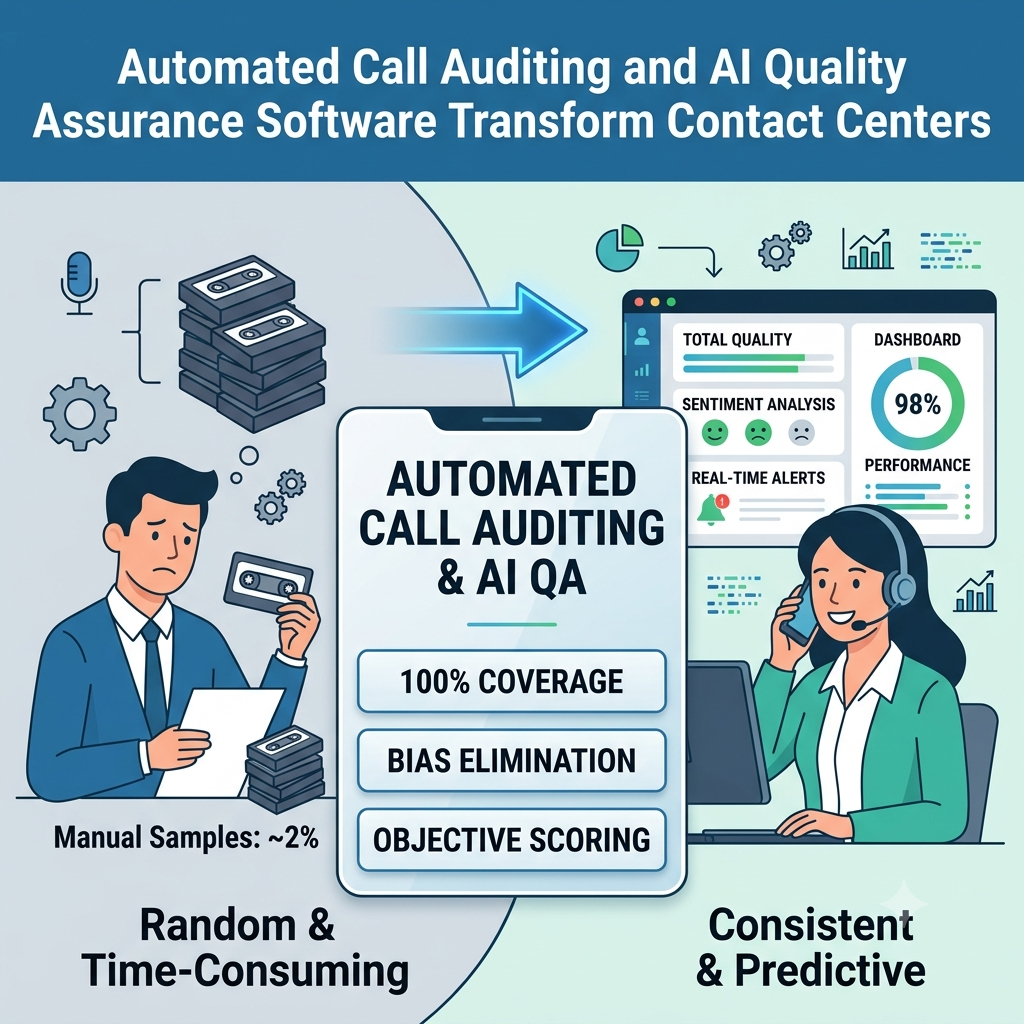
For decades, quality assurance (QA) and compliance monitoring have followed a familiar, albeit exhausting, script. Teams of human auditors sit down to review a tiny fraction of customer interactions—whether calls, chats, or emails—checking boxes against rigid scorecards.
The limitations are obvious: it’s slow, highly subjective, prone to human bias, and covers perhaps 1% to 2% of total interactions. In fast-paced, high-volume environments like contact centers and heavily regulated industries, this traditional approach leaves organizations flying blind, exposing them to compliance risks, customer churn, and missed coaching opportunities.
Fortunately, the paradigm is shifting. By integrating artificial intelligence into quality audit management software, organizations are moving from reactive, sample-based checks to proactive, 100% automated compliance monitoring.
Here is how AI is revolutionizing quality audit management and why your organization needs to make the leap.
The Bottlenecks of Traditional Quality Audits
Before looking at the solution, it helps to understand the scope of the problem. Traditional QA frameworks are bogged down by three major hurdles:
-
The Sampling Fallacy: Reviewing 2% of customer interactions means 98% of your operational data goes unanalyzed. Critical compliance violations, disgruntled customers, and top-performing agent behaviors slip right through the cracks.
-
Subjectivity and Inconsistency: Different human auditors interpret guidelines differently. What one auditor considers a minor slip-up, another might flag as a critical compliance failure, leading to agent frustration and unreliable QA data.
-
Delayed Feedback Loops: By the time an auditor flags a compliance issue from three weeks ago, the agent has repeated the same mistake dozens of times. The opportunity for real-time coaching is lost.
Enter AI: The Catalyst for Automated Compliance Monitoring
Artificial intelligence—specifically Natural Language Processing (NLP), speech-to-text transcription, and sentiment analysis—solves these bottlenecks by automating the heavy lifting of data collection and evaluation.
Instead of manually sorting through audio files, automated compliance monitoring tools ingest 100% of customer interactions instantly. They transcribe audio, analyze text, and evaluate conversations against predefined compliance and quality rubrics in real time.
Here is what that transformation looks like in practice:
1. 100% Coverage, Zero Blind Spots
AI doesn't get fatigued. It can evaluate every single call, chat, and email your organization handles. This complete coverage ensures that high-risk compliance failures—such as failing to read mandatory disclosures, using unauthorized language, or missing security verifications—are flagged immediately, protecting the business from hefty regulatory fines.
2. Objective, Data-Driven Scoring
AI evaluates interactions based on logic and rules, eliminating human bias and mood-based grading. AI call auditing solutions listen for specific keywords, phrases, silences, and even tone of voice. If an agent fails to follow the script or displays hostile behavior, the AI flags it objectively every single time. This consistency builds trust with agents, who know their evaluations are fair and standardized.
3. Real-Time Insights and Alerts
Traditional audits look backward. AI-powered quality audit management looks forward. If a customer interaction begins to turn hostile or an agent misses a crucial compliance step, the system can trigger real-time alerts. Supervisors can step in before the call ends, or agents can receive instant nudges to course-correct.
4. Amplifying Human QA Teams
A common fear is that AI will replace human auditors. In reality, it elevates them. By automating the routine, repetitive scoring of flawless calls, AI frees up QA professionals to focus on what humans do best: strategic coaching, empathy building, and root-cause analysis. Instead of spending 80% of their time finding problems, auditors spend 80% of their time solving them.
Key Features to Look for in AI-Driven QA Software
If you are looking to upgrade your tech stack, your modern quality audit management software should feature more than just digital checklists. Look for platforms that offer:
-
Advanced Speech Analytics: Capable of handling accents, background noise, and varying speeds to deliver accurate transcriptions.
-
Customizable Scorecards: The ability to easily build and modify evaluation criteria tailored to your specific industry regulations (e.g., HIPAA, GDPR, PCI-DSS).
-
Automated Root-Cause Analysis: Tools that aggregate data across thousands of interactions to show why compliance is dropping in certain areas, rather than just pointing out that it did.
-
Integrated Agent Dashboards: Transparent portals where agents can view their own AI-driven scores, track their progress, and access targeted micro-learning resources.
The Bottom Line: Compliance Meets Continuous Improvement
Quality audit management is no longer just a box-ticking exercise designed to appease regulators. When supercharged by AI, it becomes a strategic engine for continuous improvement, customer retention, and brand protection.
By implementing automated compliance monitoring and robust ai call auditing solutions, organizations can scale their QA operations infinitely without exponentially increasing headcount. You stop guessing what is happening on the front lines and start knowing—giving your business the agility, accuracy, and confidence it needs to thrive in a competitive market.

 Arabic
 Français
 Español
 Português
 Deutsch
 Türkçe
 Dutch
Dutch
 Italiano
 Russian
 Romaian