Choosing between Android and iOS is one of the earliest strategic decisions a business makes when planning a mobile product. For companies operating in Riyadh, the decision should be based on more than personal preference or assumptions about which operating system is “better.”
The right platform depends on the target audience, business model, application objectives, budget, required functionality, development timeline, and long-term expansion plans. Some companies may benefit from launching on one platform first, while others may need both Android and iOS from the beginning.
A carefully planned mobile app strategy in Riyadh can help businesses invest in the platform combination that matches their actual customers and commercial goals.
Android vs iOS: What Is the Difference?
Android and iOS represent two different mobile ecosystems.
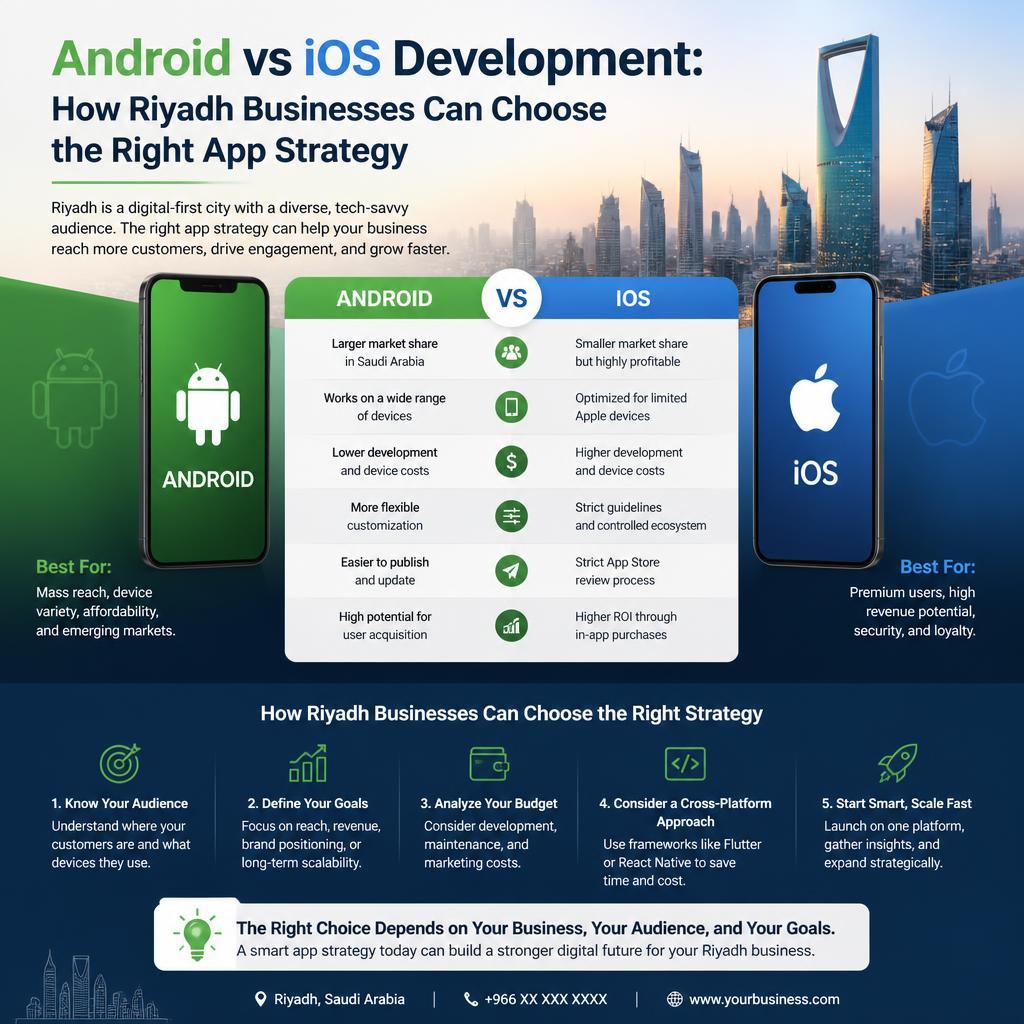
Android development focuses on applications designed for devices running Google's Android operating system. The ecosystem includes smartphones from numerous manufacturers and a broad variety of hardware configurations.
iOS development focuses primarily on Apple's mobile ecosystem, including iPhone and other Apple devices that support the relevant operating system.
From a business perspective, the important question is not simply which platform has more users. Companies should understand who their customers are, how they use mobile technology, and what the application needs to accomplish.
Why Should Riyadh Businesses Study Their Audience First?
Before selecting a platform, businesses should analyze their intended users.
For example, a consumer application aimed at a broad audience may need to accommodate different devices and price segments. A premium customer service platform may have a different audience profile.
Businesses in Riyadh, Saudi Arabia can examine:
- Customer demographics
- Existing device usage
- Purchasing behavior
- Geographic reach
- Customer income segments
- Business versus consumer users
- Expected application frequency
- Preferred digital services
Existing website analytics, customer surveys, sales information, and market research can provide useful signals.
Rather than choosing a platform based on assumptions, businesses can use evidence to make the decision.
When Can Android Be the Better Starting Point?
Android can be attractive for businesses that want to reach users across a wide range of devices.
Its broad hardware ecosystem can be relevant for companies targeting diverse customer segments. Android applications can also be useful for businesses with specific device requirements, field operations, or specialized hardware environments.
For example, organizations involved in delivery, logistics, field services, retail, or workforce management may need applications that interact with particular devices or operational tools.
For companies considering Android app development in Riyadh, developers should account for differences in screen sizes, hardware capabilities, operating-system versions, and device performance.
That makes testing an important part of the development process.
When Can iOS Be the Better Choice?
iOS can be an attractive option when a business's target audience is strongly concentrated within Apple's ecosystem.
It may also be appropriate for companies building premium digital services where the customer experience, design consistency, and integration with Apple technologies are particularly important.
Businesses considering iOS app development in Riyadh should evaluate their customer analytics before making the decision.
If a substantial portion of the intended audience already uses iPhones, launching an iOS application may provide a strong initial opportunity.
Should Businesses Launch on Both Platforms?
Sometimes the answer is yes.
If customers are distributed significantly across Android and iOS, supporting both platforms can prevent the company from excluding a substantial portion of its audience.
A business could develop:
- Android application
- iOS application
- Shared backend
- Common database
- Centralized administration system
- Integrated analytics
- Shared APIs
The user experience can remain consistent while each platform receives appropriate implementation.
For established companies in Riyadh, a dual-platform strategy can make sense when mobile technology is a central part of the customer journey.
However, launching both platforms simultaneously may require a larger initial investment and more testing.
Native vs Cross-Platform Development
Platform selection is only one part of the technical decision.
Businesses must also determine how the application will be developed.
Native Development
Native applications are built specifically for Android or iOS using technologies designed for each ecosystem.
Advantages can include:
- Platform-specific performance
- Deep access to device capabilities
- Greater control over native features
- Platform-specific user experiences
However, maintaining separate native applications can require additional development resources.
Cross-Platform Development
Cross-platform frameworks allow businesses to create applications for multiple platforms using a shared development approach.
Potential benefits include:
- Shared code
- Faster development for certain projects
- Easier feature synchronization
- Potentially lower development complexity
However, the suitability of cross-platform development depends on the application's functionality and technical requirements.
A good development team should recommend an approach based on the project rather than forcing every business into the same technology.
What About Application Performance?
Performance directly affects user experience.
Customers are less likely to remain engaged with an application that takes too long to load, freezes frequently, or consumes excessive device resources.
For businesses in Riyadh, developers should consider:
- Application loading speed
- Network conditions
- Image optimization
- API response times
- Database efficiency
- Memory usage
- Offline capabilities where required
Performance testing should happen throughout development instead of waiting until the final release.
Security Should Influence the Platform Strategy
Mobile applications can handle valuable customer and business information.
Depending on the application, this could include:
- Account information
- Personal details
- Payment information
- Business records
- Location data
- Customer communications
A professional enterprise mobile application in Riyadh should incorporate security throughout its architecture.
Important considerations include:
- Secure authentication
- Encryption
- Role-based access
- Secure API communication
- Session management
- Data protection
- Security testing
- Monitoring
Businesses should also identify applicable regulatory and compliance requirements before development.
Localization Matters for Riyadh Customers
Choosing Android or iOS is not enough to create a locally relevant application.
Businesses serving customers in Riyadh should consider localization throughout the experience.
Depending on the target audience, this may include:
- Arabic language support
- English language support
- Right-to-left interface design
- Local payment options
- Appropriate date and number formats
- Relevant customer-service options
- Regionally appropriate content
Localization should be integrated into the product architecture rather than treated as a last-minute translation exercise.
How Can Businesses Control Development Costs?
Budget should be considered alongside business value.
The cheapest development approach is not always the least expensive option in the long term. Poor architecture, weak testing, and inadequate maintenance can create additional expenses after launch.
Businesses can manage costs by:
- Defining the core business objective.
- Prioritizing essential features.
- Creating an MVP when appropriate.
- Selecting the right technology architecture.
- Avoiding unnecessary complexity.
- Planning future features without building everything immediately.
For startups and growing businesses in Riyadh, a phased strategy can allow them to validate demand before making larger investments.
What Should Businesses Consider Before Choosing?
A useful decision framework includes several questions.
1. Who Are the Target Users?
Understand the devices your customers and employees actually use.
2. What Is the Business Objective?
Determine whether the application is intended for sales, customer service, internal operations, bookings, communication, logistics, or another purpose.
3. What Features Are Required?
Some features may depend heavily on specific platform capabilities.
4. What Is the Budget?
Consider development, testing, infrastructure, maintenance, updates, and future enhancements.
5. How Quickly Must the Product Launch?
The development strategy should match the desired timeline without sacrificing essential quality.
6. Will the Application Need to Scale?
If the user base or service portfolio is expected to grow, architecture should support that expansion.
How Can Analytics Help After Launch?
The platform decision should not be considered permanent.
Once the application is live, analytics can show:
- Number of active users
- Platform distribution
- Feature usage
- Customer retention
- Conversion rates
- Session behavior
- Drop-off points
- Application performance
For example, a business may discover that Android represents the majority of its active customers while iOS users generate higher transaction values.
Such insights can influence future product investment.
Why Is the Development Partner Important?
The development team can significantly influence the quality of the final product.
A capable Mobile app development company in Riyadh should be able to discuss platform strategy, UX design, backend development, APIs, cloud infrastructure, security, testing, analytics, and maintenance.
Businesses should ask prospective developers:
- Which platform would you recommend and why?
- What evidence supports that recommendation?
- Would native or cross-platform development suit our requirements?
- How will you handle Arabic and English interfaces?
- How will the application integrate with our existing systems?
- How will performance and security be tested?
- What support will be available after launch?
Five Programmers can help businesses evaluate their mobile requirements and develop Android, iOS, or multi-platform solutions based on their audience, functionality, and long-term objectives.
The focus should remain on creating a useful product rather than simply selecting a popular technology.
Android or iOS: Which One Should Riyadh Businesses Choose?
There is no universal answer.
Choose Android when broad device coverage, diverse hardware, or a particular Android-focused audience is central to the business strategy.
Consider iOS when the target customers are strongly concentrated within Apple's ecosystem or when platform-specific Apple capabilities are important.
Choose both platforms when the application's success depends on serving a broad mobile audience and the business can support the additional development and maintenance requirements.
Most importantly, base the decision on customer evidence and business objectives rather than assumptions.
Frequently Asked Questions
1. Is Android better than iOS for businesses in Riyadh?
Neither platform is automatically better. The appropriate choice depends on the company's target users, application requirements, budget, and growth strategy.
2. Can one application work on both Android and iOS?
Yes. Businesses can use native development for each platform or appropriate cross-platform technologies, depending on technical requirements.
3. Should a startup develop Android and iOS immediately?
Not always. A startup may begin with the platform most aligned with its target audience, validate demand, and expand later. However, both platforms may be justified when the target market is evenly distributed.
4. How important is Arabic support?
For businesses serving Arabic-speaking customers in Riyadh, Saudi Arabia, Arabic support can be an important part of localization and user experience planning.
Build the Right Mobile Strategy for Your Riyadh Business
The Android-versus-iOS decision should be treated as a business strategy rather than merely a technical preference. Understanding the target audience, application objectives, budget, functionality, security requirements, localization needs, and future roadmap can help businesses make a more informed choice.
Whether your organization needs Android, iOS, or a combination of both, the most valuable application is one that solves a genuine customer or operational problem.
If your business is planning a new mobile product in Riyadh, now is a good time to evaluate your audience and technology requirements carefully.
Contact Us today or Get a Free Quote Today to discuss your mobile application strategy and discover the right Android, iOS, or multi-platform approach for your business in Riyadh, Saudi Arabia.




 Arabic
 Français
 Español
 Português
 Deutsch
 Türkçe
 Dutch
Dutch
 Italiano
 Russian
 Romaian